Albite
A variety of Plagioclase

What is Albite?
Albite is a common member of the feldspar family. Its white or colorless crystal is fairly hard and takes a polish well, and so may very occasionally be carved into a gemstone, especially in the rare instances where it has a slight hue to it. They are usually only of interest to specialist collectors. Albite is also used occasionally in glass and ceramics manufacturing.
Uses & Applications
Albite is used in the creation of glass and ceramics. When it is finely ground and mixed with quartz and kaolin, it binds these component materials together. The albite's fused feldspar is also a main ingredient for the glaze used on porcelain.
Healing Properties
Albite is believed to improve memory and cognitive thinking skills. It works with the Crown chakra to stimulate the brain and provide for better clarity and focus. Many use it during meditation to release energy from the Third Eye chakra and help them understand dreams or visions. Can be worn, carried, or placed in the home or workplace.
Optical Properties
- Refractive Index
- 1.525-1.542
- Birefringence
- 0.008-0.011
- Optical Character
- Biaxial positive
Market Value Factors
Pricing varies for every rock and mineral, so use these universal factors to gauge Albite before comparing listings or appraisals.
Size & Weight
Larger, intact specimens usually command higher prices.
Rarity & Demand
Scarce material or popular varieties sell at a premium.
Condition & Finish
Chips, repairs, and heavy wear lower value; clean prep helps.
Treatment & Provenance
Untreated specimens with documented locality are prized.
Where to Find Albite
RockHoundR, the free-to-download rockhounding map from the Ruby Glint team, shows where collectors find albite in the US, with land-access notes for BLM land and national forests. Collecting is banned in national parks.
See where to find albiteAlways check the local rules and get the landowner's permission before you collect.
Key Characteristics
Characteristics of Albite
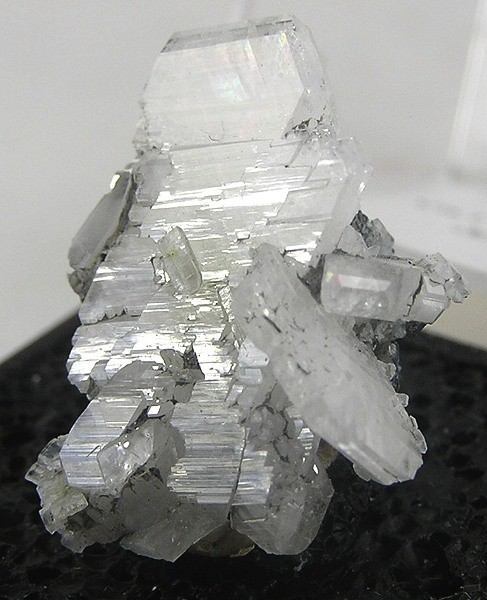
Albite crystallizes with triclinic pinacoidal forms. Its specific gravity is about 2.62 and it has a Mohs hardness of 6–6.5. Albite almost always exhibits crystal twinning often as minute parallel striations on the crystal face. Albite often occurs as fine parallel segregations alternating with pink microcline in perthite as a result of exolution on cooling. There are two variants of albite, which are referred to as low albite and high albite; the latter is also known as analbite. Although both variants are triclinic, they differ in the volume of their unit cell, which is slightly larger for the high form. The high form can be produced from the low form by heating above c. 750 °C (1382 °F) High albite can be found in meteor impact craters such as in Winslow, Coconino Co., Arizona, United States. Upon further heating to more than c. 1050 °C the crystal symmetry changes from triclinic to monoclinic; this variant is also known as monalbite. Albite melts at 1100-1120 °C. Oftentimes, potassium can replace the sodium characteristic in albite at amounts of up to 10%. When this is exceeded the mineral is then considered to be anorthoclase.
Formation of Albite
It occurs in granitic and pegmatite masses (often as the variety Cleavelandite), in some hydrothermal vein deposits, and forms part of the typical greenschist metamorphic facies for rocks of originally basaltic composition. Minerals that albite is often considered associated with in occurrence include biotite, hornblende, orthoclase, muscovite and quartz.
More Images
Quick Facts
Physical Properties
- Color
- White to grey, bluish, greenish, reddish
- Hardness (Mohs)
- 6 - 6.5
- Rock tumbling
- With care
- Density
- 2.615 g/cm³
- Streak
- White
Chemical Properties
- Chemical Formula
- Na(AlSi3O8)
- Elements
- Al, Na, O, Si
Also Known As
Identify Albite Instantly
- Snap a photo, get instant results
- 6,700+ rocks, minerals & crystals
- Discover collecting spots near you
Albite FAQs
How do I identify Albite?
Albite can be identified by its hardness of 6 - 6.5 on the Mohs scale, White to grey color. Look for these key characteristics when examining specimens.
What color is Albite?
Albite typically appears in White to grey, bluish, greenish, reddish. Color can vary depending on impurities and formation conditions.
How hard is Albite?
Albite has a hardness of 6 - 6.5 on the Mohs scale. This gives it moderate hardness.
What is the characteristics of albite of Albite?
Albite crystallizes with triclinic pinacoidal forms. Its specific gravity is about 2.62 and it has a Mohs hardness of 6–6.5. Albite almost always exhibits crystal twinning often as minute parallel striations on the crystal face. Albite often occurs as fine parallel segregations alternating with pink microcline in perthite as a result of exolution on cooling. There are two variants of albite, which are referred to as low albite and high albite; the latter is also known as analbite. Although both variants are triclinic, they differ in the volume of their unit cell, which is slightly larger for the high form. The high form can be produced from the low form by heating above c. 750 °C (1382 °F) High albite can be found in meteor impact craters such as in Winslow, Coconino Co., Arizona, United States. Upon further heating to more than c. 1050 °C the crystal symmetry changes from triclinic to monoclinic; this variant is also known as monalbite. Albite melts at 1100-1120 °C. Oftentimes, potassium can replace the sodium characteristic in albite at amounts of up to 10%. When this is exceeded the mineral is then considered to be anorthoclase.
What is the formation of albite of Albite?
It occurs in granitic and pegmatite masses (often as the variety Cleavelandite), in some hydrothermal vein deposits, and forms part of the typical greenschist metamorphic facies for rocks of originally basaltic composition. Minerals that albite is often considered associated with in occurrence include biotite, hornblende, orthoclase, muscovite and quartz.

