Ammolite
A variety of Aragonite
What is Ammolite?
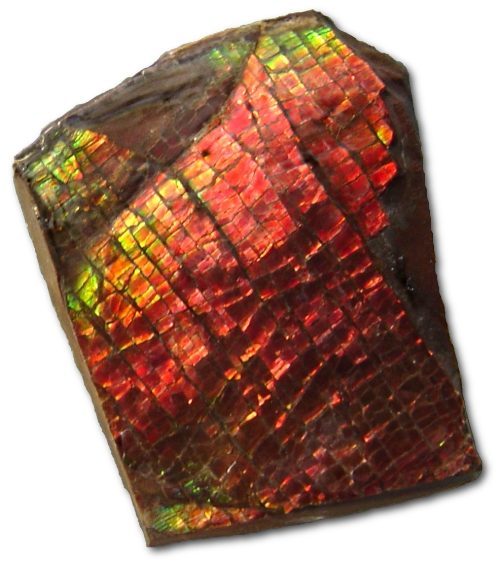
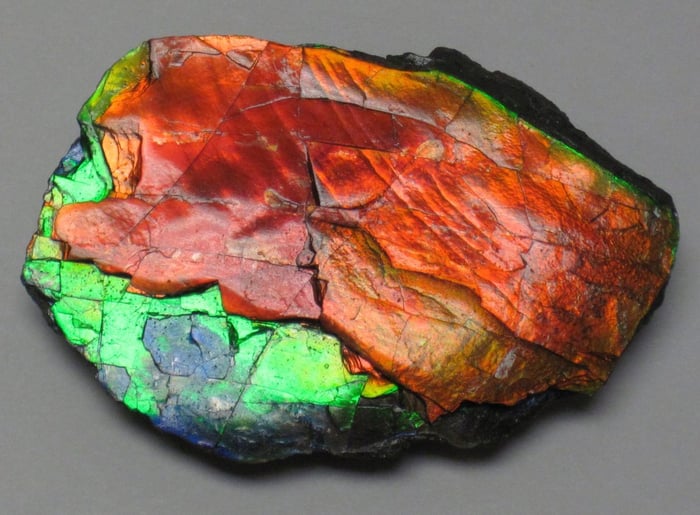
Ammolite is a trade name for an opal-like material mined primarily in the Rocky Mountains of North America and the Bearpaw Formation in Alberta, Canada. This organic material is actually fossilized shells of ammonites, the extinct marine mollusks. Gem-quality ammolite exhibits a vivid color display when observed under reflected light and is commonly used with jewelry.
Uses & Applications
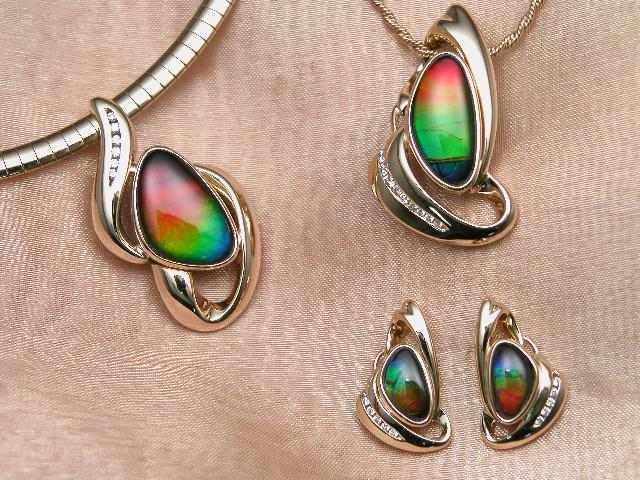
Jewelry is a common use for the beautiful fossil material known as ammolite. Pendants and earrings are popular because they tend to catch the light, but it is not as common in rings and bracelets. It is often used with sterling silver, though gold is another option. The stone can also be mounted on a display base, turning it into an attractive piece of art.
Healing Properties
Ammolite is a protective stone that works with the Root chakra to bring balance and harmony. It is believed to attract prosperity and good fortune. When used during meditation, it is often said to enhance dreams and provide better recall and understanding of them. Along the way, one can enhance their spiritual and emotional growth for deeper and truer relationships.
Optical Properties
- Refractive Index
- 1.520-1.670
- Birefringence
- 0.15
- Pleochroism
- Strong
- Optical Character
- Biaxial negative
Market Value Factors
Pricing varies for every rock and mineral, so use these universal factors to gauge Ammolite before comparing listings or appraisals.
Size & Weight
Larger, intact specimens usually command higher prices.
Rarity & Demand
Scarce material or popular varieties sell at a premium.
Condition & Finish
Chips, repairs, and heavy wear lower value; clean prep helps.
Treatment & Provenance
Untreated specimens with documented locality are prized.
Where to Find Ammolite
Ammolite is a variety of Aragonite. RockHoundR, the free-to-download rockhounding map from the Ruby Glint team, shows where collectors find aragonite in the US, with land-access notes for BLM land and national forests. Collecting is banned in national parks.
See where to find aragoniteAlways check the local rules and get the landowner's permission before you collect.
The Meaning
Ammolite has been traditionally used in Native American rituals and ceremonies. Some tribes prized it as a healing stone, making it an important part of healing ceremonies. However, it was also used as a talisman during hunting. In ancient Egypt, the stone was associated with the major deity called Ammon and was considered a divine stone.
Associated Chakras
Key Characteristics
Characteristics of Ammolite
The chemical composition of ammolite is variable, and aside from aragonite may include calcite, silica, pyrite, or other minerals. The shell itself may contain a number of trace elements, including: aluminium; barium; chromium; copper; iron; magnesium; manganese; strontium; titanium; and vanadium. Its crystallography is orthorhombic. Its hardness is 3.5–4.5, and its specific gravity is 2.60–2.85. The refractive index of Canadian material (as measured via sodium light, 589.3 nm) is as follows: α 1.522; β 1.672–1.673; γ 1.676–1.679; biaxial negative. Under ultraviolet light, ammolite may fluoresce a mustard yellow.
Formation of Ammolite
Significant deposits of gem-quality ammolite are only found in the Bearpaw Formation that extends from Alberta to Saskatchewan in Canada and south to Montana in the USA. However, small deposits have been found as far south as Central Utah which also contains gem-quality ammolite. The best grade of gem quality ammolite is along high energy river systems on the eastern slopes of the Rockies in southern Alberta. Most commercial mining operations have been conducted along the banks of the St. Mary River, in an area south of and between the town of Magrath and the city of Lethbridge. Roughly half of all ammolite deposits are contained within the Kainah (Kainaiwa) reserve, and its inhabitants play a major role in ammolite mining. Since its founding in 1979, Korite has operated primarily within the reservation. The company had an agreement with the Kainah (Blood) tribe, with Korite paying the tribe royalties based on how much land the company has mined. This agreement has expired. It prohibited the Blood Tribe members from surface mining along the banks and cliffs of the St. Mary River. There were about 35 licensed Blood surface miners in 2018. The surface miners are self employed mining in all kinds of weather. Some miners also restore the fossils they find or resell their finds to other fabricators.
More Images
Quick Facts
Physical Properties
- Color
- Iridescent, commonly red, brown, orange, yellow, green, blue
- Hardness (Mohs)
- 3.5 - 4
- Rock tumbling
- Not recommended
- Streak
- White
- Luster
- Vitreous, Resinous
- Crystal System
- Orthorhombic, Trigonal
Chemical Properties
- Chemical Formula
- CaCO3
- Elements
- C, Ca, O
Also Known As
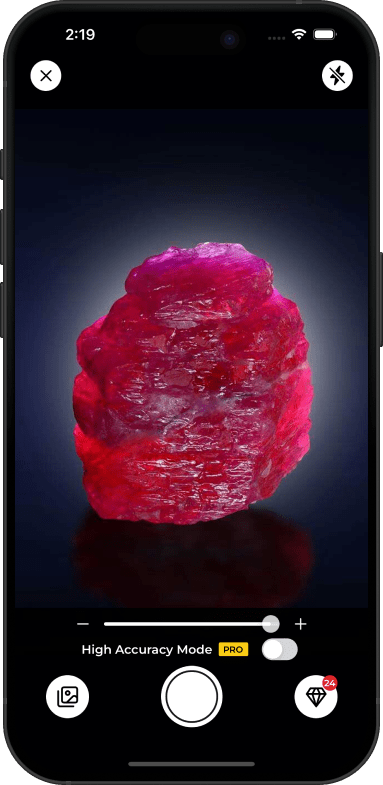
Identify Ammolite Instantly
- Snap a photo, get instant results
- 6,700+ rocks, minerals & crystals
- Discover collecting spots near you
Ammolite FAQs
How do I identify Ammolite?
Ammolite can be identified by its hardness of 3.5 - 4 on the Mohs scale, Iridescent color, Vitreous, Resinous luster, Orthorhombic, Trigonal crystal system. Look for these key characteristics when examining specimens.
What color is Ammolite?
Ammolite typically appears in Iridescent, commonly red, brown, orange, yellow, green, blue. Color can vary depending on impurities and formation conditions.
How hard is Ammolite?
Ammolite has a hardness of 3.5 - 4 on the Mohs scale. This gives it moderate hardness.
What is the characteristics of ammolite of Ammolite?
The chemical composition of ammolite is variable, and aside from aragonite may include calcite, silica, pyrite, or other minerals. The shell itself may contain a number of trace elements, including: aluminium; barium; chromium; copper; iron; magnesium; manganese; strontium; titanium; and vanadium. Its crystallography is orthorhombic. Its hardness is 3.5–4.5, and its specific gravity is 2.60–2.85. The refractive index of Canadian material (as measured via sodium light, 589.3 nm) is as follows: α 1.522; β 1.672–1.673; γ 1.676–1.679; biaxial negative. Under ultraviolet light, ammolite may fluoresce a mustard yellow.
What is the formation of ammolite of Ammolite?
Significant deposits of gem-quality ammolite are only found in the Bearpaw Formation that extends from Alberta to Saskatchewan in Canada and south to Montana in the USA. However, small deposits have been found as far south as Central Utah which also contains gem-quality ammolite. The best grade of gem quality ammolite is along high energy river systems on the eastern slopes of the Rockies in southern Alberta. Most commercial mining operations have been conducted along the banks of the St. Mary River, in an area south of and between the town of Magrath and the city of Lethbridge. Roughly half of all ammolite deposits are contained within the Kainah (Kainaiwa) reserve, and its inhabitants play a major role in ammolite mining. Since its founding in 1979, Korite has operated primarily within the reservation. The company had an agreement with the Kainah (Blood) tribe, with Korite paying the tribe royalties based on how much land the company has mined. This agreement has expired. It prohibited the Blood Tribe members from surface mining along the banks and cliffs of the St. Mary River. There were about 35 licensed Blood surface miners in 2018. The surface miners are self employed mining in all kinds of weather. Some miners also restore the fossils they find or resell their finds to other fabricators.