Basalt
A variety of Igneous
What is Basalt?
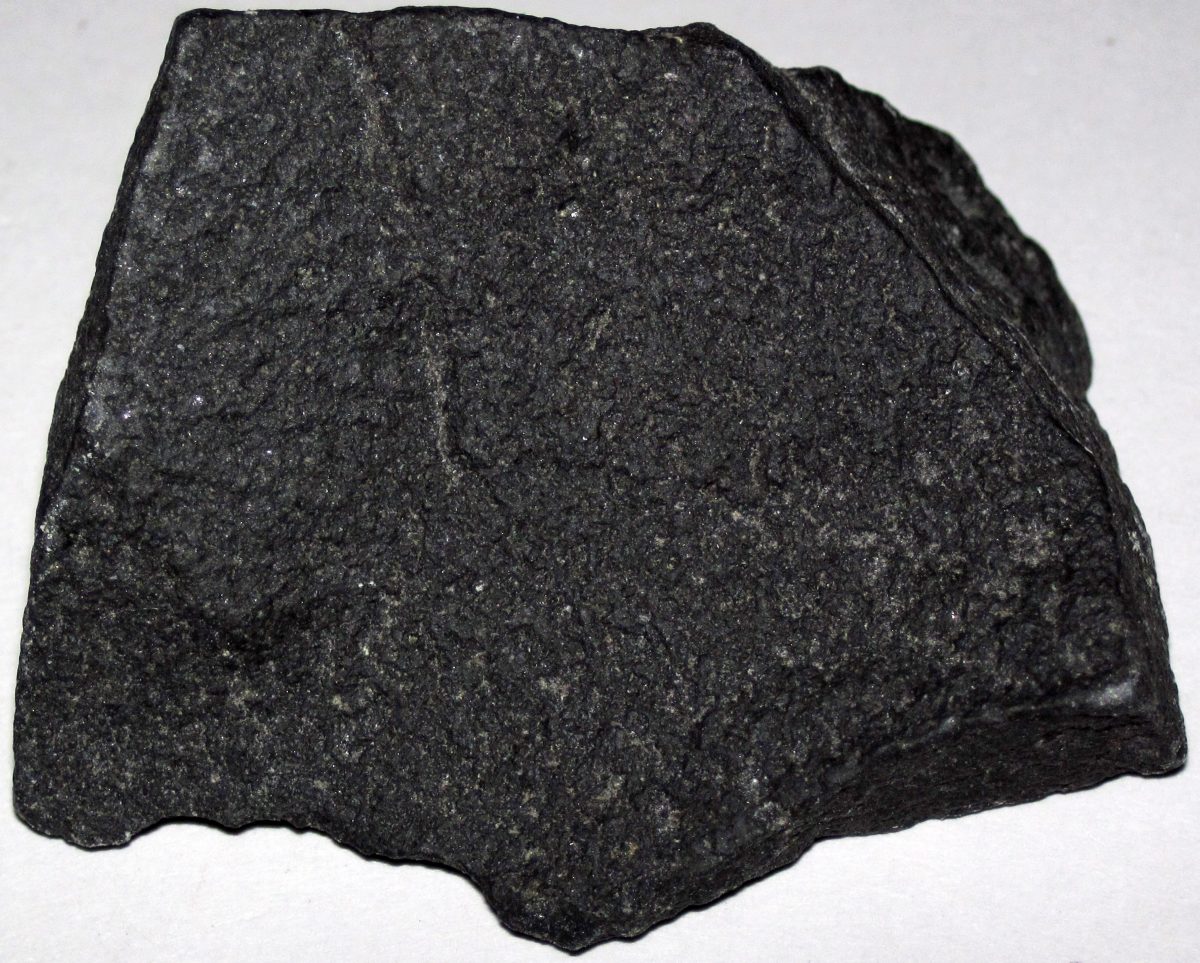
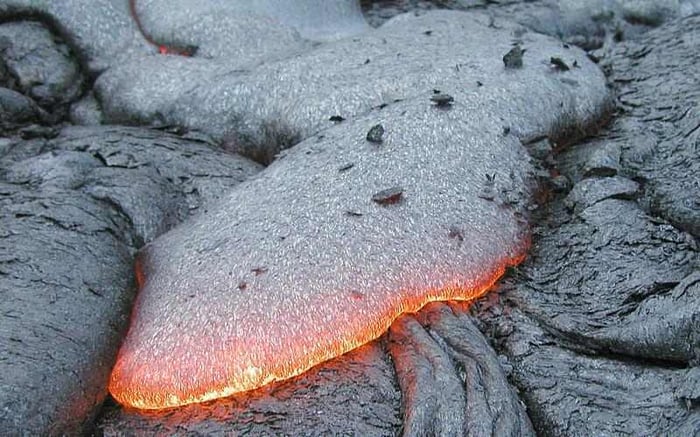
Basalt is a dark, iconic rock that forms when lava rapidly cools. Many famous geological structures, including the Giant's Causeway in the UK and the Devil’s Postpile in California, are made from basalt. Though relatively uniform in color and texture, the rock may take on many fascinating shapes, ranging from towering, perfectly angled hexagonal columns to billowy basalt pillows (formed when lava cools underwater).
Etymology & Origins
The word "basalt" is ultimately derived from Late Latin basaltes, a misspelling of Latin basanites "very hard stone", which was imported from Ancient Greek βασανίτης (basanites), from βάσανος (basanos, "touchstone") and perhaps originated in Egyptian bauhun "slate". The modern petrological term basalt describing a particular composition of lava-derived rock originates from its use by Georgius Agricola in 1556 in his famous work of mining and mineralogy De re metallica, libri XII. Agricola applied "basalt" to the volcanic black rock of the Schloßberg (local castle hill) at Stolpen, believing it to be the same as the "very hard stone" described by Pliny the Elder in Naturalis Historiae.
Uses & Applications
Basalt is a popular choice in construction, and has been used in cobblestones and floor tiles because it is strong and a great thermal insulator. Additionally, it is used to construct roads as well as the ballasts for railroad tracks. Research is currently underway to utilize this rock in carbon sequestration in order to battle ongoing climate change.
Discover Values
Market Value Factors
Pricing varies for every rock and mineral, so use these universal factors to gauge Basalt before comparing listings or appraisals.
Size & Weight
Larger, intact specimens usually command higher prices.
Rarity & Demand
Scarce material or popular varieties sell at a premium.
Condition & Finish
Chips, repairs, and heavy wear lower value; clean prep helps.
Treatment & Provenance
Untreated specimens with documented locality are prized.
Geochemistry
Relative to most common igneous rocks, basalt compositions are rich in MgO and CaO and low in SiO2 and the alkali oxides, i.e., Na2O + K2O, consistent with the TAS classification. Basalt generally has a composition of 45–55 wt% SiO2, 2–6 wt% total alkalis, 0.5–2.0 wt% TiO2, 5–14 wt% FeO and 14 wt% or more Al2O3. Contents of CaO are commonly near 10 wt%, those of MgO commonly in the range 5 to 12 wt%. High-alumina basalts have aluminium contents of 17–19 wt% Al2O3; boninites have magnesium (MgO) contents of up to 15 percent. Rare feldspathoid-rich mafic rocks, akin to alkali basalts, may have Na2O + K2O contents of 12% or more. The abundances of the lanthanide or rare-earth elements (REE) can be a useful diagnostic tool to help explain the history of mineral crystallisation as the melt cooled. In particular, the relative abundance of europium compared to the other REE is often markedly higher or lower, and called the europium anomaly. It arises because Eu can substitute for Ca in plagioclase feldspar, unlike any of the other lanthanides, which tend to only form 3+ cations. Mid-ocean ridge basalts (MORB) and their intrusive equivalents, gabbros, are the characteristic igneous rocks formed at mid-ocean ridges. They are tholeiitic basalts particularly low in total alkalis and in incompatible trace elements, and they have relatively flat rare-earth element (REE) patterns normalized to mantle or chondrite values. In contrast, alkali basalts have normalized patterns highly enriched in the light REE, and with greater abundances of the REE and of other incompatible elements. Because MORB basalt is considered a key to understanding plate tectonics, its compositions have been much studied. Although MORB compositions are distinctive relative to average compositions of basalts erupted in other environments, they are not uniform. For instance, compositions change with position along the Mid-Atlantic Ridge, and the compositions also define different ranges in different ocean basins. Mid-ocean ridge basalts have been subdivided into varieties such as normal (NMORB) and those slightly more enriched in incompatible elements (EMORB). Isotope ratios of elements such as strontium, neodymium, lead, hafnium, and osmium in basalts have been much studied to learn about the evolution of the Earth's mantle. Isotopic ratios of noble gases, such as He/He, are also of great value: for instance, ratios for basalts range from 6 to 10 for mid-ocean ridge tholeiitic basalt (normalized to atmospheric values), but to 15–24 and more for ocean-island basalts thought to be derived from mantle plumes. Source rocks for the partial melts probably include both peridotite and pyroxenite (e.g., Sobolev et al., 2007).
Key Characteristics
Rock Types of Basalt
Tholeiitic basalt is relatively rich in iron and poor in alkali metals and aluminium. Included in this category are most basalts of the ocean floor, most large oceanic islands, and continental flood basalts such as the Columbia River Plateau. High-alumina basalt may be silica-undersaturated or -oversaturated (see normative mineralogy). It has greater than 17% alumina (Al2O3) and is intermediate in composition between tholeiitic basalt and alkali basalt; the relatively alumina-rich composition is based on rocks without phenocrysts of plagioclase. These represent the low silica end of the calc-alkaline magma series. Alkali basalt is relatively rich in alkali metals. It is silica-undersaturated and may contain feldspathoids, alkali feldspar, phlogopite, and kaersutite. Augite in alkali basalts is titanium-enriched augite, and low-calcium pyroxenes are never present. Boninite is a high-magnesium form of basalt that is erupted generally in back-arc basins, distinguished by its low titanium content and trace-element composition. Ocean island basalts include both tholeiites and alkali basalts, with tholeiite predominating early in the eruptive history of the island. These basalts are characterized by elevated concentrations of incompatible elements. This suggests that their source mantle rock has produced little magma in the past (it is undepleted.)
Characteristics of Basalt
The mineralogy of basalt is characterized by a preponderance of calcic plagioclase feldspar and pyroxene. Olivine can also be a significant constituent. Accessory minerals present in relatively minor amounts include iron oxides and iron-titanium oxides, such as magnetite, ulvöspinel, and ilmenite. Because of the presence of such oxide minerals, basalt can acquire strong magnetic signatures as it cools, and paleomagnetic studies have made extensive use of basalt. In tholeiitic basalt, pyroxene (augite and orthopyroxene or pigeonite) and calcium-rich plagioclase are common phenocryst minerals. Olivine may also be a phenocryst, and when present, may have rims of pigeonite. The groundmass contains interstitial quartz or tridymite or cristobalite. Olivine tholeiitic basalt has augite and orthopyroxene or pigeonite with abundant olivine, but olivine may have rims of pyroxene and is unlikely to be present in the groundmass. Ocean floor basalts, erupted originally at mid-ocean ridges, are known as MORB (mid-ocean ridge basalt) and are characteristically low in incompatible elements. Alkali basalts typically have mineral assemblages that lack orthopyroxene but contain olivine. Feldspar phenocrysts typically are labradorite to andesine in composition. Augite is rich in titanium compared to augite in tholeiitic basalt. Minerals such as alkali feldspar, leucite, nepheline, sodalite, phlogopite mica, and apatite may be present in the groundmass. Basalt has high liquidus and solidus temperatures—values at the Earth's surface are near or above 1200 °C (liquidus) and near or below 1000 °C (solidus); these values are higher than those of other common igneous rocks. The majority of tholeiitic basalts are formed at approximately 50–100 km depth within the mantle. Many alkali basalts may be formed at greater depths, perhaps as deep as 150–200 km. The origin of high-alumina basalt continues to be controversial, with disagreement over whether it is a primary melt or derived from other basalt types by fractionation.
Composition of Basalt
By definition, basalt is an aphanitic (fine-grained) igneous rock with generally 45–53% silica (SiO2) and less than 10% feldspathoid by volume, and where at least 65% of the rock is feldspar in the form of plagioclase. This is as per definition of the International Union of Geological Sciences (IUGS) classification scheme. It is the most common volcanic rock type on Earth, being a key component of oceanic crust as well as the principal volcanic rock in many mid-oceanic islands, including Iceland, the Faroe Islands, Réunion and the islands of Hawaiʻi.
Clasts of Basalt
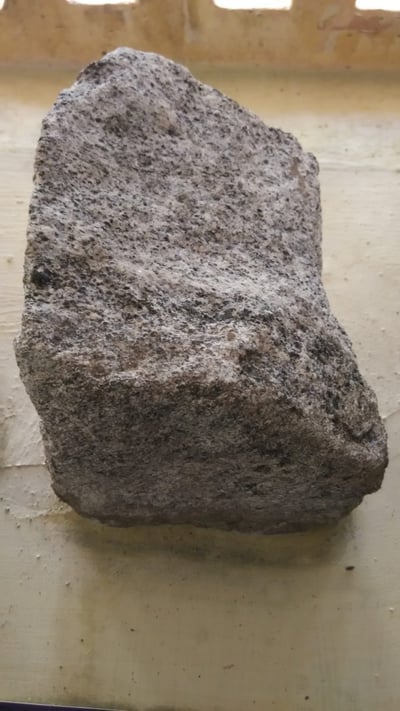
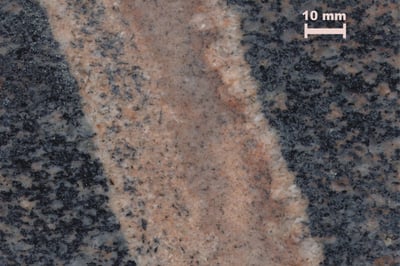
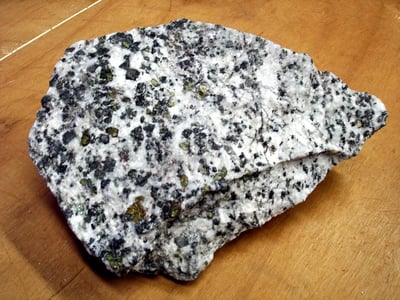
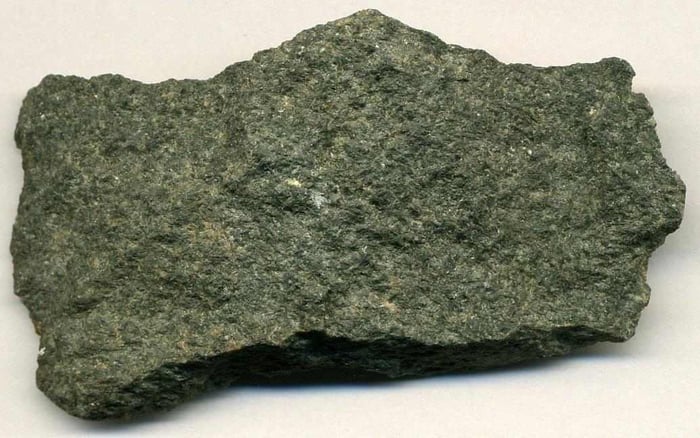
Mostly of sub-angular to subrounded greenish-black basalt cobbles and boulders, other clasts (about 10 to 15%) are pebbles to boulders of hornblende granite with pink feldspar
More Images

Quick Facts
Physical Properties
- Color
- Dark grey to black, brown, reddish brown, etc.
- Hardness (Mohs)
- 5 - 6
- Rock tumbling
- With care
- Density
- 2.9 - 3.1 g/cm³
Chemical Properties
Also Known As
Identify Basalt Instantly
- Snap a photo, get instant results
- 6,700+ rocks, minerals & crystals
- Discover collecting spots near you
Basalt FAQs
How do I identify Basalt?
Basalt can be identified by its hardness of 5 - 6 on the Mohs scale, Dark grey to black color. Look for these key characteristics when examining specimens.
What color is Basalt?
Basalt typically appears in Dark grey to black, brown, reddish brown, etc.. Color can vary depending on impurities and formation conditions.
How hard is Basalt?
Basalt has a hardness of 5 - 6 on the Mohs scale. This gives it moderate hardness.
What is the rock types of basalt of Basalt?
Tholeiitic basalt is relatively rich in iron and poor in alkali metals and aluminium. Included in this category are most basalts of the ocean floor, most large oceanic islands, and continental flood basalts such as the Columbia River Plateau. High-alumina basalt may be silica-undersaturated or -oversaturated (see normative mineralogy). It has greater than 17% alumina (Al2O3) and is intermediate in composition between tholeiitic basalt and alkali basalt; the relatively alumina-rich composition is based on rocks without phenocrysts of plagioclase. These represent the low silica end of the calc-alkaline magma series. Alkali basalt is relatively rich in alkali metals. It is silica-undersaturated and may contain feldspathoids, alkali feldspar, phlogopite, and kaersutite. Augite in alkali basalts is titanium-enriched augite, and low-calcium pyroxenes are never present. Boninite is a high-magnesium form of basalt that is erupted generally in back-arc basins, distinguished by its low titanium content and trace-element composition. Ocean island basalts include both tholeiites and alkali basalts, with tholeiite predominating early in the eruptive history of the island. These basalts are characterized by elevated concentrations of incompatible elements. This suggests that their source mantle rock has produced little magma in the past (it is undepleted.)
What is the characteristics of basalt of Basalt?
The mineralogy of basalt is characterized by a preponderance of calcic plagioclase feldspar and pyroxene. Olivine can also be a significant constituent. Accessory minerals present in relatively minor amounts include iron oxides and iron-titanium oxides, such as magnetite, ulvöspinel, and ilmenite. Because of the presence of such oxide minerals, basalt can acquire strong magnetic signatures as it cools, and paleomagnetic studies have made extensive use of basalt. In tholeiitic basalt, pyroxene (augite and orthopyroxene or pigeonite) and calcium-rich plagioclase are common phenocryst minerals. Olivine may also be a phenocryst, and when present, may have rims of pigeonite. The groundmass contains interstitial quartz or tridymite or cristobalite. Olivine tholeiitic basalt has augite and orthopyroxene or pigeonite with abundant olivine, but olivine may have rims of pyroxene and is unlikely to be present in the groundmass. Ocean floor basalts, erupted originally at mid-ocean ridges, are known as MORB (mid-ocean ridge basalt) and are characteristically low in incompatible elements. Alkali basalts typically have mineral assemblages that lack orthopyroxene but contain olivine. Feldspar phenocrysts typically are labradorite to andesine in composition. Augite is rich in titanium compared to augite in tholeiitic basalt. Minerals such as alkali feldspar, leucite, nepheline, sodalite, phlogopite mica, and apatite may be present in the groundmass. Basalt has high liquidus and solidus temperatures—values at the Earth's surface are near or above 1200 °C (liquidus) and near or below 1000 °C (solidus); these values are higher than those of other common igneous rocks. The majority of tholeiitic basalts are formed at approximately 50–100 km depth within the mantle. Many alkali basalts may be formed at greater depths, perhaps as deep as 150–200 km. The origin of high-alumina basalt continues to be controversial, with disagreement over whether it is a primary melt or derived from other basalt types by fractionation.
What is the composition of basalt of Basalt?
By definition, basalt is an aphanitic (fine-grained) igneous rock with generally 45–53% silica (SiO2) and less than 10% feldspathoid by volume, and where at least 65% of the rock is feldspar in the form of plagioclase. This is as per definition of the International Union of Geological Sciences (IUGS) classification scheme. It is the most common volcanic rock type on Earth, being a key component of oceanic crust as well as the principal volcanic rock in many mid-oceanic islands, including Iceland, the Faroe Islands, Réunion and the islands of Hawaiʻi.