Epidote
A variety of Epidote Group

What is Epidote?
Epidote isn't one of the most common minerals to stumble across, but when you do, hold on with both hands! This is an incredibly precious mineral for collectors. Although it isn't classified as a precious gemstone, the relative rarity makes it a genuine treasure. They are most commonly seen among ancient lava fields and metamorphized rock.
Etymology & Origins
The name, due to Haüy, is derived from the Greek word "epidosis" (ἐπίδοσις) which means "addition" in allusion to one side of the ideal prism being longer than the other.
Uses & Applications
The perfectly transparent, dark green crystals from the Knappenwand and from Brazil have occasionally been cut as gemstones.
Healing Properties
Epidote is believed to enhance spiritual growth and empower all who come in contact with it. Its power is said to help the body release negative energy and allow for positive healing. It is often used to counteract feelings of depression, and restore vitality and hope. It provides an earthly grounding nature that helps to balance the mind, body, and spirit.
Optical Properties
- Refractive Index
- 1.729-1.768
- Birefringence
- 0.014-0.045
- Pleochroism
- Orange/brown stones - strong trichroism: green to strong green, light brown to brown, yellow to colorless
- Green stones - strong: green, brown, yellow to colorless
- Optical Character
- Biaxial negative
- Dispersion
- 0.03
Discover Values
Market Value Factors
Pricing varies for every rock and mineral, so use these universal factors to gauge Epidote before comparing listings or appraisals.
Size & Weight
Larger, intact specimens usually command higher prices.
Rarity & Demand
Scarce material or popular varieties sell at a premium.
Condition & Finish
Chips, repairs, and heavy wear lower value; clean prep helps.
Treatment & Provenance
Untreated specimens with documented locality are prized.
Where to Find Epidote
RockHoundR, the free-to-download rockhounding map from the Ruby Glint team, shows where collectors find epidote in the US, with land-access notes for BLM land and national forests. Collecting is banned in national parks.
See where to find epidoteAlways check the local rules and get the landowner's permission before you collect.
Associated Chakras







Key Characteristics
Rock Types of Epidote
Clinozoisite is green, white or pale rose-red group species containing very little iron, thus having the same chemical composition as the orthorhombic mineral zoisite.
Characteristics of Epidote
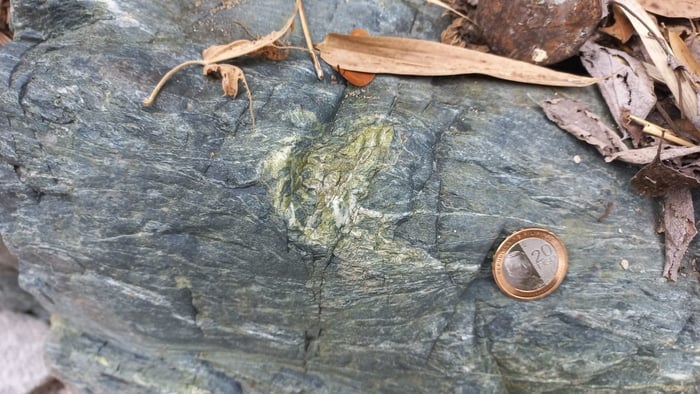
They are commonly prismatic in habit, the direction of elongation being perpendicular to the single plane of symmetry. The faces are often deeply striated and crystals are often twinned. Many of the characters of the mineral vary with the amount of iron present for instance, the color, the optical constants, and the specific gravity. The color is green, grey, brown or nearly black, but usually a characteristic shade of yellowish-green or pistachio-green. It displays strong pleochroism, the pleochroic colors being usually green, yellow and brown.
Formation of Epidote
Epidote is an abundant rock-forming mineral, but one of secondary origin. It occurs in marble and schistose rocks of metamorphic origin. It is also a product of hydrothermal alteration of various minerals (feldspars, micas, pyroxenes, amphiboles, garnets, and others) composing igneous rocks. A rock composed of quartz and epidote is known as epidosite.
Composition of Epidote
Epidote is a calcium aluminium iron sorosilicate mineral.
More Images


Quick Facts
Physical Properties
- Color
- Yellowish-green, green, brownish-green, black
- Hardness (Mohs)
- 6
- Rock tumbling
- With care
- Density
- 3.43 - 3.433 g/cm³
- Streak
- Colourless
- Luster
- Vitreous
- Crystal System
- Monoclinic
Chemical Properties
- Chemical Formula
- {Ca2}{Al2Fe3+}(Si2O7)(SiO4)O(OH)
- Elements
- Al, Ca, Fe, H, O, Si
Also Known As
Identify Epidote Instantly
- Snap a photo, get instant results
- 6,700+ rocks, minerals & crystals
- Discover collecting spots near you
Epidote FAQs
How do I identify Epidote?
Epidote can be identified by its hardness of 6 on the Mohs scale, Yellowish-green color, Vitreous luster, Monoclinic crystal system. Look for these key characteristics when examining specimens.
What color is Epidote?
Epidote typically appears in Yellowish-green, green, brownish-green, black. Color can vary depending on impurities and formation conditions.
How hard is Epidote?
Epidote has a hardness of 6 on the Mohs scale. This gives it moderate hardness.
What is the rock types of epidote of Epidote?
Clinozoisite is green, white or pale rose-red group species containing very little iron, thus having the same chemical composition as the orthorhombic mineral zoisite.
What is the characteristics of epidote of Epidote?
They are commonly prismatic in habit, the direction of elongation being perpendicular to the single plane of symmetry. The faces are often deeply striated and crystals are often twinned. Many of the characters of the mineral vary with the amount of iron present for instance, the color, the optical constants, and the specific gravity. The color is green, grey, brown or nearly black, but usually a characteristic shade of yellowish-green or pistachio-green. It displays strong pleochroism, the pleochroic colors being usually green, yellow and brown.
What is the formation of epidote of Epidote?
Epidote is an abundant rock-forming mineral, but one of secondary origin. It occurs in marble and schistose rocks of metamorphic origin. It is also a product of hydrothermal alteration of various minerals (feldspars, micas, pyroxenes, amphiboles, garnets, and others) composing igneous rocks. A rock composed of quartz and epidote is known as epidosite.
