Goethite
A variety of Diaspore Group

What is Goethite?
The primary interest in goethite is as an ore of iron; it is otherwise not very attractive as a mineral specimen. High concentrations of goethite have been found in the United States; other, less significant finds have been spotted in Mexico and Canada.
Etymology & Origins
It was first described in 1806 based on samples found in the Hollertszug Mine in Herdorf, Germany. The mineral was named after the German polymath and poet Johann Wolfgang von Goethe (1749–1832).
Uses & Applications
Goethite is a diaspore mineral which has been used for hundreds of years as a source for brown and yellow ochre paint. It is also important as an iron ore, from which iron can be extracted. Some particularly beautiful and rare types are desired by collectors, or cut into cabochons for use in jewelry.
Healing Properties
Goethite is an excellent stone to help with feelings of grief, as this stone's strong vibration can help heal emotional wounds. It has a deep connection to earth and will provide grounding especially for those who are driving in a car all day. Meditating with the stone opens the door to positive energy and if allowed it will fill one's heart with love and passion.
Optical Properties
- Refractive Index
- 2.26-2.398
- Birefringence
- 0.138
- Pleochroism
- Visible
- Optical Character
- Biaxial negative
Market Value Factors
Pricing varies for every rock and mineral, so use these universal factors to gauge Goethite before comparing listings or appraisals.
Size & Weight
Larger, intact specimens usually command higher prices.
Rarity & Demand
Scarce material or popular varieties sell at a premium.
Condition & Finish
Chips, repairs, and heavy wear lower value; clean prep helps.
Treatment & Provenance
Untreated specimens with documented locality are prized.
Where to Find Goethite
RockHoundR, the free-to-download rockhounding map from the Ruby Glint team, shows where collectors find goethite in the US, with land-access notes for BLM land and national forests. Collecting is banned in national parks.
See where to find goethiteAlways check the local rules and get the landowner's permission before you collect.
The Meaning
Goethite's oldest use comes from the ancient Phrygia. A body was found in a royal tomb believed to the father of King Midas. The burial shroud was colored with a dye containing goethite, making the shroud look golden. Historians conjecture that King Midas' golden touch legend may have started from Phrygian royalty wearing such golden-colored clothes.
Associated Chakras



Key Characteristics
Formation of Goethite
Goethite often forms through the weathering of other iron-rich minerals, and thus is a common component of soils, concentrated in laterite soils. nanoparticulate authigenic goethite is a common diagenetic iron oxyhydroxide in both marine and lake sediments. The formation of goethite is marked by the oxidation state change of Fe (ferrous) to Fe (ferric), which allows for goethite to exist at surface conditions. Because of this oxidation state change, goethite is commonly seen as a pseudomorph. As iron-bearing minerals are brought to the zone of oxidation within the soil, the iron turns from iron(II) to iron(III), while the original shape of the parent mineral is retained. Examples of common goethite pseudomorphs are: goethites after pyrite, goethite, siderite, and marcasite, though any iron(II)-bearing mineral could become a goethite pseudomorph if proper conditions are met. It may also be precipitated by groundwater or in other sedimentary conditions, or form as a primary mineral in hydrothermal deposits. Goethite has also been found to be produced by the excretion processes of certain bacteria types.
Composition of Goethite
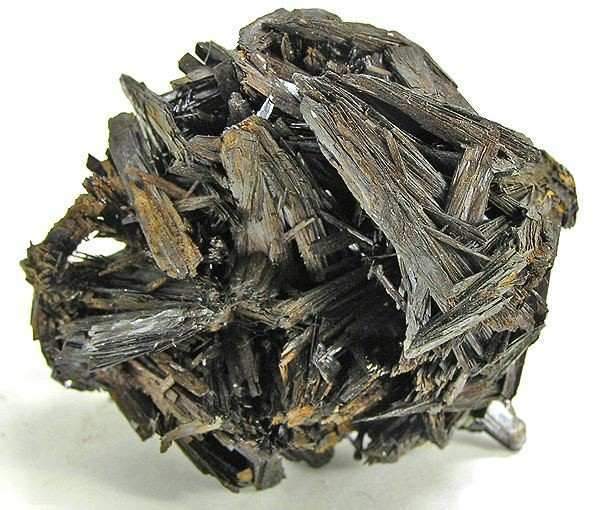
Goethite is an iron oxyhydroxide containing ferric iron. It is the main component of rust and bog iron ore. Goethite's hardness ranges from 5.0 to 5.5 on the Mohs Scale, and its specific gravity varies from 3.3 to 4.3. The mineral forms prismatic needle-like crystals ("needle iron ore") but is more typically massive. Feroxyhyte and lepidocrocite are both polymorphs of the iron oxyhydroxide FeO(OH) which are stable at the pressure and temperature conditions of the Earth's surface. Although they have the same chemical formula as goethite, their different crystalline structures make them distinct minerals. Additionally, goethite has several high-pressure and high-temperature polymorphs, which may be relevant to the conditions of the Earth's interior. These include ε-FeOOH, which has an orthorhombic crystal structure, a cubic pyrite-type polymorph with or without losing hydrogen and an ultradense hexagonal structure.
More Images

Quick Facts
Physical Properties
- Color
- Brownish black, yellow-brown, reddish brown
- Hardness (Mohs)
- 5 - 5.5
- Rock tumbling
- With care
- Density
- 4.18 g/cm³
- Streak
- Yellowish brown, orange-yellow, ocher-yellow
- Luster
- Metallic, Silky, Adamantine
- Crystal System
- Orthorhombic
Chemical Properties
- Chemical Formula
- α-Fe3+O(OH)
- Elements
- Fe, H, O
Also Known As
Identify Goethite Instantly
- Snap a photo, get instant results
- 6,700+ rocks, minerals & crystals
- Discover collecting spots near you
Goethite FAQs
How do I identify Goethite?
Goethite can be identified by its hardness of 5 - 5.5 on the Mohs scale, Brownish black color, Metallic, Silky, Adamantine luster, Orthorhombic crystal system. Look for these key characteristics when examining specimens.
What color is Goethite?
Goethite typically appears in Brownish black, yellow-brown, reddish brown. Color can vary depending on impurities and formation conditions.
How hard is Goethite?
Goethite has a hardness of 5 - 5.5 on the Mohs scale. This gives it moderate hardness.
What is the formation of goethite of Goethite?
Goethite often forms through the weathering of other iron-rich minerals, and thus is a common component of soils, concentrated in laterite soils. nanoparticulate authigenic goethite is a common diagenetic iron oxyhydroxide in both marine and lake sediments. The formation of goethite is marked by the oxidation state change of Fe (ferrous) to Fe (ferric), which allows for goethite to exist at surface conditions. Because of this oxidation state change, goethite is commonly seen as a pseudomorph. As iron-bearing minerals are brought to the zone of oxidation within the soil, the iron turns from iron(II) to iron(III), while the original shape of the parent mineral is retained. Examples of common goethite pseudomorphs are: goethites after pyrite, goethite, siderite, and marcasite, though any iron(II)-bearing mineral could become a goethite pseudomorph if proper conditions are met. It may also be precipitated by groundwater or in other sedimentary conditions, or form as a primary mineral in hydrothermal deposits. Goethite has also been found to be produced by the excretion processes of certain bacteria types.
What is the composition of goethite of Goethite?
Goethite is an iron oxyhydroxide containing ferric iron. It is the main component of rust and bog iron ore. Goethite's hardness ranges from 5.0 to 5.5 on the Mohs Scale, and its specific gravity varies from 3.3 to 4.3. The mineral forms prismatic needle-like crystals ("needle iron ore") but is more typically massive. Feroxyhyte and lepidocrocite are both polymorphs of the iron oxyhydroxide FeO(OH) which are stable at the pressure and temperature conditions of the Earth's surface. Although they have the same chemical formula as goethite, their different crystalline structures make them distinct minerals. Additionally, goethite has several high-pressure and high-temperature polymorphs, which may be relevant to the conditions of the Earth's interior. These include ε-FeOOH, which has an orthorhombic crystal structure, a cubic pyrite-type polymorph with or without losing hydrogen and an ultradense hexagonal structure.
