Hauyne
A variety of Sodalite Group

What is Hauyne?
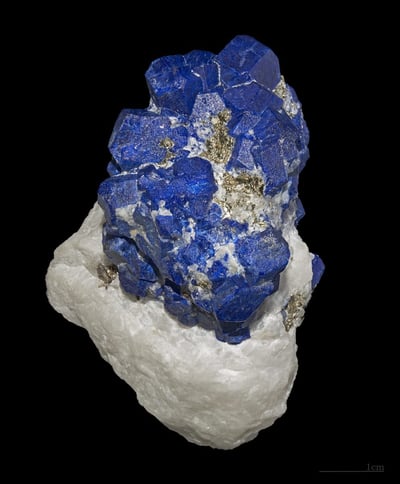
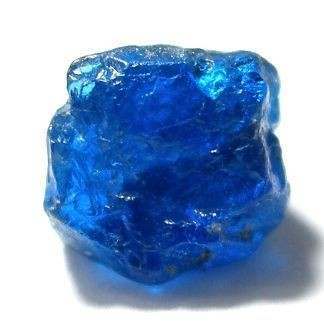
Hauyne is a rare mineral that occasionally produces gemstone-quality crystals. Though it may take on a variety of colors, its crystals are most often a striking bright blue - it is these specimens which are most likely to be cut and polished. Hauynes of exceptional quality are sought after by collectors, but beyond the gemological world, this stone is not well known.
Etymology & Origins
Hauyne was first described in 1807 from samples discovered in Vesuvian lavas in Monte Somma, Italy, and was named in 1807 by Brunn-Neergard for the French crystallographer René Just Haüy (1743–1822).
Uses & Applications
It is sometimes used as a gemstone.
Market Value Factors
Pricing varies for every rock and mineral, so use these universal factors to gauge Hauyne before comparing listings or appraisals.
Size & Weight
Larger, intact specimens usually command higher prices.
Rarity & Demand
Scarce material or popular varieties sell at a premium.
Condition & Finish
Chips, repairs, and heavy wear lower value; clean prep helps.
Treatment & Provenance
Untreated specimens with documented locality are prized.
Key Characteristics
Characteristics of Hauyne
Cleavage is distinct to perfect, and twinning is common, as contact, penetration and polysynthetic twins. The fracture is uneven to conchoidal, the mineral is brittle, and it has hardness 5 ⁄2 to 6, almost as hard as feldspar. All the members of the sodalite group have quite low densities, less than that of quartz; haüyne is the densest of them all, but still its specific gravity is only 2.44 to 2.50. If haüyne is placed on a glass slide and treated with nitric acid HNO3, and then the solution is allowed to evaporate slowly, monoclinic needles of gypsum form. This distinguishes haüyne from sodalite, which forms cubic crystals of chlorite under the same conditions. The mineral is not radioactive.
Appearance of Hauyne
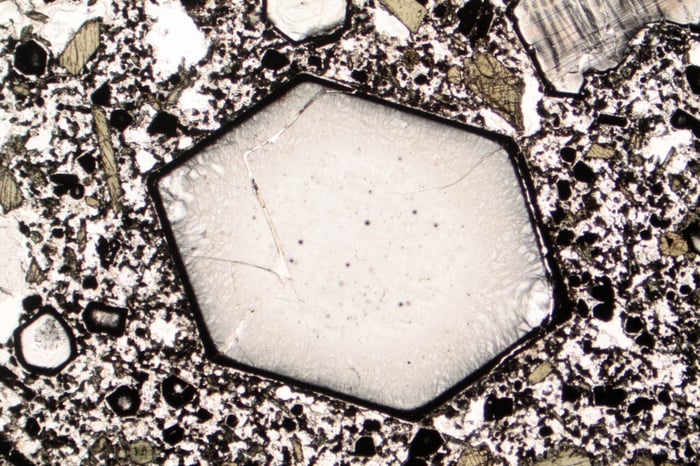
Haüyne crystallizes in the isometric system forming rare dodecahedral or pseudo-octahedral crystals that may reach 3 cm across; it also occurs as rounded grains. The crystals are transparent to translucent, with a vitreous to greasy luster. The color is usually bright blue, but it can also be white, grey, yellow, green and pink. In thin section the crystals are colorless or pale blue, and the streak is very pale blue to white.
Composition of Hauyne
All silicates have a basic structural unit that is a tetrahedron with an oxygen ion O at each apex, and a silicon ion Si in the middle, forming (SiO4). In tectosilicates (framework silicates) each oxygen ion is shared between two tetrahedra, linking all the tetrahedra together to form a framework. Since each O is shared between two tetrahedra only half of it "belongs" to the Si ion in either tetrahedron, and if no other components are present then the formula is SiO2, as in quartz. Aluminium ions Al, can substitute for some of the silicon ions, forming (AlO4) tetrahedra. If the substitution is random the ions are said to be disordered, but in haüyne the Al and Si in the tetrahedral framework are fully ordered. Si has a charge 4+, but the charge on Al is only 3+. If all the cations (positive ions) are Si then the positive charges on the Si's exactly balance the negative charges on the O's. When Al replaces Si there is a deficiency of positive charge, and this is made up by extra positively charged ions (cations) entering the structure, somewhere in between the tetrahedra. In haüyne these extra cations are sodium Na and calcium Ca, and in addition the negatively charged sulfate group (SO4) is also present. In the haüyne structure the tetrahedra are linked to form six-membered rings that are stacked up in an ..ABCABC.. sequence along one direction, and rings of four tetrahedra are stacked up parallel to another direction. The resulting arrangement forms continuous channels that can accommodate a large variety of cations and anions.
More Images
Quick Facts
Physical Properties
- Color
- Blue, white, grey, yellow, green, pink
- Hardness (Mohs)
- 5.5 - 6
- Rock tumbling
- With care
- Density
- 2.44 - 2.5 g/cm³
- Streak
- Very pale blue to white. Lazurite variety is bright blue
- Luster
- Greasy, Vitreous
- Crystal System
- Isometric
Chemical Properties
- Chemical Formula
- (Na,K)3(Ca,Na)(Al3Si3O12)(SO4,S,Cl)
- Elements
- Al, Ca, Cl, K, Na, O, S, Si
Also Known As
Identify Hauyne Instantly
- Snap a photo, get instant results
- 6,700+ rocks, minerals & crystals
- Discover collecting spots near you
Hauyne FAQs
How do I identify Hauyne?
Hauyne can be identified by its hardness of 5.5 - 6 on the Mohs scale, Blue color, Greasy, Vitreous luster, Isometric crystal system. Look for these key characteristics when examining specimens.
What color is Hauyne?
Hauyne typically appears in Blue, white, grey, yellow, green, pink. Color can vary depending on impurities and formation conditions.
How hard is Hauyne?
Hauyne has a hardness of 5.5 - 6 on the Mohs scale. This gives it moderate hardness.
What is the characteristics of hauyne of Hauyne?
Cleavage is distinct to perfect, and twinning is common, as contact, penetration and polysynthetic twins. The fracture is uneven to conchoidal, the mineral is brittle, and it has hardness 5 ⁄2 to 6, almost as hard as feldspar. All the members of the sodalite group have quite low densities, less than that of quartz; haüyne is the densest of them all, but still its specific gravity is only 2.44 to 2.50. If haüyne is placed on a glass slide and treated with nitric acid HNO3, and then the solution is allowed to evaporate slowly, monoclinic needles of gypsum form. This distinguishes haüyne from sodalite, which forms cubic crystals of chlorite under the same conditions. The mineral is not radioactive.
What is the appearance of hauyne of Hauyne?
Haüyne crystallizes in the isometric system forming rare dodecahedral or pseudo-octahedral crystals that may reach 3 cm across; it also occurs as rounded grains. The crystals are transparent to translucent, with a vitreous to greasy luster. The color is usually bright blue, but it can also be white, grey, yellow, green and pink. In thin section the crystals are colorless or pale blue, and the streak is very pale blue to white.
What is the composition of hauyne of Hauyne?
All silicates have a basic structural unit that is a tetrahedron with an oxygen ion O at each apex, and a silicon ion Si in the middle, forming (SiO4). In tectosilicates (framework silicates) each oxygen ion is shared between two tetrahedra, linking all the tetrahedra together to form a framework. Since each O is shared between two tetrahedra only half of it "belongs" to the Si ion in either tetrahedron, and if no other components are present then the formula is SiO2, as in quartz. Aluminium ions Al, can substitute for some of the silicon ions, forming (AlO4) tetrahedra. If the substitution is random the ions are said to be disordered, but in haüyne the Al and Si in the tetrahedral framework are fully ordered. Si has a charge 4+, but the charge on Al is only 3+. If all the cations (positive ions) are Si then the positive charges on the Si's exactly balance the negative charges on the O's. When Al replaces Si there is a deficiency of positive charge, and this is made up by extra positively charged ions (cations) entering the structure, somewhere in between the tetrahedra. In haüyne these extra cations are sodium Na and calcium Ca, and in addition the negatively charged sulfate group (SO4) is also present. In the haüyne structure the tetrahedra are linked to form six-membered rings that are stacked up in an ..ABCABC.. sequence along one direction, and rings of four tetrahedra are stacked up parallel to another direction. The resulting arrangement forms continuous channels that can accommodate a large variety of cations and anions.