Kunzite
A variety of Spodumene

What is Kunzite?
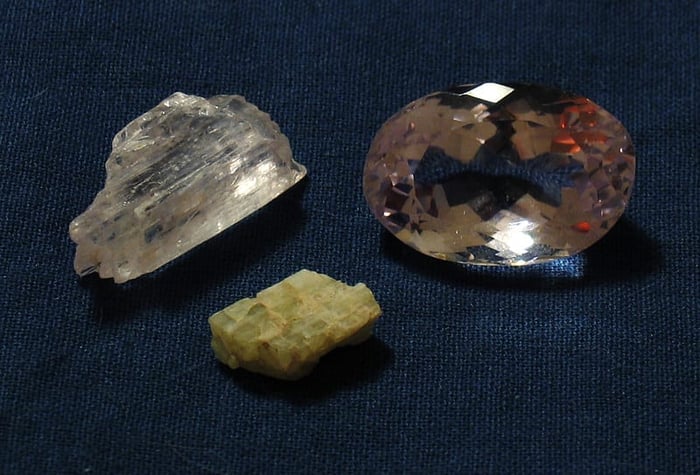
Kunzite is a gemstone that gets its pink-violet color from trace amounts of manganese. The gem has growing popularity in high-end jewelry due to its size and clarity, However, it is a difficult stone to cut and has a tendency to cleave. Kunzite is used in the making of certain batteries, medicines, and ceramics.
Uses & Applications
Kunzite is a decorative stone often used in jewelry. Bracelets and necklaces are common, but the stone can also be found in rings and earrings. Discovered in the 20th century, the stone was primarily used in industrial applications like ceramics and battery production until the 1990s when some of the more spectacular crystals began appearing as pendants for necklaces.
Healing Properties
Kunzite works with the Third Eye and Heart chakra to release negative feelings and provide emotional healing. It also works with the Crown chakra as a mood booster. When placed on the Throat chakra, practitioners say it will facilitate better communication and allow for more honesty in all areas of life.
Optical Properties
- Refractive Index
- 1.657-1.681
- Birefringence
- 0.014-0.016
- Pleochroism
- Strong trichroism: colorless, pink, violet
- Optical Character
- Biaxial positive
- Dispersion
- 0.017
Discover Values
Market Value Factors
Pricing varies for every rock and mineral, so use these universal factors to gauge Kunzite before comparing listings or appraisals.
Size & Weight
Larger, intact specimens usually command higher prices.
Rarity & Demand
Scarce material or popular varieties sell at a premium.
Condition & Finish
Chips, repairs, and heavy wear lower value; clean prep helps.
Treatment & Provenance
Untreated specimens with documented locality are prized.
Associated Chakras

Key Characteristics
Formation of Kunzite
Spodumene was first described in 1800 for an occurrence in the type locality in Utö, Södermanland, Sweden. It was discovered by Brazilian naturalist Jose Bonifacio de Andrada e Silva. The name is derived from the Greek spodumenos (σποδούμενος), meaning "burnt to ashes," owing to the opaque, ash-grey appearance of material refined for use in industry. Spodumene occurs in lithium-rich granite pegmatites and aplites. Associated minerals include: quartz, albite, petalite, eucryptite, lepidolite and beryl. Transparent material has long been used as a gemstone with varieties kunzite and hiddenite noted for their strong pleochroism. Source localities include Afghanistan, Australia, Brazil, Madagascar, Pakistan, Québec in Canada and North Carolina, California in the US.
More Images

Quick Facts
Physical Properties
- Color
- Pink to violetish purple
- Hardness (Mohs)
- 6.5 - 7
- Rock tumbling
- With care
- Density
- 3.18 g/cm³
- Streak
- white
- Luster
- Vitreous
- Crystal System
- Monoclinic
Chemical Properties
- Chemical Formula
- LiAlSi2O6
- Elements
- Al, Li, O, Si
Also Known As
Identify Kunzite Instantly
- Snap a photo, get instant results
- 6,700+ rocks, minerals & crystals
- Discover collecting spots near you
Kunzite FAQs
How do I identify Kunzite?
Kunzite can be identified by its hardness of 6.5 - 7 on the Mohs scale, Pink to violetish purple color, Vitreous luster, Monoclinic crystal system. Look for these key characteristics when examining specimens.
What color is Kunzite?
Kunzite typically appears in Pink to violetish purple. Color can vary depending on impurities and formation conditions.
How hard is Kunzite?
Kunzite has a hardness of 6.5 - 7 on the Mohs scale. This gives it moderate hardness.
What is the formation of kunzite of Kunzite?
Spodumene was first described in 1800 for an occurrence in the type locality in Utö, Södermanland, Sweden. It was discovered by Brazilian naturalist Jose Bonifacio de Andrada e Silva. The name is derived from the Greek spodumenos (σποδούμενος), meaning "burnt to ashes," owing to the opaque, ash-grey appearance of material refined for use in industry. Spodumene occurs in lithium-rich granite pegmatites and aplites. Associated minerals include: quartz, albite, petalite, eucryptite, lepidolite and beryl. Transparent material has long been used as a gemstone with varieties kunzite and hiddenite noted for their strong pleochroism. Source localities include Afghanistan, Australia, Brazil, Madagascar, Pakistan, Québec in Canada and North Carolina, California in the US.