Lawsonite
A variety of Lawsonite Group
What is Lawsonite?
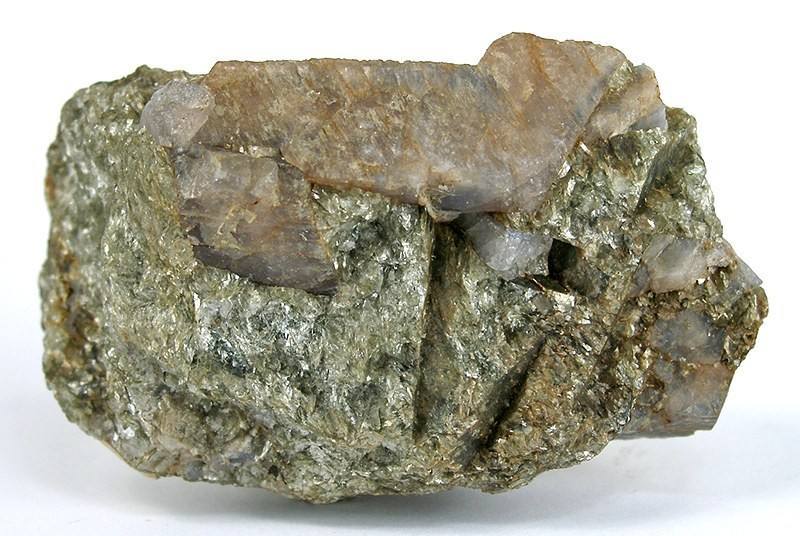
Lawsonite is a hydrous calcium aluminium sorosilicate mineral with formula CaAl2Si2O7(OH)2·H2O. Lawsonite crystallizes in the orthorhombic system in prismatic, often tabular crystals. Crystal twinning is common. It forms transparent to translucent colorless, white, and bluish to pinkish grey glassy to greasy crystals. Refractive indices are nα=1.665, nβ=1.672 - 1.676, and nγ=1.684 - 1.686. It is typically almost colorless in thin section, but some lawsonite is pleochroic from colorless to pale yellow to pale blue, depending on orientation. The mineral has a Mohs hardness of 8 and a specific gravity of 3.09. It has perfect cleavage in two directions and a brittle fracture. Lawsonite is a metamorphic mineral typical of the blueschist facies. It also occurs as a secondary mineral in altered gabbro and diorite. Associate minerals include epidote, titanite, glaucophane, garnet and quartz. It is an uncommon constituent of eclogite. It was first described in 1895 for occurrences in the Tiburon peninsula, Marin County, California. It was named for geologist Andrew Lawson (1861–1952) of the University of California by two of Lawson's graduate students, Charles Palache and Frederick Leslie Ransome.
Market Value Factors
Pricing varies for every rock and mineral, so use these universal factors to gauge Lawsonite before comparing listings or appraisals.
Size & Weight
Larger, intact specimens usually command higher prices.
Rarity & Demand
Scarce material or popular varieties sell at a premium.
Condition & Finish
Chips, repairs, and heavy wear lower value; clean prep helps.
Treatment & Provenance
Untreated specimens with documented locality are prized.
Key Characteristics
Characteristics of Lawsonite
Lawsonite has crystal habits of orthorhombic prismatic, which are crystals shaped like slender prisms, or tubular figures, which are form dimensions that are thin in one direction, both with two perfect cleavages. This crystal is transparent to translucent and varies in color from white to pale blue to colorless with a white streak and a vitreous or greasy luster. It has a relatively low specific gravity of 3.1g/cm3, and a pretty high hardness of 7.5 on Mohs scale of hardness, slightly higher than quartz. Under the microscope, lawsonite can be seen as blue, yellow, or colorless under plane polarized light while the stage is rotated. Lawsonite has three refractive indices of nα = 1.665 nβ = 1.672 - 1.676 nγ = 1.684 - 1.686, which produces a birefringence of δ = 0.019 - 0.021 and an optically positive biaxial interference figure.
Composition of Lawsonite
Lawsonite is a metamorphic silicate mineral related chemically and structurally to the epidote group of minerals. It is close to the ideal composition of CaAl2Si2O7(OH)2 . H2O giving it a close chemical composition with anorthite CaAl2Si2O8 (its anhydrous equivalent), yet lawsonite has greater density and a different Al coordination (Comodi et al., 1996). The substantial amount of water bound in lawsonite’s crystal structure is released during its breakdown to denser minerals during prograde metamorphism. This means lawsonite is capable of conveying appreciable water to shallow depths in subducting oceanic lithosphere (Clarke et al., 2006). Experimentation on lawsonite to vary its responses at different temperatures and different pressures is among its most studied aspects, for it is these qualities that affect its abilities to carry water down to mantle depths, similar to other OH-containing phases like antigorite, talc, phengite, staurolite, and epidote (Comodi et al., 1996).
Quick Facts
Physical Properties
- Color
- Colorless, white, grayish blue, pale blue
- Hardness (Mohs)
- 7.5
- Rock tumbling
- Tumbles well
- Density
- 3.09 g/cm³
- Streak
- White
Chemical Properties
- Chemical Formula
- CaAl2(Si2O7)(OH)2 · H2O
- Elements
- Al, Ca, H, O, Si
Identify Lawsonite Instantly
- Snap a photo, get instant results
- 6,700+ rocks, minerals & crystals
- Discover collecting spots near you
Lawsonite FAQs
How do I identify Lawsonite?
Lawsonite can be identified by its hardness of 7.5 on the Mohs scale, Colorless color. Look for these key characteristics when examining specimens.
What color is Lawsonite?
Lawsonite typically appears in Colorless, white, grayish blue, pale blue. Color can vary depending on impurities and formation conditions.
How hard is Lawsonite?
Lawsonite has a hardness of 7.5 on the Mohs scale. This makes it a relatively hard mineral suitable for jewelry.
What is the characteristics of lawsonite of Lawsonite?
Lawsonite has crystal habits of orthorhombic prismatic, which are crystals shaped like slender prisms, or tubular figures, which are form dimensions that are thin in one direction, both with two perfect cleavages. This crystal is transparent to translucent and varies in color from white to pale blue to colorless with a white streak and a vitreous or greasy luster. It has a relatively low specific gravity of 3.1g/cm3, and a pretty high hardness of 7.5 on Mohs scale of hardness, slightly higher than quartz. Under the microscope, lawsonite can be seen as blue, yellow, or colorless under plane polarized light while the stage is rotated. Lawsonite has three refractive indices of nα = 1.665 nβ = 1.672 - 1.676 nγ = 1.684 - 1.686, which produces a birefringence of δ = 0.019 - 0.021 and an optically positive biaxial interference figure.
What is the composition of lawsonite of Lawsonite?
Lawsonite is a metamorphic silicate mineral related chemically and structurally to the epidote group of minerals. It is close to the ideal composition of CaAl2Si2O7(OH)2 . H2O giving it a close chemical composition with anorthite CaAl2Si2O8 (its anhydrous equivalent), yet lawsonite has greater density and a different Al coordination (Comodi et al., 1996). The substantial amount of water bound in lawsonite’s crystal structure is released during its breakdown to denser minerals during prograde metamorphism. This means lawsonite is capable of conveying appreciable water to shallow depths in subducting oceanic lithosphere (Clarke et al., 2006). Experimentation on lawsonite to vary its responses at different temperatures and different pressures is among its most studied aspects, for it is these qualities that affect its abilities to carry water down to mantle depths, similar to other OH-containing phases like antigorite, talc, phengite, staurolite, and epidote (Comodi et al., 1996).
