Lazulite
A variety of Lazulite Group
What is Lazulite?
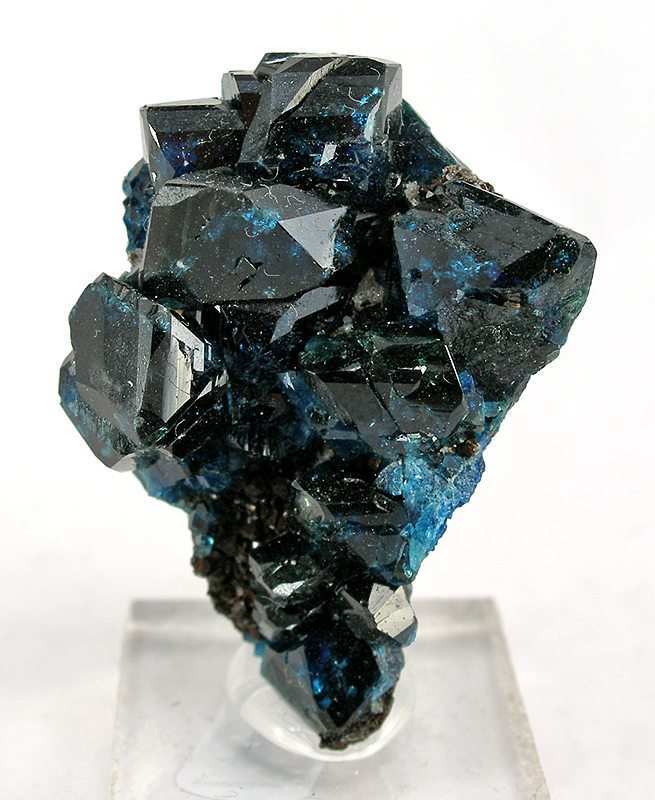
Lazulite is a deep blue mineral that is often confused for the more famous (and also very blue) lapis lazuli. This rare stone, unlike the more amorphous lapis lazuli, has cleavage planes (essentially, angular faces along which the crystal may split). Lazulite is occasionally used to make jewelry – although only somewhat translucent in its native form, it can become relatively transparent when correctly cut.
Etymology & Origins
It was first described in 1795 for deposits in Styria, Austria. Its name comes from the German lazurstein, for blue stone or from the Arabic for heaven.
Uses & Applications
Lazulite is a popular gemstone due to its brilliant blue color, but has few uses outside of that. Due to its vivid appearance, it is a popular component of many mineral collections. When polished in cabochons or beads, it can be enjoyed a similar substitute for the popular lapis lazuli, and rarely specimens are found of sufficient quality to be cut into a breathtaking faceted stone.
Healing Properties
Lazulite is a stone that is said to bridge the spiritual and physical worlds. It is believed to help one interpret their dreams and help them on their path to greater understanding of their life's purpose. Carrying the stone with you or wearing it is believed to offer serenity when faced with daily challenges and negativity, including physical pains and illnesses.
Optical Properties
- Refractive Index
- 1.604-1.646
- Birefringence
- 0.031-0.036
- Pleochroism
- Transparent stones - Strong: colorless, light blue, dark violet blue
- Optical Character
- Biaxial negative
- Dispersion
- 0.014
Market Value Factors
Pricing varies for every rock and mineral, so use these universal factors to gauge Lazulite before comparing listings or appraisals.
Size & Weight
Larger, intact specimens usually command higher prices.
Rarity & Demand
Scarce material or popular varieties sell at a premium.
Condition & Finish
Chips, repairs, and heavy wear lower value; clean prep helps.
Treatment & Provenance
Untreated specimens with documented locality are prized.
Associated Chakras


Key Characteristics
Characteristics of Lazulite
Lazulite crystallizes in the monoclinic system. Crystal habits include steep bipyramidal or wedge-shaped crystals. Lazulite has a Mohs hardness of 5.5 to 6 and a specific gravity of 3.0 to 3.1. It is infusible and insoluble.
Formation of Lazulite
It forms by high grade metamorphism of high silica quartz rich rocks and in pegmatites. It occurs in association with quartz, andalusite, rutile, kyanite, corundum, muscovite, pyrophyllite, dumortierite, wagnerite, svanbergite and berlinite in metamorphic terrains; and with albite, quartz, muscovite, tourmaline and beryl in pegmatites. It may be confused with lazurite, lapis lazuli or azurite. It is found in Salzburg, Austria; Zermatt, Switzerland; Minas Gerais, Brazil; Lincoln County, Georgia; Inyo County, California; the Yukon in Canada; and elsewhere. It was first described in 1795 for deposits in Styria, Austria. Its name comes from the German lazurstein, for blue stone or from the Arabic for heaven.
More Images

Quick Facts
Physical Properties
- Color
- Blue, sky-blue, bluish white
- Hardness (Mohs)
- 5.5 - 6
- Rock tumbling
- With care
- Density
- 3.144 g/cm³
- Streak
- White
- Luster
- Greasy, Vitreous, Resinous, Sub-vitreous
- Crystal System
- Monoclinic
Chemical Properties
- Chemical Formula
- MgAl2(PO4)2(OH)2
- Elements
- Al, H, Mg, O, P
Also Known As
Identify Lazulite Instantly
- Snap a photo, get instant results
- 6,700+ rocks, minerals & crystals
- Discover collecting spots near you
Lazulite FAQs
How do I identify Lazulite?
Lazulite can be identified by its hardness of 5.5 - 6 on the Mohs scale, Blue color, Greasy, Vitreous, Resinous, Sub-vitreous luster, Monoclinic crystal system. Look for these key characteristics when examining specimens.
What color is Lazulite?
Lazulite typically appears in Blue, sky-blue, bluish white. Color can vary depending on impurities and formation conditions.
How hard is Lazulite?
Lazulite has a hardness of 5.5 - 6 on the Mohs scale. This gives it moderate hardness.
What is the characteristics of lazulite of Lazulite?
Lazulite crystallizes in the monoclinic system. Crystal habits include steep bipyramidal or wedge-shaped crystals. Lazulite has a Mohs hardness of 5.5 to 6 and a specific gravity of 3.0 to 3.1. It is infusible and insoluble.
What is the formation of lazulite of Lazulite?
It forms by high grade metamorphism of high silica quartz rich rocks and in pegmatites. It occurs in association with quartz, andalusite, rutile, kyanite, corundum, muscovite, pyrophyllite, dumortierite, wagnerite, svanbergite and berlinite in metamorphic terrains; and with albite, quartz, muscovite, tourmaline and beryl in pegmatites. It may be confused with lazurite, lapis lazuli or azurite. It is found in Salzburg, Austria; Zermatt, Switzerland; Minas Gerais, Brazil; Lincoln County, Georgia; Inyo County, California; the Yukon in Canada; and elsewhere. It was first described in 1795 for deposits in Styria, Austria. Its name comes from the German lazurstein, for blue stone or from the Arabic for heaven.