Leonite
A variety of Leonite Group

What is Leonite?
Leonite is a hydrated double sulfate of magnesium and potassium. It has the formula K2SO4·MgSO4·4H2O. The mineral was named after Leo Strippelmann, who was director of the salt works at Westeregeln in Germany. The mineral is part of the blodite group of hydrated double sulfate minerals.
Market Value Factors
Pricing varies for every rock and mineral, so use these universal factors to gauge Leonite before comparing listings or appraisals.
Size & Weight
Larger, intact specimens usually command higher prices.
Rarity & Demand
Scarce material or popular varieties sell at a premium.
Condition & Finish
Chips, repairs, and heavy wear lower value; clean prep helps.
Treatment & Provenance
Untreated specimens with documented locality are prized.
Key Characteristics
Characteristics of Leonite
Leonite has a bitter taste. When leonite is analyzed for elements, it is usually contaminated with sodium and chloride ions, as it commonly occurs with sodium chloride.
Formation of Leonite
Starting in 1897, Jacobus Henricus van 't Hoff investigated how different salts were formed as sea water evaporated in different conditions. His purpose was to discover how salt deposits are formed. His research formed the basis for the studies of the conditions in which leonite is formed. Leonite can form when a water solution of potassium sulfate and magnesium sulfate is concentrated between the temperature range of 320–350 K (47–77 °C). Above this temperature range, langbeinite (K2Mg2(SO4)3) is formed. Below 320 K (47 °C), picromerite (K2Mg(SO4)2·6H2O) crystallises. For solutions with more than 90% proportion MgSO4, hexahydrite (MgSO4·6H2O) crystallises preferentially, and below 60%, arcanite (K2SO4) forms. In mixtures of potassium chloride, potassium sulfate, magnesium chloride and magnesium sulfate at 35 °C in water, leonite can crystallise out in a certain composition range. The plot of the system forms boundaries of leonite with potassium chloride, potassium sulfate, and picromerite. As magnesium is enriched, a quadruple point with kainite exists. In salt (NaCl) saturated brine, leonite can be deposited from magnesium and potassium sulfate mixtures as low as 25 °C. The 25 °C isotherm of the system has leonite surrounded by sylvine, picromerite, astrakanite, epsomite, and kainite. Sodium chloride saturated brines are formed by seawater evaporation, though seawater does not contain enough potassium to deposite leonite this way. Leonite is precipitated in series solar ponds at the Great Salt Lake. When picromerite is heated to between 85 and 128 °C, it gives off steam to give leonite: K2Mg(SO4)2·6H2O(s) → K2Mg(SO4)2·4H2O(s) + 2H2O(g).
Composition of Leonite
In the mineral family of leonite, the lattice contains sulfate tetrahedrons, a divalent element in an octahedral position surrounded by oxygen, and water and univalent metal (potassium) linking these other components together. One sulfate group is disordered at room temperature. The disordered sulfate becomes fixed in position as temperature is lowered. The crystal form also changes at lower temperatures, so two other crystalline forms of leonite exist at lower temperatures. The divalent metal cation (magnesium) is embedded in oxygen octahedra, four from water around the equator, and two from sulfate ions at the opposite poles. In the crystal there are two different octahedral environments. Each of these octahedra are joined together by potassium ions and hydrogen bonds.
More Images

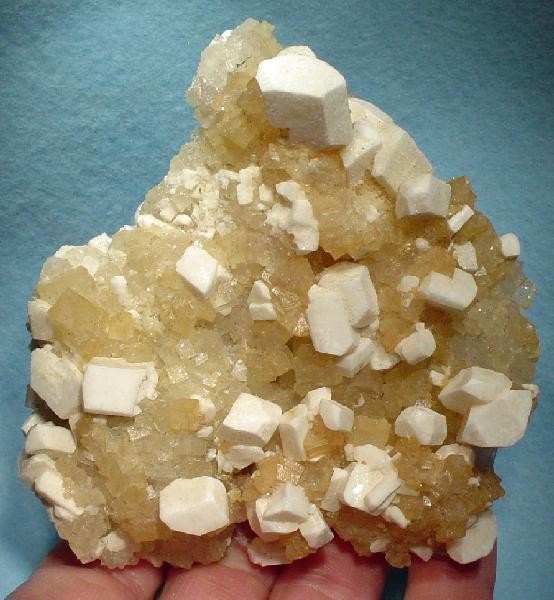
Quick Facts
Physical Properties
- Color
- Colourless, pale yellow; colourless (transmitted light).
- Hardness (Mohs)
- 2.5 - 3
- Rock tumbling
- Not recommended
- Density
- 2.201 g/cm³
Chemical Properties
- Chemical Formula
- K2Mg(SO4)2 · 4H2O
- Elements
- H, K, Mg, O, S
Also Known As
Identify Leonite Instantly
- Snap a photo, get instant results
- 6,700+ rocks, minerals & crystals
- Discover collecting spots near you
Leonite FAQs
How do I identify Leonite?
Leonite can be identified by its hardness of 2.5 - 3 on the Mohs scale, Colourless color. Look for these key characteristics when examining specimens.
What color is Leonite?
Leonite typically appears in Colourless, pale yellow; colourless (transmitted light).. Color can vary depending on impurities and formation conditions.
How hard is Leonite?
Leonite has a hardness of 2.5 - 3 on the Mohs scale. This makes it a soft mineral that can be scratched easily.
What is the characteristics of leonite of Leonite?
Leonite has a bitter taste. When leonite is analyzed for elements, it is usually contaminated with sodium and chloride ions, as it commonly occurs with sodium chloride.
What is the formation of leonite of Leonite?
Starting in 1897, Jacobus Henricus van 't Hoff investigated how different salts were formed as sea water evaporated in different conditions. His purpose was to discover how salt deposits are formed. His research formed the basis for the studies of the conditions in which leonite is formed. Leonite can form when a water solution of potassium sulfate and magnesium sulfate is concentrated between the temperature range of 320–350 K (47–77 °C). Above this temperature range, langbeinite (K2Mg2(SO4)3) is formed. Below 320 K (47 °C), picromerite (K2Mg(SO4)2·6H2O) crystallises. For solutions with more than 90% proportion MgSO4, hexahydrite (MgSO4·6H2O) crystallises preferentially, and below 60%, arcanite (K2SO4) forms. In mixtures of potassium chloride, potassium sulfate, magnesium chloride and magnesium sulfate at 35 °C in water, leonite can crystallise out in a certain composition range. The plot of the system forms boundaries of leonite with potassium chloride, potassium sulfate, and picromerite. As magnesium is enriched, a quadruple point with kainite exists. In salt (NaCl) saturated brine, leonite can be deposited from magnesium and potassium sulfate mixtures as low as 25 °C. The 25 °C isotherm of the system has leonite surrounded by sylvine, picromerite, astrakanite, epsomite, and kainite. Sodium chloride saturated brines are formed by seawater evaporation, though seawater does not contain enough potassium to deposite leonite this way. Leonite is precipitated in series solar ponds at the Great Salt Lake. When picromerite is heated to between 85 and 128 °C, it gives off steam to give leonite: K2Mg(SO4)2·6H2O(s) → K2Mg(SO4)2·4H2O(s) + 2H2O(g).
What is the composition of leonite of Leonite?
In the mineral family of leonite, the lattice contains sulfate tetrahedrons, a divalent element in an octahedral position surrounded by oxygen, and water and univalent metal (potassium) linking these other components together. One sulfate group is disordered at room temperature. The disordered sulfate becomes fixed in position as temperature is lowered. The crystal form also changes at lower temperatures, so two other crystalline forms of leonite exist at lower temperatures. The divalent metal cation (magnesium) is embedded in oxygen octahedra, four from water around the equator, and two from sulfate ions at the opposite poles. In the crystal there are two different octahedral environments. Each of these octahedra are joined together by potassium ions and hydrogen bonds.