Lizardite
A variety of Serpentine

What is Lizardite?
Népouite is a rare nickel silicate mineral which has the apple green colour typical of such compounds. It was named by E Glasser in 1907 after the place where it was first described (the type locality), the Népoui Mine, Népoui, Nouméa Commune, North Province, New Caledonia. The ideal formula is Ni3(Si2O5)(OH)4, but most specimens contain some magnesium, and (Ni,Mg)3(Si2O5)(OH)4 is more realistic. There is a similar mineral called lizardite (named after the Lizard Complex in Cornwall, England) in which all of the nickel is replaced by magnesium, formula Mg3(Si2O5)(OH)4. These two minerals form a series; intermediate compositions are possible, with varying proportions of nickel to magnesium. Pecoraite is another rare mineral with the same chemical formula as népouite, but a different structure; such minerals are said to be dimorphs of each other, in the same way as graphite is a dimorph of diamond. Népouite, lizardite and pecoraite are all members of the kaolinite-serpentine group. Garnierite is a green nickel ore that formed as a result of weathering of ultramafic rocks, and that occurs in many nickel deposits worldwide. It is a mixture of various nickel and magnesium phyllosilicates (sheet silicates), including népouite. Associated minerals include calcite, chlorite, goethite, halloysite, nontronite, pimelite, quartz, sepiolite, serpentine, talc and willemseite. As well as the type locality in New Caledonia, it has been found in Australia, Austria, the Czech Republic, the Democratic Republic of Congo, Germany, Greece, Italy, Japan, Morocco, Poland, Russia, South Africa and the US.
Healing Properties
Lizardite's supposed strong connection with Mother Earth may strengthen your bonds with the environment around you - try meditating outside with this stone. Lizardite isn't believed to work with just one chakra; it aligns them all, creating coherence and calm throughout the body. It is, however, believed to have a particular connection with the crown chakra, enhancing wisdom and retrieving lost memories.
Optical Properties
- Refractive Index
- 1.538-1.560
- Optical Character
- Uniaxial negative
Market Value Factors
Pricing varies for every rock and mineral, so use these universal factors to gauge Lizardite before comparing listings or appraisals.
Size & Weight
Larger, intact specimens usually command higher prices.
Rarity & Demand
Scarce material or popular varieties sell at a premium.
Condition & Finish
Chips, repairs, and heavy wear lower value; clean prep helps.
Treatment & Provenance
Untreated specimens with documented locality are prized.
Where to Find Lizardite
Lizardite is a variety of Serpentine. RockHoundR, the free-to-download rockhounding map from the Ruby Glint team, shows where collectors find serpentine in the US, with land-access notes for BLM land and national forests. Collecting is banned in national parks.
See where to find serpentineAlways check the local rules and get the landowner's permission before you collect.
The Meaning
As the most common serpentine crystal, lizardite has been used in Chinese ornament-making for thousands of years. Traditionally, it was thought to protect against snakebites and poison. Legend tells of kings who would only drink out of lizardite chalices to ensure they would not be poisoned.
Key Characteristics
Composition of Lizardite
Space Group Ccm21. Unit Cell: a = 5.31 Å, b = 9.19 Å, c = 14.50 Å
Quick Facts
Physical Properties
- Color
- Green, light yellow to white
- Hardness (Mohs)
- 2.5
- Rock tumbling
- Not recommended
- Density
- 2.57 g/cm³
- Streak
- White
Chemical Properties
- Chemical Formula
- Mg3(Si2O5)(OH)4
- Elements
- H, Mg, O, Si
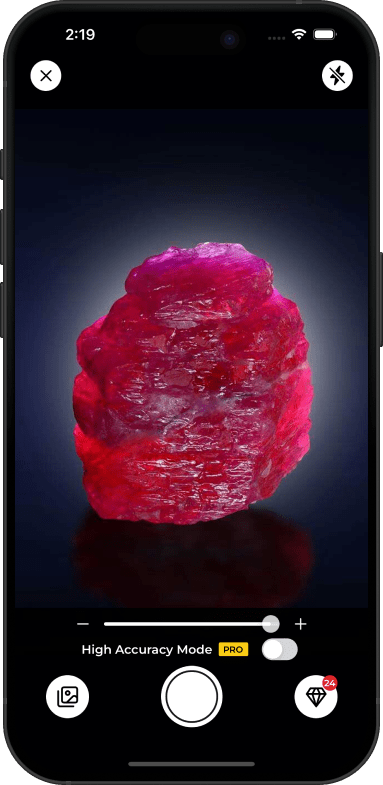
Identify Lizardite Instantly
- Snap a photo, get instant results
- 6,700+ rocks, minerals & crystals
- Discover collecting spots near you
Lizardite FAQs
How do I identify Lizardite?
Lizardite can be identified by its hardness of 2.5 on the Mohs scale, Green color. Look for these key characteristics when examining specimens.
What color is Lizardite?
Lizardite typically appears in Green, light yellow to white. Color can vary depending on impurities and formation conditions.
How hard is Lizardite?
Lizardite has a hardness of 2.5 on the Mohs scale. This makes it a soft mineral that can be scratched easily.
What is the composition of lizardite of Lizardite?
Space Group Ccm21. Unit Cell: a = 5.31 Å, b = 9.19 Å, c = 14.50 Å
