Moldavite
A variety of Tektite

What is Moldavite?
Moldavite is a natural glass that was formed as a result of a meteorite impact that occurred 15 million years ago in Europe. Being very rare and difficult to mine, moldavite is very valuable and extremely prized among collectors. Fragile just like any glass, it's commonly used with jewelry that doesn't face potential impact.
Uses & Applications
Moldavite is a very rare glassy mineral that is highly prized and sought after by mineral collectors and museums. The more translucent an example of this mineral, the more desirable and valuable it is. Despite its relative softness, this mineral is used in the jewelry industry mainly for uncut pendants. Beware, though — there are many imitations.
Healing Properties
Try clasping moldavite in the palm of your hand. Can you feel a rush of energy through your body? It's said to create an inner excitement that warms the body and soul. Moldavite is supposedly an emotional healing stone that brings forward suppressed emotions and allows you to deal with them, so they no longer negatively impact your life.
Optical Properties
- Refractive Index
- 1.48-1.54
- Pleochroism
- None
- Optical Character
- Isotropic
Discover Values
Market Value Factors
Pricing varies for every rock and mineral, so use these universal factors to gauge Moldavite before comparing listings or appraisals.
Size & Weight
Larger, intact specimens usually command higher prices.
Rarity & Demand
Scarce material or popular varieties sell at a premium.
Condition & Finish
Chips, repairs, and heavy wear lower value; clean prep helps.
Treatment & Provenance
Untreated specimens with documented locality are prized.
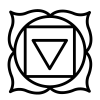
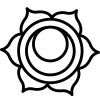
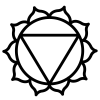
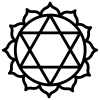
Associated Chakras

Key Characteristics
Composition of Moldavite
SiO2, Al2O3, Fe2O3, CaO, MgO, K₂O, Na₂O, H₂O
Health & Safety Information
- ⚠️Quartz, silica, crystalline silica and flint are non-toxic materials, but very fine dust containing quartz, known as respirable crystalline silicon (RCS), can cause serious and fatal lung disease. Lapidaries should exercise caution when cutting silica.
More Images

Quick Facts
Physical Properties
- Color
- Green
- Hardness (Mohs)
- 5 - 5.5
- Rock tumbling
- With care
- Density
- 2.32 - 2.38 g/cm³
- Streak
- White
- Luster
- Vitreous
Chemical Properties
- Chemical Formula
- SiO2(+Al2O3)
- Elements
- Si, O, Al
Identify Moldavite Instantly
- Snap a photo, get instant results
- 6,700+ rocks, minerals & crystals
- Discover collecting spots near you
Moldavite FAQs
How do I identify Moldavite?
Moldavite can be identified by its hardness of 5 - 5.5 on the Mohs scale, Green color, Vitreous luster. Look for these key characteristics when examining specimens.
What color is Moldavite?
Moldavite typically appears in Green. Color can vary depending on impurities and formation conditions.
How hard is Moldavite?
Moldavite has a hardness of 5 - 5.5 on the Mohs scale. This gives it moderate hardness.
What is the composition of moldavite of Moldavite?
SiO2, Al2O3, Fe2O3, CaO, MgO, K₂O, Na₂O, H₂O