Muscovite
A variety of Dioctahedral mica Group

What is Muscovite?
Muscovite is a common member of the mica family that often forms thin, shimmering, highly fragile sheets. As the mineral associates with all types of rocks and boasts a global distribution, if you've spent a fair amount of time outside, you've probably seen some muscovite! When ground or processed into sheets, this mineral is a component in plastics, rubbers, asphalt roofing, paint, and a whole host of specialized engineering and electronics components.
Etymology & Origins
The name muscovite comes from Muscovy-glass, a name given to the mineral in Elizabethan England due to its use in medieval Russia (Muscovy) as a cheaper alternative to glass in windows. This usage became widely known in England during the sixteenth century with its first mention appearing in letters by George Turberville, the secretary of England's ambassador to the Muscovite tsar Ivan the Terrible, in 1568.
Uses & Applications
Muscovite, like many micaceous minerals, is has many uses in construction. It is often incorporated with gypsum to reinforce sheet rock, and can be used to reinforce other materials such as rubber used in tires. Muscovite is also a good insulator in electrical devices.
Healing Properties
Muscovite is believed to help reveal a person's true self, allowing them to open their heart to a deeper love and understanding of others. Often used on the Third Eye and Crown chakra, it is said to help a person with everyday decision making and living a purposeful life. The vibrations from the stone are believed to open channels between a person and their spirit guide.
Optical Properties
- Refractive Index
- 1.552-1.618
- Pleochroism
- Weak
- Optical Character
- Biaxial negative
Discover Values
Market Value Factors
Pricing varies for every rock and mineral, so use these universal factors to gauge Muscovite before comparing listings or appraisals.
Size & Weight
Larger, intact specimens usually command higher prices.
Rarity & Demand
Scarce material or popular varieties sell at a premium.
Condition & Finish
Chips, repairs, and heavy wear lower value; clean prep helps.
Treatment & Provenance
Untreated specimens with documented locality are prized.
Where to Find Muscovite
RockHoundR, the free-to-download rockhounding map from the Ruby Glint team, shows where collectors find muscovite in the US, with land-access notes for BLM land and national forests. Collecting is banned in national parks.
See where to find muscoviteAlways check the local rules and get the landowner's permission before you collect.
The Meaning
Muscovite is said to have been used in magic. It was believed to enhance a witch’s psychic powers. These witches would supposedly use the gemstone to assist with their magical visions. Muscovite is also said to have been used by witches when they wished to speak with spirits.
Associated Chakras


Key Characteristics
Rock Types of Muscovite
The green, chromium-rich variety is called fuchsite; mariposite is also a chromium-rich type of muscovite.
Characteristics of Muscovite
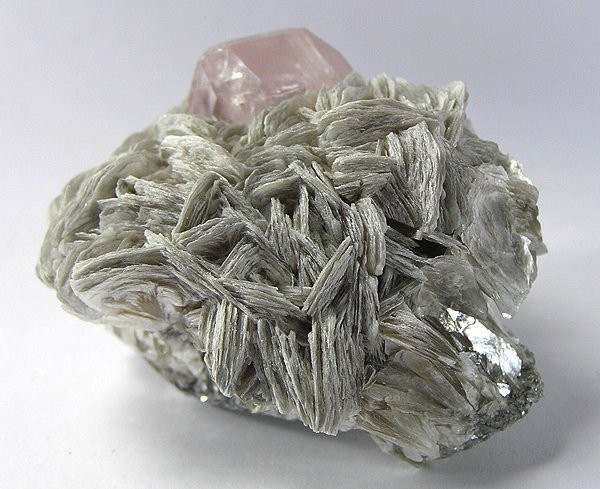
It has a highly perfect basal cleavage yielding remarkably thin laminae (sheets) which are often highly elastic. Muscovite has a Mohs hardness of 2–2.25 parallel to the [001] face, 4 perpendicular to the [001] and a specific gravity of 2.76–3. It can be colorless or tinted through grays, browns, greens, yellows, or (rarely) violet or red, and can be transparent or translucent. It is anisotropic and has high birefringence. Its crystal system is monoclinic.
More Images

Quick Facts
Physical Properties
- Color
- White, colorless, silvery-white
- Hardness (Mohs)
- 2.5
- Rock tumbling
- Not recommended
- Density
- 2.83 g/cm³
- Streak
- White
- Luster
- Pearly, Vitreous, Silky
- Crystal System
- Monoclinic
Chemical Properties
- Chemical Formula
- KAl2(AlSi3O10)(OH)2
- Elements
- Al, H, K, O, Si
Also Known As
Identify Muscovite Instantly
- Snap a photo, get instant results
- 6,700+ rocks, minerals & crystals
- Discover collecting spots near you
Muscovite FAQs
How do I identify Muscovite?
Muscovite can be identified by its hardness of 2.5 on the Mohs scale, White color, Pearly, Vitreous, Silky luster, Monoclinic crystal system. Look for these key characteristics when examining specimens.
What color is Muscovite?
Muscovite typically appears in White, colorless, silvery-white. Color can vary depending on impurities and formation conditions.
How hard is Muscovite?
Muscovite has a hardness of 2.5 on the Mohs scale. This makes it a soft mineral that can be scratched easily.
What is the rock types of muscovite of Muscovite?
The green, chromium-rich variety is called fuchsite; mariposite is also a chromium-rich type of muscovite.
What is the characteristics of muscovite of Muscovite?
It has a highly perfect basal cleavage yielding remarkably thin laminae (sheets) which are often highly elastic. Muscovite has a Mohs hardness of 2–2.25 parallel to the [001] face, 4 perpendicular to the [001] and a specific gravity of 2.76–3. It can be colorless or tinted through grays, browns, greens, yellows, or (rarely) violet or red, and can be transparent or translucent. It is anisotropic and has high birefringence. Its crystal system is monoclinic.