Selenite (Gypsum)
Selenite
A variety of Gypsum
What is Selenite (Gypsum)?
Selenite (Gypsum) is a transparent and colorless variety of gypsum. This mineral is very soft according to the Mohs scale of hardness and can be scratched with a fingernail. selenite (Gypsum) may sometimes show fluorescence.
Optical Properties
- Refractive Index
- 1.521-1.531
- Birefringence
- 0.01
- Pleochroism
- None
- Optical Character
- Biaxial positive
Discover Values
Market Value Factors
Pricing varies for every rock and mineral, so use these universal factors to gauge Selenite (Gypsum) before comparing listings or appraisals.
Size & Weight
Larger, intact specimens usually command higher prices.
Rarity & Demand
Scarce material or popular varieties sell at a premium.
Condition & Finish
Chips, repairs, and heavy wear lower value; clean prep helps.
Treatment & Provenance
Untreated specimens with documented locality are prized.
Where to Find Selenite (Gypsum)
Selenite (Gypsum) is a variety of Gypsum. RockHoundR, the free-to-download rockhounding map from the Ruby Glint team, shows where collectors find gypsum in the US, with land-access notes for BLM land and national forests. Collecting is banned in national parks.
See where to find gypsumAlways check the local rules and get the landowner's permission before you collect.
Key Characteristics
Rock Types of Selenite (Gypsum)
Gypsum is found as different varieties in nature. The transparent and cleavable variety is called selenite. The silky and fibrous variety is commonly called satin spar. The granular and massive variety is named as alabaster. In arid areas, gypsum can occur in a flower-like form, typically opaque, with embedded sand grains called desert rose.
Characteristics of Selenite (Gypsum)
Gypsum is moderately water-soluble (~2.0–2.5 g/l at 25 °C) and, in contrast to most other salts, it exhibits retrograde solubility, becoming less soluble at higher temperatures. When gypsum is heated in air it loses water and converts first to calcium sulfate hemihydrate, (bassanite, often simply called "plaster") and, if heated further, to anhydrous calcium sulfate (anhydrite). As with anhydrite, the solubility of gypsum in saline solutions and in brines is also strongly dependent on NaCl (common table salt) concentration. The structure of gypsum consists of layers of calcium (Ca) and sulfate (SO4) ions tightly bound together. These layers are bonded by sheets of anion water molecules via weaker hydrogen bonding, which gives the crystal perfect cleavage along the sheets (in the {010} plane).
Formation of Selenite (Gypsum)
Gypsum is a common mineral, with thick and extensive evaporite beds in association with sedimentary rocks. Deposits are known to occur in strata from as far back as the Archaean eon. Gypsum is deposited from lake and sea water, as well as in hot springs, from volcanic vapors, and sulfate solutions in veins. Hydrothermal anhydrite in veins is commonly hydrated to gypsum by groundwater in near-surface exposures. It is often associated with the minerals halite and sulfur. Gypsum is the most common sulfate mineral. Pure gypsum is white, but other substances found as impurities may give a wide range of colors to local deposits. Because gypsum dissolves over time in water, gypsum is rarely found in the form of sand. However, the unique conditions of the White Sands National Park in the US state of New Mexico have created a 710 km (270 sq mi) expanse of white gypsum sand, enough to supply the US construction industry with drywall for 1,000 years. Commercial exploitation of the area, strongly opposed by area residents, was permanently prevented in 1933 when President Herbert Hoover declared the gypsum dunes a protected national monument. Gypsum is also formed as a by-product of sulfide oxidation, amongst others by pyrite oxidation, when the sulfuric acid generated reacts with calcium carbonate. Its presence indicates oxidizing conditions. Under reducing conditions, the sulfates it contains can be reduced back to sulfide by sulfate-reducing bacteria. This can lead to accumulation of elemental sulfur in oil-bearing formations, such as salt domes, where it can be mined using the Frasch process Electric power stations burning coal with flue gas desulfurization produce large quantities of gypsum as a byproduct from the scrubbers. Orbital pictures from the Mars Reconnaissance Orbiter (MRO) have indicated the existence of gypsum dunes in the northern polar region of Mars, which were later confirmed at ground level by the Mars Exploration Rover (MER) Opportunity.
Health & Safety Information
- ⚠️People can be exposed to gypsum in the workplace by breathing it in, skin contact, and eye contact. Calcium sulfate per se is nontoxic and is even approved as a food additive, but as powdered gypsum, it can irritate skin and mucous membranes. United States The Occupational Safety and Health Administration (OSHA) has set the legal limit (permissible exposure limit) for gypsum exposure in the workplace as TWA 15 mg/m³ for total exposure and TWA 5 mg/m³ for respiratory exposure over an 8-hour workday. The National Institute for Occupational Safety and Health (NIOSH) has set a recommended exposure limit (REL) of TWA 10 mg/m³ for total exposure and TWA 5 mg/m³ for respiratory exposure over an 8-hour workday.
Quick Facts
Physical Properties
- Color
- Colourless, light tints
- Hardness (Mohs)
- 2
- Rock tumbling
- Not recommended
- Density
- 2.312 - 2.322 g/cm³
- Streak
- White
- Luster
- Vitreous
- Crystal System
- Monoclinic
Chemical Properties
- Chemical Formula
- CaSO4 · 2H2O
- Elements
- Ca, H, O, S
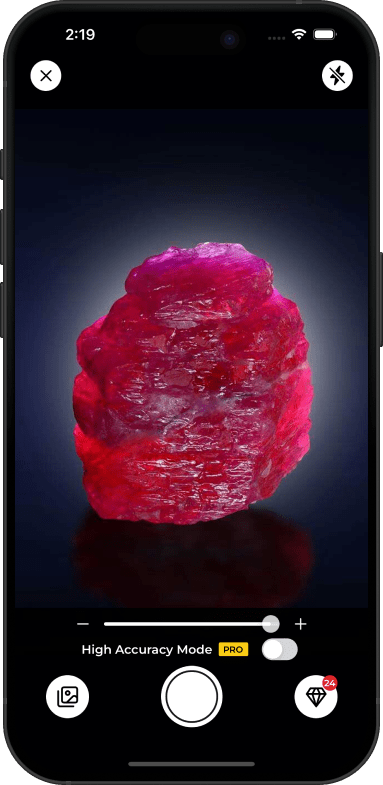
Identify Selenite (Gypsum) Instantly
- Snap a photo, get instant results
- 6,700+ rocks, minerals & crystals
- Discover collecting spots near you
Selenite (Gypsum) FAQs
How do I identify Selenite (Gypsum)?
Selenite (Gypsum) can be identified by its hardness of 2 on the Mohs scale, Colourless color, Vitreous luster, Monoclinic crystal system. Look for these key characteristics when examining specimens.
What color is Selenite (Gypsum)?
Selenite (Gypsum) typically appears in Colourless, light tints. Color can vary depending on impurities and formation conditions.
How hard is Selenite (Gypsum)?
Selenite (Gypsum) has a hardness of 2 on the Mohs scale. This makes it a soft mineral that can be scratched easily.
What is the rock types of selenite (gypsum) of Selenite (Gypsum)?
Gypsum is found as different varieties in nature. The transparent and cleavable variety is called selenite. The silky and fibrous variety is commonly called satin spar. The granular and massive variety is named as alabaster. In arid areas, gypsum can occur in a flower-like form, typically opaque, with embedded sand grains called desert rose.
What is the characteristics of selenite (gypsum) of Selenite (Gypsum)?
Gypsum is moderately water-soluble (~2.0–2.5 g/l at 25 °C) and, in contrast to most other salts, it exhibits retrograde solubility, becoming less soluble at higher temperatures. When gypsum is heated in air it loses water and converts first to calcium sulfate hemihydrate, (bassanite, often simply called "plaster") and, if heated further, to anhydrous calcium sulfate (anhydrite). As with anhydrite, the solubility of gypsum in saline solutions and in brines is also strongly dependent on NaCl (common table salt) concentration. The structure of gypsum consists of layers of calcium (Ca) and sulfate (SO4) ions tightly bound together. These layers are bonded by sheets of anion water molecules via weaker hydrogen bonding, which gives the crystal perfect cleavage along the sheets (in the {010} plane).
What is the formation of selenite (gypsum) of Selenite (Gypsum)?
Gypsum is a common mineral, with thick and extensive evaporite beds in association with sedimentary rocks. Deposits are known to occur in strata from as far back as the Archaean eon. Gypsum is deposited from lake and sea water, as well as in hot springs, from volcanic vapors, and sulfate solutions in veins. Hydrothermal anhydrite in veins is commonly hydrated to gypsum by groundwater in near-surface exposures. It is often associated with the minerals halite and sulfur. Gypsum is the most common sulfate mineral. Pure gypsum is white, but other substances found as impurities may give a wide range of colors to local deposits. Because gypsum dissolves over time in water, gypsum is rarely found in the form of sand. However, the unique conditions of the White Sands National Park in the US state of New Mexico have created a 710 km (270 sq mi) expanse of white gypsum sand, enough to supply the US construction industry with drywall for 1,000 years. Commercial exploitation of the area, strongly opposed by area residents, was permanently prevented in 1933 when President Herbert Hoover declared the gypsum dunes a protected national monument. Gypsum is also formed as a by-product of sulfide oxidation, amongst others by pyrite oxidation, when the sulfuric acid generated reacts with calcium carbonate. Its presence indicates oxidizing conditions. Under reducing conditions, the sulfates it contains can be reduced back to sulfide by sulfate-reducing bacteria. This can lead to accumulation of elemental sulfur in oil-bearing formations, such as salt domes, where it can be mined using the Frasch process Electric power stations burning coal with flue gas desulfurization produce large quantities of gypsum as a byproduct from the scrubbers. Orbital pictures from the Mars Reconnaissance Orbiter (MRO) have indicated the existence of gypsum dunes in the northern polar region of Mars, which were later confirmed at ground level by the Mars Exploration Rover (MER) Opportunity.