Stibnite
A variety of Stibnite Group
What is Stibnite?
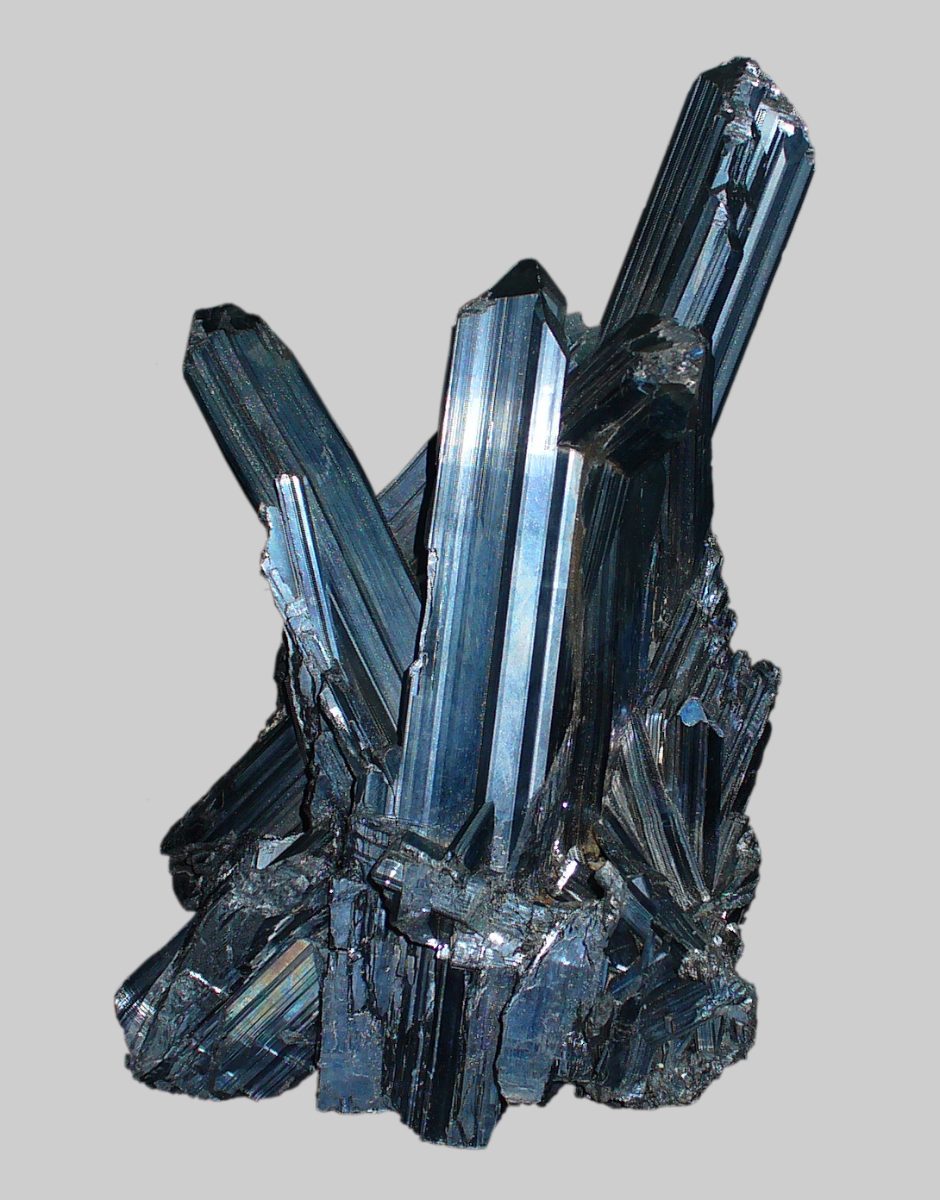
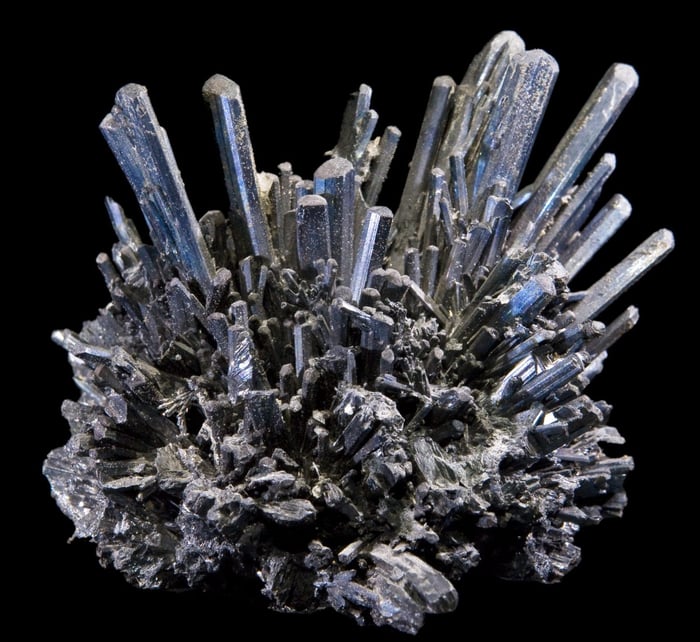
Stibnite is an uncommon mineral with an almost otherworldly appearance - it forms long, dark grey crystals with a strong metallic sheen. It was used by ancient Egyptians as a cosmetic around the eyes, referred to as "kohl." Today, stibnite is mined for its antimony content. That element is used in the manufacture of fireworks and matches, among other products.
Etymology & Origins
The name is from the Greek στίβι stibi through the Latin stibium as the old name for the mineral and the element antimony.
Uses & Applications
Stibnite was historically used as a metallic powder applied as eye shadow, though today it is the primary ore for antimony. The antimony mined from stibnite is further used in batteries and semiconductors, and can be used to make flame retardant materials like paint and pottery.
Healing Properties
Stibnite is believed to have transformative energy that helps to align all the chakras, allowing the individual to realize their aspirations and move positively toward their personal goals. It is said that by carrying it or keeping it in your home, it will help to attract the things in life that are most desirable to you. Combining it with other stones is believed to increase its power.
Market Value Factors
Pricing varies for every rock and mineral, so use these universal factors to gauge Stibnite before comparing listings or appraisals.
Size & Weight
Larger, intact specimens usually command higher prices.
Rarity & Demand
Scarce material or popular varieties sell at a premium.
Condition & Finish
Chips, repairs, and heavy wear lower value; clean prep helps.
Treatment & Provenance
Untreated specimens with documented locality are prized.
Associated Chakras

Key Characteristics
Characteristics of Stibnite
The melting point of Sb2S3 is 823 K. The band gap is 1.88 eV at room temperature and it is a photoconductor.
Formation of Stibnite
Stibnite occurs in hydrothermal deposits and is associated with realgar, orpiment, cinnabar, galena, pyrite, marcasite, arsenopyrite, cervantite, stibiconite, calcite, ankerite, barite and chalcedony. Small deposits of stibnite are common, but large deposits are rare. It occurs in Canada, Mexico, Peru, Japan, China, Germany, Romania, Italy, France, England, Algeria, and Kalimantan, Borneo. In the United States it is found in Arkansas, Idaho, Nevada, California, and Alaska. As of May 2007, the largest specimen on public display (1000 pounds) is at the American Museum of Natural History. The largest documented single crystals of stibnite measured ~60×5×5 cm and originated from different locations including Japan, France and Germany.
Composition of Stibnite
Stibnite has a structure similar to that of arsenic trisulfide, As2S3. The Sb(III) centers, which are pyramidal and three-coordinate, are linked via bent two-coordinate sulfide ions. However, recent studies confirm that the actual coordination polyhedra of antimony are in fact SbS7, with (3+4) coordination at the M1 site and (5+2) at the M2 site. Some of the secondary bonds impart cohesion and are connected with packing. Stibnite is grey when fresh, but can turn superficially black due to oxidation in air.
Health & Safety Information
- ⚠️Stibnite dust is toxic because it contains heavy metals Antimony.
- ⚠️It's advisable to handle stibnite carefully to avoid generating dust and wash hands thoroughly afterward. When cutting or polishing stibnite, wear a dust mask to prevent inhaling heavy metal particles. Store stibnite in a sealed container in a well-ventilated area, away from children and pets. For those involved in crystal healing, never put it in your mouth.
More Images
Quick Facts
Physical Properties
- Color
- Lead-gray with pale blue tint
- Hardness (Mohs)
- 2
- Rock tumbling
- Not recommended
- Density
- 4.625 g/cm³
- Streak
- Lead grey
- Luster
- Metallic
- Crystal System
- Orthorhombic
Chemical Properties
- Chemical Formula
- Sb2S3
- Elements
- S, Sb
Also Known As
Identify Stibnite Instantly
- Snap a photo, get instant results
- 6,700+ rocks, minerals & crystals
- Discover collecting spots near you
Stibnite FAQs
How do I identify Stibnite?
Stibnite can be identified by its hardness of 2 on the Mohs scale, Lead-gray with pale blue tint color, Metallic luster, Orthorhombic crystal system. Look for these key characteristics when examining specimens.
What color is Stibnite?
Stibnite typically appears in Lead-gray with pale blue tint. Color can vary depending on impurities and formation conditions.
How hard is Stibnite?
Stibnite has a hardness of 2 on the Mohs scale. This makes it a soft mineral that can be scratched easily.
What is the characteristics of stibnite of Stibnite?
The melting point of Sb2S3 is 823 K. The band gap is 1.88 eV at room temperature and it is a photoconductor.
What is the formation of stibnite of Stibnite?
Stibnite occurs in hydrothermal deposits and is associated with realgar, orpiment, cinnabar, galena, pyrite, marcasite, arsenopyrite, cervantite, stibiconite, calcite, ankerite, barite and chalcedony. Small deposits of stibnite are common, but large deposits are rare. It occurs in Canada, Mexico, Peru, Japan, China, Germany, Romania, Italy, France, England, Algeria, and Kalimantan, Borneo. In the United States it is found in Arkansas, Idaho, Nevada, California, and Alaska. As of May 2007, the largest specimen on public display (1000 pounds) is at the American Museum of Natural History. The largest documented single crystals of stibnite measured ~60×5×5 cm and originated from different locations including Japan, France and Germany.
What is the composition of stibnite of Stibnite?
Stibnite has a structure similar to that of arsenic trisulfide, As2S3. The Sb(III) centers, which are pyramidal and three-coordinate, are linked via bent two-coordinate sulfide ions. However, recent studies confirm that the actual coordination polyhedra of antimony are in fact SbS7, with (3+4) coordination at the M1 site and (5+2) at the M2 site. Some of the secondary bonds impart cohesion and are connected with packing. Stibnite is grey when fresh, but can turn superficially black due to oxidation in air.