Sunstone
A variety of Oligoclase

What is Sunstone?
Sunstone is a type of feldspar that can often be yellow, orange or red and have a distinctive glitter called aventurescence. The most famous deposits in the United States are located in Oregon. Sunstone's lack of hardness means it is most often used for earrings, small pendants, and beads and is rarely subject to rough wear.
Uses & Applications
Sunstone is set into rings and used for earrings and necklaces. Smaller pieces of the stone often decorate spas and meditation centers. Along with being carved into beads and cabochons, the stone is also used for small figurines and sculptures. Clear pieces are used to make faceted jewelry stones.
Healing Properties
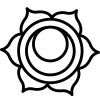
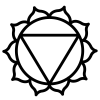
Sunstone is an energizing stone that activates all of the chakras. Its positive energy is thought to attract romance, happiness, and success. Along the way, it also alleviates fear, encourages independence, and improves self-esteem. Wear it as jewelry for constant effects, use it for meditation for specific areas, or keep it in the home for balance and stability.
Optical Properties
- Refractive Index
- 1.525-1.552
- Birefringence
- 0.007-0.010
- Pleochroism
- Weak or absent
- Optical Character
- Biaxial negative
Discover Values
Market Value Factors
Pricing varies for every rock and mineral, so use these universal factors to gauge Sunstone before comparing listings or appraisals.
Size & Weight
Larger, intact specimens usually command higher prices.
Rarity & Demand
Scarce material or popular varieties sell at a premium.
Condition & Finish
Chips, repairs, and heavy wear lower value; clean prep helps.
Treatment & Provenance
Untreated specimens with documented locality are prized.
The Meaning
Commonly associated with and named after the Sun, sunstone has been used by Vikings as a talisman on their journeys. According to Native American lore, this stone was formed on the place where a warrior was wounded - his blood fell on the rocks and a beautiful sunstone was created.
Associated Chakras
Key Characteristics
Characteristics of Sunstone
The optical effect appears to be due to reflections from inclusions of red copper, in the form of minute scales, which are hexagonal, rhombic, or irregular in shape, and are disposed parallel to the principal cleavage-plane. These inclusions give the stone an appearance something like that of aventurine, hence sunstone is known also as "aventurine-feldspar". The optical effect called schiller and the color in Oregon Sunstone is due to copper. The middle part of this crystal sparkles, and usually the color is darkest in the middle and becomes lighter toward the outer edges. The feldspar which usually displays the aventurine appearance is oligoclase, though the effect is sometimes seen in orthoclase: hence two kinds of sunstone are distinguished as "oligoclase sunstone" and "orthoclase sunstone".
More Images


Quick Facts
Physical Properties
- Color
- Orange, yellow, red, green, colorless, brown and copper shiller
- Hardness (Mohs)
- 6 - 6.5
- Rock tumbling
- With care
- Density
- 2.64 - 2.66 g/cm³
- Streak
- white
- Luster
- Vitreous
- Crystal System
- Triclinic
Chemical Properties
- Chemical Formula
- (Ca, Na)(Al, Si)2Si2O8
- Elements
- Na, Al, Si, O, Ca
Also Known As
Identify Sunstone Instantly
- Snap a photo, get instant results
- 6,700+ rocks, minerals & crystals
- Discover collecting spots near you
Sunstone FAQs
How do I identify Sunstone?
Sunstone can be identified by its hardness of 6 - 6.5 on the Mohs scale, Orange color, Vitreous luster, Triclinic crystal system. Look for these key characteristics when examining specimens.
What color is Sunstone?
Sunstone typically appears in Orange, yellow, red, green, colorless, brown and copper shiller. Color can vary depending on impurities and formation conditions.
How hard is Sunstone?
Sunstone has a hardness of 6 - 6.5 on the Mohs scale. This gives it moderate hardness.
What is the characteristics of sunstone of Sunstone?
The optical effect appears to be due to reflections from inclusions of red copper, in the form of minute scales, which are hexagonal, rhombic, or irregular in shape, and are disposed parallel to the principal cleavage-plane. These inclusions give the stone an appearance something like that of aventurine, hence sunstone is known also as "aventurine-feldspar". The optical effect called schiller and the color in Oregon Sunstone is due to copper. The middle part of this crystal sparkles, and usually the color is darkest in the middle and becomes lighter toward the outer edges. The feldspar which usually displays the aventurine appearance is oligoclase, though the effect is sometimes seen in orthoclase: hence two kinds of sunstone are distinguished as "oligoclase sunstone" and "orthoclase sunstone".