Zircon
A variety of Zircon Group

What is Zircon?
Not to be confused with cubic zirconia, zircon is its very own, unique mineral and can appear in a brilliant variation of colors. To date, zircon is considered the oldest mineral found on earth and is estimated to be over 4 billion years old! It's incredibly resistant to heat and can withstand acid, making it perfect for glass-making and ceramics.
Etymology & Origins
The name derives from the Persian zargun, meaning "gold-hued". This word is corrupted into "jargoon", a term applied to light-colored zircons. The English word "zircon" is derived from Zirkon, which is the German adaptation of this word. Yellow, orange and red zircon is also known as "hyacinth", from the flower hyacinthus, whose name is of Ancient Greek origin.
Uses & Applications
Zircon has been a popular gemstone for thousands of years, and is also used in refractory materials, ceramic production, whitening agents, and pigments. Furthermore, zircon is the oldest mineral on Earth, making it a crucial mineral used for radioactive dating. It is also an important ore of zirconium metal and zirconium dioxide.
Healing Properties
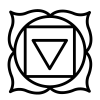
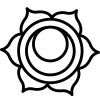
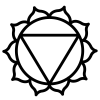
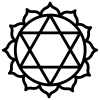
Zircon is considered a grounding stone that can help with organizational skills and perseverance. It helps to improve focus and allows a person to move closer to their goals. Its positive energies work to help a person examine matters with better clarity, removing personal preferences which might hinder decision making. It activates and aligns all of the chakras, providing positive energy to the mind, body and spirit.
Optical Properties
- Refractive Index
- 1.810-2.024
- Birefringence
- 0.045-0.059
- Pleochroism
- Red zircon - distinct: purplish-red, reddish-brown
- Orange/brown zircon - weak: yellow-brown, red-brown
- Yellow zircon - weak: honey-yellow, brown-yellow
- Blue zircon - strong: colorless to gray, blue
- Green zircon - weak: brownish-green, green
- Optical Character
- Biaxial positive
- Dispersion
- 0.039
Discover Values
Market Value Factors
Pricing varies for every rock and mineral, so use these universal factors to gauge Zircon before comparing listings or appraisals.
Size & Weight
Larger, intact specimens usually command higher prices.
Rarity & Demand
Scarce material or popular varieties sell at a premium.
Condition & Finish
Chips, repairs, and heavy wear lower value; clean prep helps.
Treatment & Provenance
Untreated specimens with documented locality are prized.
Where to Find Zircon
RockHoundR, the free-to-download rockhounding map from the Ruby Glint team, shows where collectors find zircon in the US, with land-access notes for BLM land and national forests. Collecting is banned in national parks.
See where to find zirconAlways check the local rules and get the landowner's permission before you collect.
The Meaning
One of the birthstones of December, zircon is also one of the oldest stones discovered on Earth. Its name is derived from the Persian word for "gold-colored," and is thought to be the ore used to make up the leaves of Hinduism's Kalpavriksha tree.
Associated Chakras
Key Characteristics
Characteristics of Zircon
Zircon is common in the crust of Earth. It occurs as a common accessory mineral in igneous rocks (as primary crystallization products), in metamorphic rocks and as detrital grains in sedimentary rocks. Large zircon crystals are rare. Their average size in granite rocks is about 0.1–0.3 mm, but they can also grow to sizes of several centimeters, especially in mafic pegmatites and carbonatites. Zircon is also very resistant to heat and corrosion. Because of their uranium and thorium content, some zircons undergo metamictization. Connected to internal radiation damage, these processes partially disrupt the crystal structure and partly explain the highly variable properties of zircon. As zircon becomes more and more modified by internal radiation damage, the density decreases, the crystal structure is compromised, and the color changes. Zircon occurs in many colors, including reddish brown, yellow, green, blue, gray and colorless. The color of zircons can sometimes be changed by heat treatment. Common brown zircons can be transformed into colorless and blue zircons by heating to 800 to 1000 °C. In geological settings, the development of pink, red, and purple zircon occurs after hundreds of millions of years, if the crystal has sufficient trace elements to produce color centers. Color in this red or pink series is annealed in geological conditions above temperatures of around 400 °C.
Formation of Zircon
Zircon is a common accessory to trace mineral constituent of most granite and felsic igneous rocks. Due to its hardness, durability and chemical inertness, zircon persists in sedimentary deposits and is a common constituent of most sands. Zircon is rare within mafic rocks and very rare within ultramafic rocks aside from a group of ultrapotassic intrusive rocks such as kimberlites, carbonatites, and lamprophyre, where zircon can occasionally be found as a trace mineral owing to the unusual magma genesis of these rocks. Zircon forms economic concentrations within heavy mineral sands ore deposits, within certain pegmatites, and within some rare alkaline volcanic rocks, for example the Toongi Trachyte, Dubbo, New South Wales Australia in association with the zirconium-hafnium minerals eudialyte and armstrongite. Australia leads the world in zircon mining, producing 37% of the world total and accounting for 40% of world EDR (economic demonstrated resources) for the mineral. South Africa is Africa's main producer, with 30% of world production, second after Australia.
Health & Safety Information
- ⚠️Zircon is toxic due to its Radioactivity.
- ⚠️Most zircons are safe to wear, but some may contain small amounts of radioactive uranium and thorium, especially the low or metamict variety (green, brown, orange). It's good for gem cutters to check the radioactivity of zircons using a Geiger counter before working on them.
- ⚠️Zircon may contain trace amounts of uranium-238, resulting in slight radioactivity that's safe for jewelry. However, if you plan to cut or polish zircon, wear gloves and a mask to avoid skin and lung exposure to its dust. Afterward, wash your hands thoroughly. Store it in a sealed container away from children and pets to prevent accidental ingestion.
More Images

Quick Facts
Physical Properties
- Color
- Colourless, yellow, grey, reddish-brown, green, brown, black
- Hardness (Mohs)
- 7.5
- Rock tumbling
- With care
- Density
- 4.714 g/cm³
- Streak
- White
- Luster
- Greasy, Vitreous, Adamantine
- Crystal System
- Tetragonal
Chemical Properties
- Chemical Formula
- Zr(SiO4)
- Elements
- O, Si, Zr
Also Known As
Identify Zircon Instantly
- Snap a photo, get instant results
- 6,700+ rocks, minerals & crystals
- Discover collecting spots near you
Zircon FAQs
How do I identify Zircon?
Zircon can be identified by its hardness of 7.5 on the Mohs scale, Colourless color, Greasy, Vitreous, Adamantine luster, Tetragonal crystal system. Look for these key characteristics when examining specimens.
What color is Zircon?
Zircon typically appears in Colourless, yellow, grey, reddish-brown, green, brown, black. Color can vary depending on impurities and formation conditions.
How hard is Zircon?
Zircon has a hardness of 7.5 on the Mohs scale. This makes it a relatively hard mineral suitable for jewelry.
What is the characteristics of zircon of Zircon?
Zircon is common in the crust of Earth. It occurs as a common accessory mineral in igneous rocks (as primary crystallization products), in metamorphic rocks and as detrital grains in sedimentary rocks. Large zircon crystals are rare. Their average size in granite rocks is about 0.1–0.3 mm, but they can also grow to sizes of several centimeters, especially in mafic pegmatites and carbonatites. Zircon is also very resistant to heat and corrosion. Because of their uranium and thorium content, some zircons undergo metamictization. Connected to internal radiation damage, these processes partially disrupt the crystal structure and partly explain the highly variable properties of zircon. As zircon becomes more and more modified by internal radiation damage, the density decreases, the crystal structure is compromised, and the color changes. Zircon occurs in many colors, including reddish brown, yellow, green, blue, gray and colorless. The color of zircons can sometimes be changed by heat treatment. Common brown zircons can be transformed into colorless and blue zircons by heating to 800 to 1000 °C. In geological settings, the development of pink, red, and purple zircon occurs after hundreds of millions of years, if the crystal has sufficient trace elements to produce color centers. Color in this red or pink series is annealed in geological conditions above temperatures of around 400 °C.
What is the formation of zircon of Zircon?
Zircon is a common accessory to trace mineral constituent of most granite and felsic igneous rocks. Due to its hardness, durability and chemical inertness, zircon persists in sedimentary deposits and is a common constituent of most sands. Zircon is rare within mafic rocks and very rare within ultramafic rocks aside from a group of ultrapotassic intrusive rocks such as kimberlites, carbonatites, and lamprophyre, where zircon can occasionally be found as a trace mineral owing to the unusual magma genesis of these rocks. Zircon forms economic concentrations within heavy mineral sands ore deposits, within certain pegmatites, and within some rare alkaline volcanic rocks, for example the Toongi Trachyte, Dubbo, New South Wales Australia in association with the zirconium-hafnium minerals eudialyte and armstrongite. Australia leads the world in zircon mining, producing 37% of the world total and accounting for 40% of world EDR (economic demonstrated resources) for the mineral. South Africa is Africa's main producer, with 30% of world production, second after Australia.