Beryl
A variety of Beryl Group

What is Beryl?
Beryl is an uncommon mineral, although several varieties of it are well-known gemstones. Emerald, aquamarine, and morganite are all beryls, each with minor chemical impurities which give them their green, light blue, and pink hues. Since beryl is somewhat soft and often occurs with inclusions, clear, unchipped specimens and/or gemstones are particularly rare and highly prized.
Etymology & Origins
The name "beryl" is derived (via Latin: beryllus, Old French: beryl, and Middle English: beril) from Greek βήρυλλος beryllos which referred to a "precious blue-green color-of-sea-water stone"; from Prakrit verulia, veluriya ("beryl"), from Sanskrit वैडूर्य vaiḍūrya "brought from Vidûra" (originally lapis lazuli) which is ultimately of Dravidian origin, maybe from the name of Belur or "Velur" a town in Karnataka, southern India. The term was later adopted for the mineral beryl more exclusively. When the first eyeglasses were constructed in 13th century Italy, the lenses were made of beryl (or of rock crystal) as glass could not be made clear enough. Consequently, glasses were named Brillen in German (bril in Dutch and briller in Danish).
Uses & Applications
Beryl is very popularly used in jewelry and also in art. There are six varieties of this mineral, with emerald and aquamarine being the most popular. It is also one of the sources of the element beryllium, which is used by the scientific community for applications such as wiring; however, it is more costly to extract beryllium from this mineral than other sources.
Healing Properties
Beryl is believed to detoxify the body from the negative effects caused by excessive stress and mental exhaustion. It is believed that the stone helps to encourage positive energy to flow through the body and also restores vitality and drive. This stone can be used to align the chakras, bringing a sense of balance and contentment to meet the challenges of daily life.
Optical Properties
- Refractive Index
- 1.560-1.604
- Birefringence
- 0.003-0.010
- Pleochroism
- Red beryl - distinct: orangey-red, purplish-red
- Golden beryl - weak: yellowish, greenish-yellow
- Green beryl - distinct: yellow-green, blue-green
- Optical Character
- Uniaxial negative
- Dispersion
- 0.014
Discover Values
Market Value Factors
Pricing varies for every rock and mineral, so use these universal factors to gauge Beryl before comparing listings or appraisals.
Size & Weight
Larger, intact specimens usually command higher prices.
Rarity & Demand
Scarce material or popular varieties sell at a premium.
Condition & Finish
Chips, repairs, and heavy wear lower value; clean prep helps.
Treatment & Provenance
Untreated specimens with documented locality are prized.
Where to Find Beryl
RockHoundR, the free-to-download rockhounding map from the Ruby Glint team, shows where collectors find beryl in the US, with land-access notes for BLM land and national forests. Collecting is banned in national parks.
See where to find berylAlways check the local rules and get the landowner's permission before you collect.
The Meaning
In ancient Mesopotamia, beryl was prized as a precious stone with the power to strengthen one's belief in gods. According to existing legends, this stone was used as a talisman to ward off evil spirits. In ancient Greece, the stone was believed to have magical healing properties.
Key Characteristics
Rock Types of Beryl
Well-known varieties of beryl include emerald and aquamarine.
Composition of Beryl
Beryl belongs to the hexagonal crystal system. Normally Beryl forms hexagonal columns but can also occur in massive habits. As a cyclosilicate beryl incorporates rings of silicate tetrahedra of Si6O18 that are arranged in columns along the C axis and as parallel layers perpendicular to the C axis, forming channels along the C axis. These channels permit a variety of ions, neutral atoms, and molecules to be incorporated into the crystal thus disrupting the overall charge of the crystal permitting further substitutions in Aluminium, Silicon, and Beryllium sites in the crystal structure. These impurities give rise to the variety of colors of beryl that can be found. Increasing alkali content within the silicate ring channels causes increases to the refractive indices and birefringence.
Health & Safety Information
- ⚠️Beryl is a beryllium compound that is a known carcinogen with acute toxic effects leading to pneumonitis when inhaled. Care must thus be used when mining, handling, and refining these gems.
More Images


Quick Facts
Physical Properties
- Color
- Colorless, green, blue, yellow, white, pink, etc
- Hardness (Mohs)
- 7.5 - 8
- Rock tumbling
- With care
- Density
- 2.63 - 2.92 g/cm³
- Streak
- White
Chemical Properties
- Chemical Formula
- Be3Al2(Si6O18)
- Elements
- Al, Be, O, Si
Also Known As
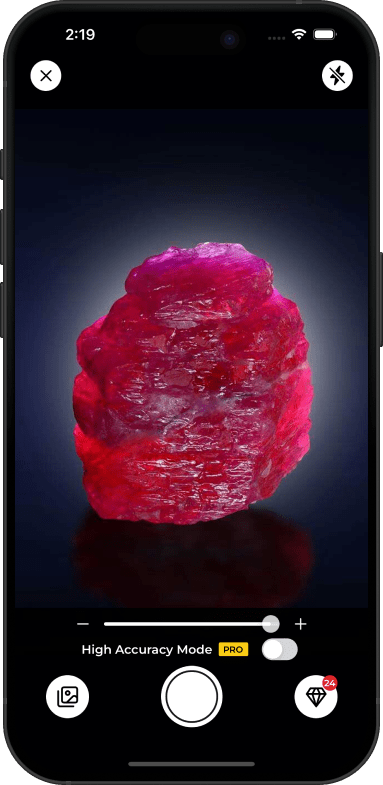
Identify Beryl Instantly
- Snap a photo, get instant results
- 6,700+ rocks, minerals & crystals
- Discover collecting spots near you
Beryl FAQs
How do I identify Beryl?
Beryl can be identified by its hardness of 7.5 - 8 on the Mohs scale, Colorless color. Look for these key characteristics when examining specimens.
What color is Beryl?
Beryl typically appears in Colorless, green, blue, yellow, white, pink, etc. Color can vary depending on impurities and formation conditions.
How hard is Beryl?
Beryl has a hardness of 7.5 - 8 on the Mohs scale. This makes it a relatively hard mineral suitable for jewelry.
What is the rock types of beryl of Beryl?
Well-known varieties of beryl include emerald and aquamarine.
What is the composition of beryl of Beryl?
Beryl belongs to the hexagonal crystal system. Normally Beryl forms hexagonal columns but can also occur in massive habits. As a cyclosilicate beryl incorporates rings of silicate tetrahedra of Si6O18 that are arranged in columns along the C axis and as parallel layers perpendicular to the C axis, forming channels along the C axis. These channels permit a variety of ions, neutral atoms, and molecules to be incorporated into the crystal thus disrupting the overall charge of the crystal permitting further substitutions in Aluminium, Silicon, and Beryllium sites in the crystal structure. These impurities give rise to the variety of colors of beryl that can be found. Increasing alkali content within the silicate ring channels causes increases to the refractive indices and birefringence.
