Pezzottaite
A variety of Beryl Group

What is Pezzottaite?
Pezzottaite is a newer addition to the mineral world and was only discovered deep within Madagascar in 2002. After its first discovery, it was mined extensively and thought to be thoroughly mined out. It wasn't until recently a new cache of this remarkable gem was found in Afghanistan.
Optical Properties
- Refractive Index
- 1.598-1.620
- Birefringence
- 0.007-0.011
- Pleochroism
- Strong: pinkish-orange, purplish-pink
- Optical Character
- Uniaxial negative
Market Value Factors
Pricing varies for every rock and mineral, so use these universal factors to gauge Pezzottaite before comparing listings or appraisals.
Size & Weight
Larger, intact specimens usually command higher prices.
Rarity & Demand
Scarce material or popular varieties sell at a premium.
Condition & Finish
Chips, repairs, and heavy wear lower value; clean prep helps.
Treatment & Provenance
Untreated specimens with documented locality are prized.
Key Characteristics
Characteristics of Pezzottaite
With the exception of hardness (8 on Mohs scale), the physical and optical properties of pezzottaite—i.e., specific gravity 3.10 (average), refractive index 1.601 to 1.620, birefringence 0.008 to 0.011 (uniaxial negative)—are all higher than typical beryl. Pezzottiate is brittle with a conchoidal to irregular fracture, and streaks white. Like beryl, it has an imperfect to fair basal cleavage. Pleochroism is moderate, from pink-orange or purplish pink to pinkish purple. Pezzottaite's absorption spectrum, as seen by a hand-held (direct vision) spectroscope, features a band at 485–500 nm with some specimens showing additional weak lines at 465 and 477 nm and a weak band at 550 to 580 nm.
Quick Facts
Physical Properties
- Color
- Raspberry-red to pink
- Hardness (Mohs)
- 8
- Rock tumbling
- Tumbles well
- Density
- 3.06 g/cm³
- Streak
- colorless to white
- Luster
- Vitreous
- Crystal System
- Trigonal
Chemical Properties
- Chemical Formula
- Cs(Be2Li)Al2(Si6O18)
- Elements
- Al, Be, Cs, Li, O, Si
Also Known As
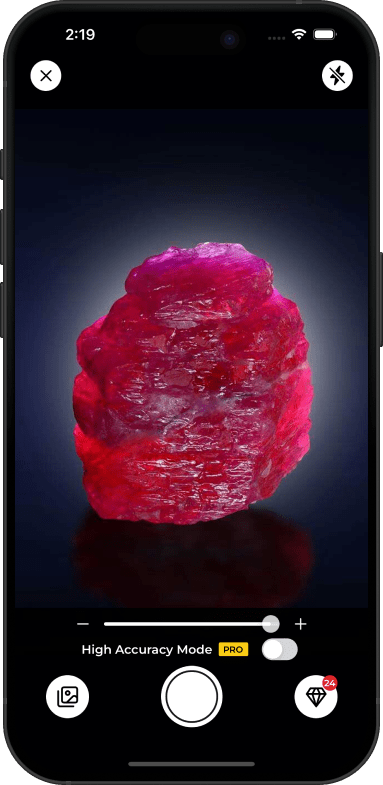
Identify Pezzottaite Instantly
- Snap a photo, get instant results
- 6,700+ rocks, minerals & crystals
- Discover collecting spots near you
Pezzottaite FAQs
How do I identify Pezzottaite?
Pezzottaite can be identified by its hardness of 8 on the Mohs scale, Raspberry-red to pink color, Vitreous luster, Trigonal crystal system. Look for these key characteristics when examining specimens.
What color is Pezzottaite?
Pezzottaite typically appears in Raspberry-red to pink. Color can vary depending on impurities and formation conditions.
How hard is Pezzottaite?
Pezzottaite has a hardness of 8 on the Mohs scale. This makes it a relatively hard mineral suitable for jewelry.
What is the characteristics of pezzottaite of Pezzottaite?
With the exception of hardness (8 on Mohs scale), the physical and optical properties of pezzottaite—i.e., specific gravity 3.10 (average), refractive index 1.601 to 1.620, birefringence 0.008 to 0.011 (uniaxial negative)—are all higher than typical beryl. Pezzottiate is brittle with a conchoidal to irregular fracture, and streaks white. Like beryl, it has an imperfect to fair basal cleavage. Pleochroism is moderate, from pink-orange or purplish pink to pinkish purple. Pezzottaite's absorption spectrum, as seen by a hand-held (direct vision) spectroscope, features a band at 485–500 nm with some specimens showing additional weak lines at 465 and 477 nm and a weak band at 550 to 580 nm.
