Bornite
A variety of Minerals

What is Bornite?
Bornite is one of the most colorful minerals in the world, coming in almost all the colors of the rainbow. While attractive, it is not very valuable because it is so abundant and easily found. It is often labeled as the "Peacock ore" and sold to tourists and amateur collectors, although this name is also given to Chalcopyrite treated with acid. It's a useful ore of copper, found in copper deposits.
Etymology & Origins
It was named in 1845 for Austrian mineralogist Ignaz von Born (born as Born Ignác into a Hungarian family) (1742–1791).
Healing Properties
Bornite activates and aligns all of the chakras, or can be used on individual chakras as needed. It is considered a stone of happiness and joy as it removes negative energy from the body and allows positive energy to flow through. It helps the user deal with stressful situations and aids in the recognition of obstacles that are standing in the way of success.
Discover Values
Market Value Factors
Pricing varies for every rock and mineral, so use these universal factors to gauge Bornite before comparing listings or appraisals.
Size & Weight
Larger, intact specimens usually command higher prices.
Rarity & Demand
Scarce material or popular varieties sell at a premium.
Condition & Finish
Chips, repairs, and heavy wear lower value; clean prep helps.
Treatment & Provenance
Untreated specimens with documented locality are prized.
Where to Find Bornite
RockHoundR, the free-to-download rockhounding map from the Ruby Glint team, shows where collectors find bornite in the US, with land-access notes for BLM land and national forests. Collecting is banned in national parks.
See where to find borniteAlways check the local rules and get the landowner's permission before you collect.
The Meaning
Bornite is a birthstone for the zodiac sign of Cancer.
Associated Chakras
Key Characteristics
Appearance of Bornite
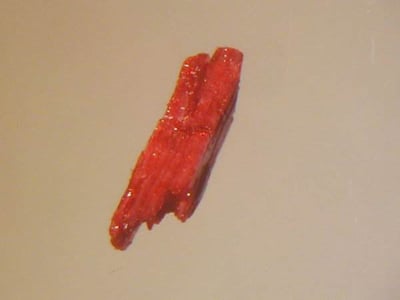
Bornite has a brown to copper-red color on fresh surfaces that tarnishes to various iridescent shades of blue to purple in places. Its striking iridescence gives it the nickname peacock copper or peacock ore.
Formation of Bornite
It occurs globally in copper ores with notable crystal localities in Butte, Montana and at Bristol, Connecticut in the U.S. It is also collected from the Carn Brea mine, Illogan, and elsewhere in Cornwall, England. Large crystals are found from the Frossnitz Alps, eastern Tirol, Austria; the Mangula mine, Lomagundi district, Zimbabwe; from the N'ouva mine, Talate, Morocco, the West Coast of Tasmania and in Dzhezkazgan, Kazakhstan. There are also traces of it found amongst the hematite in the Pilbara region of Western Australia.
Composition of Bornite
Substantial variation in the relative amounts of copper and iron is possible and solid solution extends towards chalcopyrite (CuFeS2) and digenite (Cu9S5). Exsolution of blebs and lamellae of chalcopyrite, digenite, and chalcocite is common.
Health & Safety Information
- ⚠️Bornite dust is toxic because it contains heavy metals Copper.
- ⚠️Copper
- ⚠️It's advisable to handle bornite carefully to avoid generating dust and wash hands thoroughly afterward. When cutting or polishing bornite, wear a dust mask to prevent inhaling heavy metal particles. Store bornite in a sealed container in a well-ventilated area, away from children and pets. For those involved in crystal healing, never put it in your mouth.
More Images

Quick Facts
Physical Properties
- Color
- Copper-red to pinchbeck-brown, purplish
- Hardness (Mohs)
- 3
- Rock tumbling
- Not recommended
- Density
- 5.09 g/cm³
- Streak
- Grey-Black
- Luster
- Metallic
- Crystal System
- Orthorhombic
Chemical Properties
- Chemical Formula
- Cu5FeS4
- Elements
- Cu, Fe, S
Also Known As
Identify Bornite Instantly
- Snap a photo, get instant results
- 6,700+ rocks, minerals & crystals
- Discover collecting spots near you
Bornite FAQs
How do I identify Bornite?
Bornite can be identified by its hardness of 3 on the Mohs scale, Copper-red to pinchbeck-brown color, Metallic luster, Orthorhombic crystal system. Look for these key characteristics when examining specimens.
What color is Bornite?
Bornite typically appears in Copper-red to pinchbeck-brown, purplish. Color can vary depending on impurities and formation conditions.
How hard is Bornite?
Bornite has a hardness of 3 on the Mohs scale. This makes it a soft mineral that can be scratched easily.
What is the appearance of bornite of Bornite?
Bornite has a brown to copper-red color on fresh surfaces that tarnishes to various iridescent shades of blue to purple in places. Its striking iridescence gives it the nickname peacock copper or peacock ore.
What is the formation of bornite of Bornite?
It occurs globally in copper ores with notable crystal localities in Butte, Montana and at Bristol, Connecticut in the U.S. It is also collected from the Carn Brea mine, Illogan, and elsewhere in Cornwall, England. Large crystals are found from the Frossnitz Alps, eastern Tirol, Austria; the Mangula mine, Lomagundi district, Zimbabwe; from the N'ouva mine, Talate, Morocco, the West Coast of Tasmania and in Dzhezkazgan, Kazakhstan. There are also traces of it found amongst the hematite in the Pilbara region of Western Australia.
What is the composition of bornite of Bornite?
Substantial variation in the relative amounts of copper and iron is possible and solid solution extends towards chalcopyrite (CuFeS2) and digenite (Cu9S5). Exsolution of blebs and lamellae of chalcopyrite, digenite, and chalcocite is common.

%252FAbenakiite-(ce)-01.jpg&size=small)

