Cerussite
A variety of Aragonite Group
What is Cerussite?
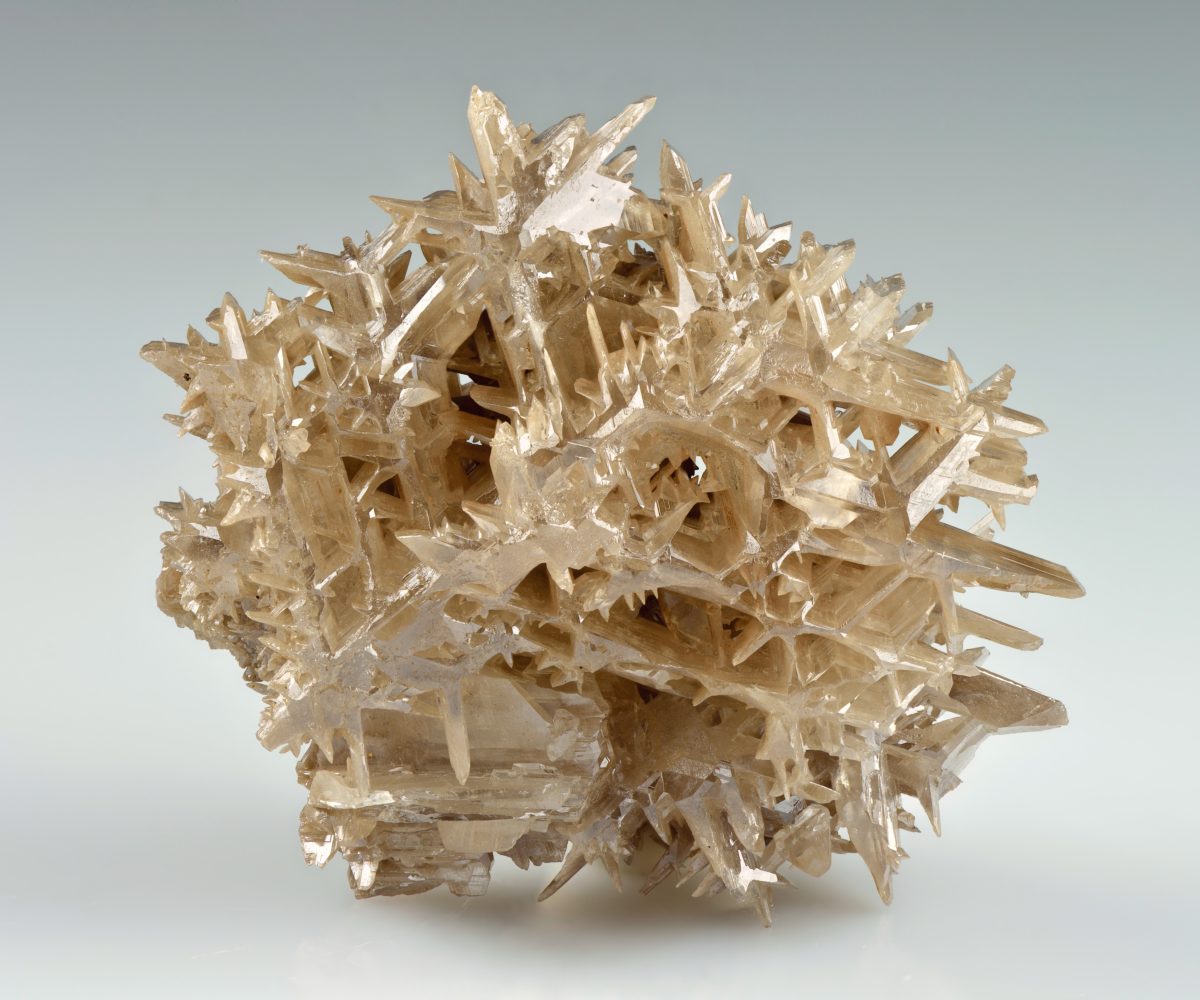
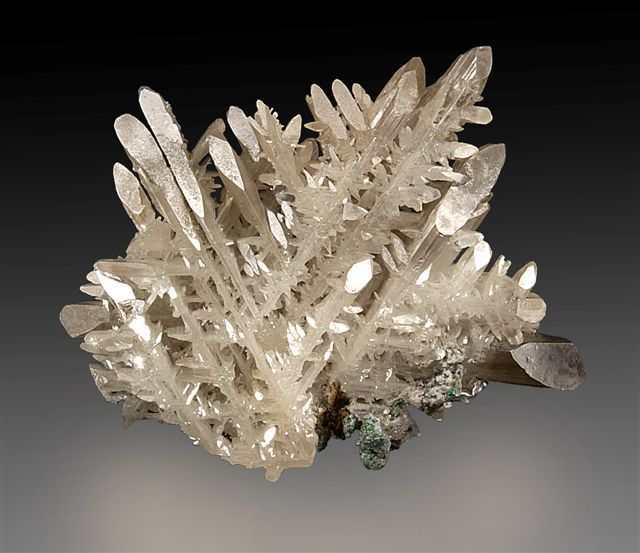
Cerussite, also known as "white lead," has been industrially mined for several centuries (lead has historically been used in a wide variety of industrial processes and alloys). It can crystalize into some truly striking forms. "Twined" specimens have crystals that appear to be interwoven, with empty space in between. Gemstone-quality crystals are rare, but breathtaking, such as the spectacular 898-carat "Light of the Desert" which was found in Namibia.
Etymology & Origins
Cerussite (also known as lead carbonate or white lead ore) is a mineral consisting of lead carbonate (PbCO3 ), and is an important ore of lead. The name is from the Latin cerussa, white lead. Cerussa nativa was mentioned by Conrad Gessner in 1565, and in 1832 F. S. Beudant applied the name cruise to the mineral, whilst the present form, cerussite, is due to W. Haidinger (1845). Miners' names in early use were lead-spar and white-lead-ore.
Uses & Applications
Cerussite was once an important ore of lead used in paints and cosmetics, but its use was discontinued to to toxicity. It is also a popular gemstone among collectors. However, while it is a popular gemstone among collectors, it is too brittle to be worn as jewelry.
Healing Properties
Cerussite is believed to be a transformative stone that improves one's physical, emotional, and spiritual self. When worn, it is believed to make a person's aura brighter, giving them a feeling of hope and confidence. It is said to make a person more confident in decision making and allow them to see matters more clearly and rationally, rather than from an emotional aspect.
Optical Properties
- Refractive Index
- 1.803-2.078
- Birefringence
- 0.274
- Pleochroism
- None
- Optical Character
- Biaxial negative
- Dispersion
- 0.055
Market Value Factors
Pricing varies for every rock and mineral, so use these universal factors to gauge Cerussite before comparing listings or appraisals.
Size & Weight
Larger, intact specimens usually command higher prices.
Rarity & Demand
Scarce material or popular varieties sell at a premium.
Condition & Finish
Chips, repairs, and heavy wear lower value; clean prep helps.
Treatment & Provenance
Untreated specimens with documented locality are prized.
Where to Find Cerussite
RockHoundR, the free-to-download rockhounding map from the Ruby Glint team, shows where collectors find cerussite in the US, with land-access notes for BLM land and national forests. Collecting is banned in national parks.
See where to find cerussiteAlways check the local rules and get the landowner's permission before you collect.
Associated Chakras
Key Characteristics
Rock Types of Cerussite
A variety containing 7% of zinc carbonate, replacing lead carbonate, is known as iglesiasite, from Iglesias in Sardinia, where it is found.
Characteristics of Cerussite
Cerussite crystallizes in the orthorhombic system and is isomorphous with aragonite. Like aragonite it is very frequently twinned, the compound crystals being pseudo-hexagonal in form. Three crystals are usually twinned together on two faces of the prism, producing six-rayed stellate groups with the individual crystals intercrossing at angles of nearly 60°. Crystals are of frequent occurrence and they usually have very bright and smooth faces. The mineral also occurs in compact granular masses, and sometimes in fibrous forms. The mineral is usually colorless or white, sometimes grey or greenish in tint and varies from transparent to translucent with an adamantine lustre. It is very brittle, and has a conchoidal fracture. It has a Mohs hardness of 3 to 3.75 and a specific gravity of 6.5. A variety containing 7% of zinc carbonate, replacing lead carbonate, is known as iglesiasite, from Iglesias in Sardinia, where it is found. The mineral may be readily recognized by its characteristic twinning, in conjunction with the adamantine lustre and high specific gravity. It dissolves with effervescence in dilute nitric acid.
Health & Safety Information
- ⚠️Cerussite dust is toxic because it contains heavy metals Lead.
- ⚠️Lead
- ⚠️It's advisable to handle cerussite carefully to avoid generating dust and wash hands thoroughly afterward. When cutting or polishing cerussite, wear a dust mask to prevent inhaling heavy metal particles. Store cerussite in a sealed container in a well-ventilated area, away from children and pets. For those involved in crystal healing, never put it in your mouth.
More Images

Quick Facts
Physical Properties
- Color
- Colourless, white, gray, blue, green, colourless in transmitted light
- Hardness (Mohs)
- 3 - 3.5
- Rock tumbling
- Not recommended
- Density
- 6.558 g/cm³
- Streak
- White
- Luster
- Pearly, Vitreous, Resinous, Adamantine, Dull
- Crystal System
- Orthorhombic
Chemical Properties
- Chemical Formula
- PbCO3
- Elements
- C, O, Pb
Also Known As
Identify Cerussite Instantly
- Snap a photo, get instant results
- 6,700+ rocks, minerals & crystals
- Discover collecting spots near you
Cerussite FAQs
How do I identify Cerussite?
Cerussite can be identified by its hardness of 3 - 3.5 on the Mohs scale, Colourless color, Pearly, Vitreous, Resinous, Adamantine, Dull luster, Orthorhombic crystal system. Look for these key characteristics when examining specimens.
What color is Cerussite?
Cerussite typically appears in Colourless, white, gray, blue, green, colourless in transmitted light. Color can vary depending on impurities and formation conditions.
How hard is Cerussite?
Cerussite has a hardness of 3 - 3.5 on the Mohs scale. This makes it a soft mineral that can be scratched easily.
What is the rock types of cerussite of Cerussite?
A variety containing 7% of zinc carbonate, replacing lead carbonate, is known as iglesiasite, from Iglesias in Sardinia, where it is found.
What is the characteristics of cerussite of Cerussite?
Cerussite crystallizes in the orthorhombic system and is isomorphous with aragonite. Like aragonite it is very frequently twinned, the compound crystals being pseudo-hexagonal in form. Three crystals are usually twinned together on two faces of the prism, producing six-rayed stellate groups with the individual crystals intercrossing at angles of nearly 60°. Crystals are of frequent occurrence and they usually have very bright and smooth faces. The mineral also occurs in compact granular masses, and sometimes in fibrous forms. The mineral is usually colorless or white, sometimes grey or greenish in tint and varies from transparent to translucent with an adamantine lustre. It is very brittle, and has a conchoidal fracture. It has a Mohs hardness of 3 to 3.75 and a specific gravity of 6.5. A variety containing 7% of zinc carbonate, replacing lead carbonate, is known as iglesiasite, from Iglesias in Sardinia, where it is found. The mineral may be readily recognized by its characteristic twinning, in conjunction with the adamantine lustre and high specific gravity. It dissolves with effervescence in dilute nitric acid.


