Strontianite
A variety of Aragonite Group
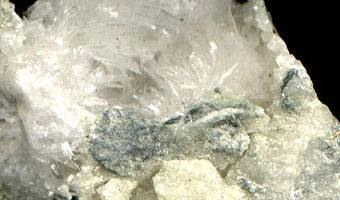
What is Strontianite?
Strontianite serves as one of the world's most important sources of the element Strontium. Strontium has many industrial uses, including as a shielding component in TV cathode-ray tubes, as an ingredient in red fireworks, and as a component of ferrite magnets. Though its crystals are usually not particularly impressive under normal light, they are highly fluorescent, glowing a bright purple under a UV bulb.
Uses & Applications
The refined ore of strontianite is used to remove non-sugar elements from sugar during the clarification process. Strontianite is also used to create a vibrant red color in fireworks. It is sometimes mined as an ore of strontium. For collectors, it is primarily valued for its scarcity, especially cut specimens.
Optical Properties
- Refractive Index
- 1.517-1.667
- Optical Character
- Biaxial negative
Market Value Factors
Pricing varies for every rock and mineral, so use these universal factors to gauge Strontianite before comparing listings or appraisals.
Size & Weight
Larger, intact specimens usually command higher prices.
Rarity & Demand
Scarce material or popular varieties sell at a premium.
Condition & Finish
Chips, repairs, and heavy wear lower value; clean prep helps.
Treatment & Provenance
Untreated specimens with documented locality are prized.
Key Characteristics
Characteristics of Strontianite
Cleavage is nearly perfect parallel to one set of prism faces, {110}, and poor on {021}. Traces of cleavage have been observed on {010}. Twinning is very common, with twin plane {110}. The twins are usually contact twins; in a contact twin the two individuals appear to be reflections of each other in the twin plane. Penetration twins of strontainite are rarer; penetration twins are made up of interpenetrating individuals that are related to each other by rotation about a twin axis. Repeated twins are made up of three or more individuals twinned according to the same law. If all the twin planes are parallel then the twin is polysynthetic, otherwise it is cyclic. In strontianite repeated twinning forms cyclic twins with three or four individuals, or polysynthetic twins. The mineral is brittle, and breaks with a subconchoidal to uneven fracture. It is quite soft, with a Mohs hardness of 3 ⁄2, between calcite and fluorite. The specific gravity of the pure end member with no calcium substituting for strontium is 3.78, but most samples contain some calcium, which is lighter than strontium, giving a lower specific gravity, in the range 3.74 to 3.78. Substitutions of the heavier ions barium and/or lead increase the specific gravity, although such substitutions are never very abundant. Strontianite is soluble in dilute hydrochloric acid HCl and it is not radioactive.
Composition of Strontianite
Strontianite is isostructural with aragonite. When the CO3 group is combined with large divalent cations with ionic radii greater than 1.0 Å, the radius ratios generally do not permit stable 6-fold coordination. For small cations the structure is rhombohedral, but for large cations it is orthorhombic. This is the aragonite structure type with space group Pmcn. In this structure the CO3 groups lie perpendicular to the c axis, in two structural planes, with the CO3 triangular groups of one plane pointing in opposite directions to those of the other. These layers are separated by layers of cations. The CO3 group is slightly non-planar; the carbon atom lies 0.007 Å out of the plane of the oxygen atoms. The groups are tilted such that the angle between a plane drawn through the oxygen atoms and a plane parallel to the a-b unit cell plane is 2°40’.
Health & Safety Information
- ⚠️Strontianite dust is toxic because it contains heavy metals Strontium.
- ⚠️Strontium
- ⚠️It's advisable to handle strontianite carefully to avoid generating dust and wash hands thoroughly afterward. When cutting or polishing strontianite, wear a dust mask to prevent inhaling heavy metal particles. Store strontianite in a sealed container in a well-ventilated area, away from children and pets. For those involved in crystal healing, never put it in your mouth.
More Images
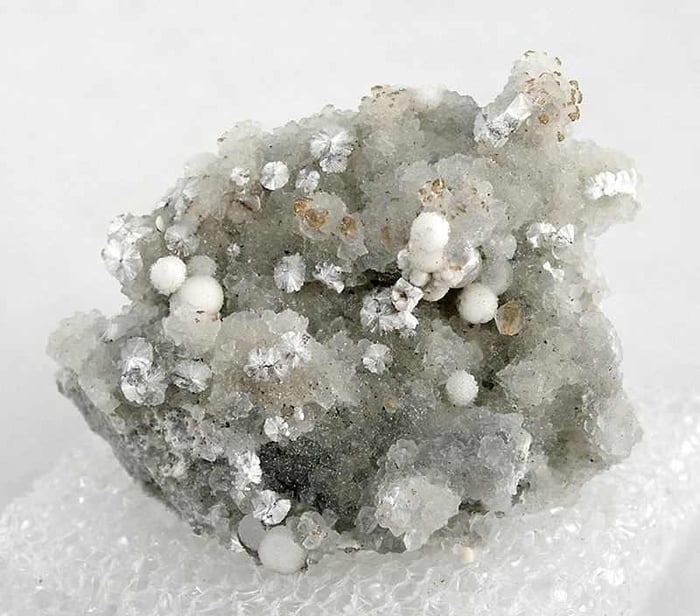
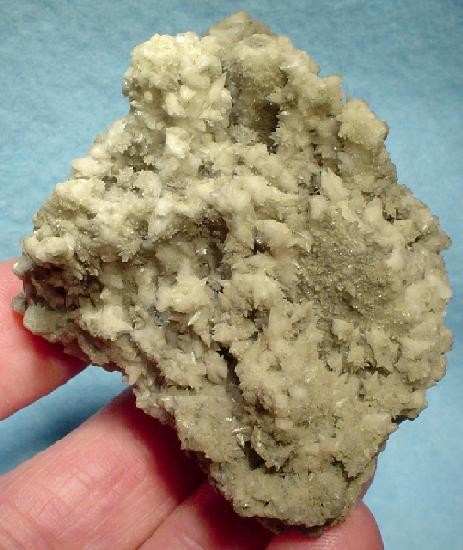
Quick Facts
Physical Properties
- Color
- Colourless, white, gray, light yellow, green, brown, colourless in transmitted light
- Hardness (Mohs)
- 3.5
- Rock tumbling
- Not recommended
- Density
- 3.722 g/cm³
- Streak
- White
- Luster
- Vitreous, Resinous
- Crystal System
- Orthorhombic
Chemical Properties
- Chemical Formula
- SrCO3
- Elements
- C, O, Sr
Also Known As
Identify Strontianite Instantly
- Snap a photo, get instant results
- 6,700+ rocks, minerals & crystals
- Discover collecting spots near you
Strontianite FAQs
How do I identify Strontianite?
Strontianite can be identified by its hardness of 3.5 on the Mohs scale, Colourless color, Vitreous, Resinous luster, Orthorhombic crystal system. Look for these key characteristics when examining specimens.
What color is Strontianite?
Strontianite typically appears in Colourless, white, gray, light yellow, green, brown, colourless in transmitted light. Color can vary depending on impurities and formation conditions.
How hard is Strontianite?
Strontianite has a hardness of 3.5 on the Mohs scale. This gives it moderate hardness.
What is the characteristics of strontianite of Strontianite?
Cleavage is nearly perfect parallel to one set of prism faces, {110}, and poor on {021}. Traces of cleavage have been observed on {010}. Twinning is very common, with twin plane {110}. The twins are usually contact twins; in a contact twin the two individuals appear to be reflections of each other in the twin plane. Penetration twins of strontainite are rarer; penetration twins are made up of interpenetrating individuals that are related to each other by rotation about a twin axis. Repeated twins are made up of three or more individuals twinned according to the same law. If all the twin planes are parallel then the twin is polysynthetic, otherwise it is cyclic. In strontianite repeated twinning forms cyclic twins with three or four individuals, or polysynthetic twins. The mineral is brittle, and breaks with a subconchoidal to uneven fracture. It is quite soft, with a Mohs hardness of 3 ⁄2, between calcite and fluorite. The specific gravity of the pure end member with no calcium substituting for strontium is 3.78, but most samples contain some calcium, which is lighter than strontium, giving a lower specific gravity, in the range 3.74 to 3.78. Substitutions of the heavier ions barium and/or lead increase the specific gravity, although such substitutions are never very abundant. Strontianite is soluble in dilute hydrochloric acid HCl and it is not radioactive.
What is the composition of strontianite of Strontianite?
Strontianite is isostructural with aragonite. When the CO3 group is combined with large divalent cations with ionic radii greater than 1.0 Å, the radius ratios generally do not permit stable 6-fold coordination. For small cations the structure is rhombohedral, but for large cations it is orthorhombic. This is the aragonite structure type with space group Pmcn. In this structure the CO3 groups lie perpendicular to the c axis, in two structural planes, with the CO3 triangular groups of one plane pointing in opposite directions to those of the other. These layers are separated by layers of cations. The CO3 group is slightly non-planar; the carbon atom lies 0.007 Å out of the plane of the oxygen atoms. The groups are tilted such that the angle between a plane drawn through the oxygen atoms and a plane parallel to the a-b unit cell plane is 2°40’.


