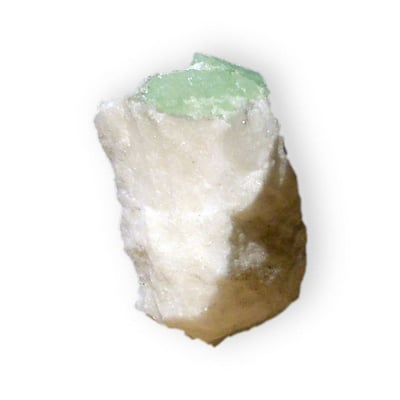
Ettringite
A variety of Ettringite Group

What is Ettringite?
The transparent crystals of ettringite are long and hexagonal, but they're rarely cut into gems as they are colorless and quite soft. This mineral is used to coat paper to create "satin white" finish, and is also an important hydration product of cement, created during the chemical reactions of the stiffening process.
Uses & Applications
Ettringite occurs not only in nature, but is also a product of the cement-making process which helps give cement its rapid-setting properties. Research is currently underway to understand how this mineral may help remove heavy metals and dangerous toxic substances from soil.
Optical Properties
- Refractive Index
- 1.470-1.491
- Birefringence
- 0.021
- Optical Character
- Uniaxial negative
Market Value Factors
Pricing varies for every rock and mineral, so use these universal factors to gauge Ettringite before comparing listings or appraisals.
Size & Weight
Larger, intact specimens usually command higher prices.
Rarity & Demand
Scarce material or popular varieties sell at a premium.
Condition & Finish
Chips, repairs, and heavy wear lower value; clean prep helps.
Treatment & Provenance
Untreated specimens with documented locality are prized.
Key Characteristics
Formation of Ettringite
Ettringite was first described in 1874 by J.Lehmann, for an occurrence near the Ettringer Bellerberg Volcano, Ettringen, Rheinland-Pfalz, Germany. It occurs within metamorphically altered limestone adjacent to igneous intrusive rocks or within xenoliths. It also occurs as weathering crusts on larnite in the Hatrurim Formation of Israel. It occurs associated with portlandite, afwillite and hydrocalumite at Scawt Hill, Ireland and with afwillite, hydrocalumite, mayenite and gypsum in the Hatrurim Formation. It has also been reported from the Zeilberg quarry, Maroldsweisach, Bavaria; at Boisséjour, near Clermont-Ferrand, Puy-de-Dôme, Auvergne, France; the N’Chwaning mine, Kuruman district, Cape Province, South Africa; in the US, occurrences were found in spurrite-merwinite-gehlenite skarn at the 910 level of the Commercial quarry, Crestmore, Riverside County, California and in the Lucky Cuss mine, Tombstone, Arizona.
Composition of Ettringite
The mineral ettringite has a structure that runs parallel to the c axis -the needle axis-; in the middle of these two lie the sulfate ions and H2O molecules, the space group is P31c. Ettringite crystal system is trigonal, crystals are elongated and in a needle like shape, occurrence of disorder or twining is common, which affects the intercolumn material. The first X-ray study was done by Bannister, Hey & Bernal (1936), which found that the crystal unit cell is of a hexagonal form with a=11.26 and c=21.48 with space group P63/mmcand Z=2. From observations on dehydration and chemical formulas there were suggestions of the structure being composed of Ca and Al(OH)6, were between them lie SO4 ions and H2O molecules. Further X-ray studies ensued; namely Wellin (1956) which determined the crystal structure of thaumasite, and Besjak & Jelenic (1966) which gave affirmation of the structure nature of ettringite. An ettringite sample extracted from Scawt Hill was analysed by C. E. Tilley, the crystal was 1.1 x 0.8 0.5 mm, with specific gravity of 1.772±0.002, the density was determined by immersing the sample in a solution of carbon tetrachloride mixed with bromoform. The crystal showed five prism faces of the form m {1010} and a small face a{1120}, with no pyramidal or basal faces, upon x-ray diffraction a Lauer gram along the c-axis revealed a hexagonal axis with vertical planes of symmetry, this study showed that the structure has a hexagonal and not a rhombohedral lattice. further studies conducted on synthetic ettringite by use of x-ray and powder diffraction confirmed earlier assumptions and analyses. Upon analyzing the structure of both ettringite and thaumasite, it was deduced that both minerals have hexagonal structures, but different space groups. Ettringite crystals have a P31c with a=11.224 Å, c= 21,108 Å, while thaumasite crystals fall into space group P63 with a= 11.04 Å, c= 10.39 Å. While these two minerals form a solid solution, the difference in space groups lead to discontinuities in unit cell parameters. Differences between structures of ettringite and thaumasite arise from the columns of cations and anions: Ettringite cation columns are composed of Ca3[Al(OH)6·12H2O], which run parallel to the c axis, and the other columns of sulfate anions and water molecules in channels parallel to these columns. In contrast, thaumasite consists of a cylindrical column of Ca3[Si(OH)6·12H2O] in the c axis, with sulfate and carbonate anions in channels between these columns which contain water molecules as well.
More Images


Quick Facts
Physical Properties
- Color
- Colourless, colourless in transmitted light
- Hardness (Mohs)
- 2 - 2.5
- Rock tumbling
- Not recommended
- Density
- 1.76 g/cm³
- Streak
- White
- Luster
- Vitreous
- Crystal System
- Trigonal
Chemical Properties
- Chemical Formula
- Ca6Al2(SO4)3(OH)12 · 26H2O
- Elements
- Al, Ca, H, O, S
Identify Ettringite Instantly
- Snap a photo, get instant results
- 6,700+ rocks, minerals & crystals
- Discover collecting spots near you
Ettringite FAQs
How do I identify Ettringite?
Ettringite can be identified by its hardness of 2 - 2.5 on the Mohs scale, Colourless color, Vitreous luster, Trigonal crystal system. Look for these key characteristics when examining specimens.
What color is Ettringite?
Ettringite typically appears in Colourless, colourless in transmitted light. Color can vary depending on impurities and formation conditions.
How hard is Ettringite?
Ettringite has a hardness of 2 - 2.5 on the Mohs scale. This makes it a soft mineral that can be scratched easily.
What is the formation of ettringite of Ettringite?
Ettringite was first described in 1874 by J.Lehmann, for an occurrence near the Ettringer Bellerberg Volcano, Ettringen, Rheinland-Pfalz, Germany. It occurs within metamorphically altered limestone adjacent to igneous intrusive rocks or within xenoliths. It also occurs as weathering crusts on larnite in the Hatrurim Formation of Israel. It occurs associated with portlandite, afwillite and hydrocalumite at Scawt Hill, Ireland and with afwillite, hydrocalumite, mayenite and gypsum in the Hatrurim Formation. It has also been reported from the Zeilberg quarry, Maroldsweisach, Bavaria; at Boisséjour, near Clermont-Ferrand, Puy-de-Dôme, Auvergne, France; the N’Chwaning mine, Kuruman district, Cape Province, South Africa; in the US, occurrences were found in spurrite-merwinite-gehlenite skarn at the 910 level of the Commercial quarry, Crestmore, Riverside County, California and in the Lucky Cuss mine, Tombstone, Arizona.
What is the composition of ettringite of Ettringite?
The mineral ettringite has a structure that runs parallel to the c axis -the needle axis-; in the middle of these two lie the sulfate ions and H2O molecules, the space group is P31c. Ettringite crystal system is trigonal, crystals are elongated and in a needle like shape, occurrence of disorder or twining is common, which affects the intercolumn material. The first X-ray study was done by Bannister, Hey & Bernal (1936), which found that the crystal unit cell is of a hexagonal form with a=11.26 and c=21.48 with space group P63/mmcand Z=2. From observations on dehydration and chemical formulas there were suggestions of the structure being composed of Ca and Al(OH)6, were between them lie SO4 ions and H2O molecules. Further X-ray studies ensued; namely Wellin (1956) which determined the crystal structure of thaumasite, and Besjak & Jelenic (1966) which gave affirmation of the structure nature of ettringite. An ettringite sample extracted from Scawt Hill was analysed by C. E. Tilley, the crystal was 1.1 x 0.8 0.5 mm, with specific gravity of 1.772±0.002, the density was determined by immersing the sample in a solution of carbon tetrachloride mixed with bromoform. The crystal showed five prism faces of the form m {1010} and a small face a{1120}, with no pyramidal or basal faces, upon x-ray diffraction a Lauer gram along the c-axis revealed a hexagonal axis with vertical planes of symmetry, this study showed that the structure has a hexagonal and not a rhombohedral lattice. further studies conducted on synthetic ettringite by use of x-ray and powder diffraction confirmed earlier assumptions and analyses. Upon analyzing the structure of both ettringite and thaumasite, it was deduced that both minerals have hexagonal structures, but different space groups. Ettringite crystals have a P31c with a=11.224 Å, c= 21,108 Å, while thaumasite crystals fall into space group P63 with a= 11.04 Å, c= 10.39 Å. While these two minerals form a solid solution, the difference in space groups lead to discontinuities in unit cell parameters. Differences between structures of ettringite and thaumasite arise from the columns of cations and anions: Ettringite cation columns are composed of Ca3[Al(OH)6·12H2O], which run parallel to the c axis, and the other columns of sulfate anions and water molecules in channels parallel to these columns. In contrast, thaumasite consists of a cylindrical column of Ca3[Si(OH)6·12H2O] in the c axis, with sulfate and carbonate anions in channels between these columns which contain water molecules as well.