Hornblende
A variety of Hornblende Root Name Group
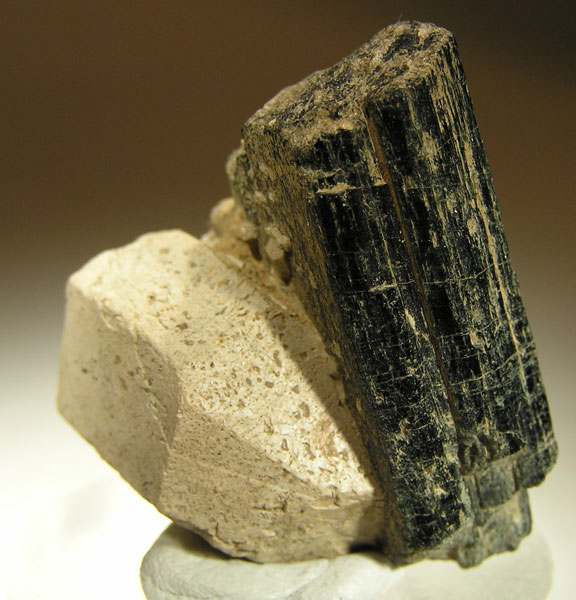
What is Hornblende?
Hornblende is a term commonly used to describe dark green to black amphiboles. While it is not officially recognized as a distinct mineral, the name is widely used in the field to refer to this particular group of minerals. Hornblende minerals are often found in igneous and metamorphic rocks. Hornblende is often associated with other minerals like feldspar and quartz. Its presence in rocks provides valuable clues about their geological origins and history.
Etymology & Origins
The word hornblende is derived from the German horn and blenden, to 'deceive' in allusion to its similarity in appearance to metal-bearing ore minerals.
Market Value Factors
Pricing varies for every rock and mineral, so use these universal factors to gauge Hornblende before comparing listings or appraisals.
Size & Weight
Larger, intact specimens usually command higher prices.
Rarity & Demand
Scarce material or popular varieties sell at a premium.
Condition & Finish
Chips, repairs, and heavy wear lower value; clean prep helps.
Treatment & Provenance
Untreated specimens with documented locality are prized.
Where to Find Hornblende
RockHoundR, the free-to-download rockhounding map from the Ruby Glint team, shows where collectors find hornblende in the US, with land-access notes for BLM land and national forests. Collecting is banned in national parks.
See where to find hornblendeAlways check the local rules and get the landowner's permission before you collect.
Key Characteristics
Characteristics of Hornblende
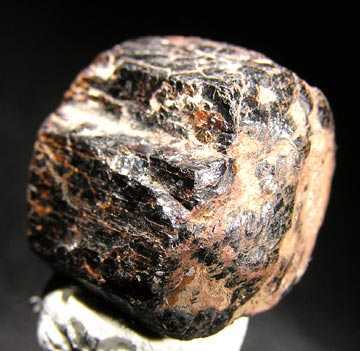
Hornblende has a hardness of 5–6, a specific gravity of 2.9–3.4 and is typically an opaque green, greenish-brown, brown or black color. Its cleavage angles are at 56 and 124 degrees. It is most often confused with various pyroxene minerals and biotite mica, which are black and can be found in granite and in charnockite.
Formation of Hornblende
Hornblende is a common constituent of many igneous and metamorphic rocks such as granite, syenite, diorite, gabbro, basalt, andesite, gneiss, and schist. It is the principal mineral of amphibolites. Very dark brown to black hornblendes that contain titanium are ordinarily called basaltic hornblende, from the fact that they are usually a constituent of basalt and related rocks. Hornblende alters easily to chlorite and epidote. A rare variety of hornblende contains less than 5% of iron oxide, is gray to white in color, and is named edenite from its locality in Edenville, Orange County, New York. Other minerals in the hornblende series include: pargasite hastingsite tschermakite edenite
More Images

Quick Facts
Physical Properties
- Color
- Black, dark green, brown
- Hardness (Mohs)
- 5 - 6
- Rock tumbling
- With care
- Density
- 3 - 3.4 g/cm³
- Streak
- Colorless
- Luster
- Vitreous, Dull
- Crystal System
- Monoclinic
Chemical Properties
- Chemical Formula
- Ca₂(Mg,Fe,Al)₅(Al,Si)₈O₂₂(OH)₂
- Elements
- Ca,Mg,Fe,Al,Si,O,H
Identify Hornblende Instantly
- Snap a photo, get instant results
- 6,700+ rocks, minerals & crystals
- Discover collecting spots near you
Hornblende FAQs
How do I identify Hornblende?
Hornblende can be identified by its hardness of 5 - 6 on the Mohs scale, Black color, Vitreous, Dull luster, Monoclinic crystal system. Look for these key characteristics when examining specimens.
What color is Hornblende?
Hornblende typically appears in Black, dark green, brown. Color can vary depending on impurities and formation conditions.
How hard is Hornblende?
Hornblende has a hardness of 5 - 6 on the Mohs scale. This gives it moderate hardness.
What is the characteristics of hornblende of Hornblende?
Hornblende has a hardness of 5–6, a specific gravity of 2.9–3.4 and is typically an opaque green, greenish-brown, brown or black color. Its cleavage angles are at 56 and 124 degrees. It is most often confused with various pyroxene minerals and biotite mica, which are black and can be found in granite and in charnockite.
What is the formation of hornblende of Hornblende?
Hornblende is a common constituent of many igneous and metamorphic rocks such as granite, syenite, diorite, gabbro, basalt, andesite, gneiss, and schist. It is the principal mineral of amphibolites. Very dark brown to black hornblendes that contain titanium are ordinarily called basaltic hornblende, from the fact that they are usually a constituent of basalt and related rocks. Hornblende alters easily to chlorite and epidote. A rare variety of hornblende contains less than 5% of iron oxide, is gray to white in color, and is named edenite from its locality in Edenville, Orange County, New York. Other minerals in the hornblende series include: pargasite hastingsite tschermakite edenite