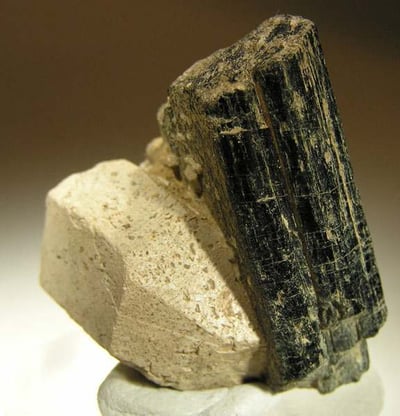
Ferro-hornblende
A variety of Hornblende Root Name Group
What is Ferro-hornblende?
Hornblende is a complex inosilicate series of minerals (ferrohornblende – magnesiohornblende). It is not a recognized mineral in its own right, but the name is used as a general or field term, to refer to a dark amphibole. The general formula is (Ca,Na)2-3(Mg,Fe,Al)5(Al,Si)8O22(OH,F)2.
Market Value Factors
Pricing varies for every rock and mineral, so use these universal factors to gauge Ferro-hornblende before comparing listings or appraisals.
Size & Weight
Larger, intact specimens usually command higher prices.
Rarity & Demand
Scarce material or popular varieties sell at a premium.
Condition & Finish
Chips, repairs, and heavy wear lower value; clean prep helps.
Treatment & Provenance
Untreated specimens with documented locality are prized.
Key Characteristics
Characteristics of Ferro-hornblende
Hornblende has a hardness of 5–6, a specific gravity of 2.9–3.4 and is typically an opaque green, greenish-brown, brown or black color. Its cleavage angles are at 56 and 124 degrees. It is most often confused with various pyroxene minerals and biotite mica, which are black and can be found in granite and in charnockite.
Formation of Ferro-hornblende
Hornblende is a common constituent of many igneous and metamorphic rocks such as granite, syenite, diorite, gabbro, basalt, andesite, gneiss, and schist. It is the principal mineral of amphibolites. Very dark brown to black hornblendes that contain titanium are ordinarily called basaltic hornblende, from the fact that they are usually a constituent of basalt and related rocks. Hornblende alters easily to chlorite and epidote. A rare variety of hornblende contains less than 5% of iron oxide, is gray to white in color, and is named edenite from its locality in Edenville, Orange County, New York. Other minerals in the hornblende series include: pargasite hastingsite tschermakite edenite
Quick Facts
Physical Properties
- Color
- Dark green to black, greenish-brown, more rarely lighter green
- Hardness (Mohs)
- 5 - 6
- Rock tumbling
- With care
- Streak
- Pale grey-green, grey-white
Chemical Properties
- Chemical Formula
- ☐{Ca2}{Fe2+4Al}(AlSi7O22)(OH)2 Defined as an amphibole in the magnesio-hornblende group of the Calcium subgroup with Fe2+>Mg and Al>Fe3+ in the C position and (OH) as the dominant ion in the W position.
- Elements
- Al, Ca, Fe, H, O, Si
Also Known As
Identify Ferro-hornblende Instantly
- Snap a photo, get instant results
- 6,700+ rocks, minerals & crystals
- Discover collecting spots near you
Ferro-hornblende FAQs
How do I identify Ferro-hornblende?
Ferro-hornblende can be identified by its hardness of 5 - 6 on the Mohs scale, Dark green to black color. Look for these key characteristics when examining specimens.
What color is Ferro-hornblende?
Ferro-hornblende typically appears in Dark green to black, greenish-brown, more rarely lighter green. Color can vary depending on impurities and formation conditions.
How hard is Ferro-hornblende?
Ferro-hornblende has a hardness of 5 - 6 on the Mohs scale. This gives it moderate hardness.
What is the characteristics of ferro-hornblende of Ferro-hornblende?
Hornblende has a hardness of 5–6, a specific gravity of 2.9–3.4 and is typically an opaque green, greenish-brown, brown or black color. Its cleavage angles are at 56 and 124 degrees. It is most often confused with various pyroxene minerals and biotite mica, which are black and can be found in granite and in charnockite.
What is the formation of ferro-hornblende of Ferro-hornblende?
Hornblende is a common constituent of many igneous and metamorphic rocks such as granite, syenite, diorite, gabbro, basalt, andesite, gneiss, and schist. It is the principal mineral of amphibolites. Very dark brown to black hornblendes that contain titanium are ordinarily called basaltic hornblende, from the fact that they are usually a constituent of basalt and related rocks. Hornblende alters easily to chlorite and epidote. A rare variety of hornblende contains less than 5% of iron oxide, is gray to white in color, and is named edenite from its locality in Edenville, Orange County, New York. Other minerals in the hornblende series include: pargasite hastingsite tschermakite edenite