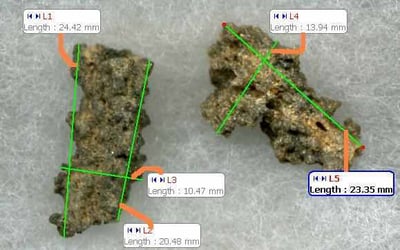
Hornfels
A variety of Metamorphic
What is Hornfels?
Hornfels is the name of a group of attractive-looking crystalline metamorphic rocks primarily used in architecture as beautification stones — they are used for interior floors, facades, and/or pavings. With the ability to resonate when struck, they were used for making lithopones (musical instruments) back in the 19th century in England.
Uses & Applications
Hornfels is a metamorphic rock that is commonly used as a tough but eye-catching material in the building industry. It can be used to produce paving and curbstones as well as for indoor tiling. This rock can also be ground down to produce aggregate for covering road surfaces.
Healing Properties
Are you looking to increase your mental capability? Hornfels is said to do just that, making you better able to manage difficulties and more courageous when approaching risks. It's also said to bring good luck! Healers believe that this stone diminishes negative emotions, spreading positivity and love throughout your whole body. Using this stone as an amulet may keep evil spirits away.
Market Value Factors
Pricing varies for every rock and mineral, so use these universal factors to gauge Hornfels before comparing listings or appraisals.
Size & Weight
Larger, intact specimens usually command higher prices.
Rarity & Demand
Scarce material or popular varieties sell at a premium.
Condition & Finish
Chips, repairs, and heavy wear lower value; clean prep helps.
Treatment & Provenance
Untreated specimens with documented locality are prized.
Key Characteristics
Characteristics of Hornfels
Hornfels have the ability to resonate when struck. Michael Tellinger had described these stones in South Africa also known as "ring-stones" due to their ability to ring like a bell. The Musical Stones of Skiddaw are an example of a lithophone made from hornfels.
Composition of Hornfels
The structure of the hornfels is very characteristic. Very rarely do any of the minerals show crystalline form, but the small grains fit closely together like the fragments of a mosaic; they are usually of nearly equal dimensions. This has been called pflaster or pavement structure from the resemblance to rough pavement work. Each mineral may also enclose particles of the others; in the quartz, for example, small crystals of graphite, biotite, iron oxides, sillimanite or feldspar may appear in great numbers. Often the whole of the grains are rendered semi-opaque in this way. The minutest crystals may show traces of crystalline outlines; undoubtedly they are of new formation and have originated in situ. This leads us to believe that the whole rock has been recrystallized at a high temperature and in the solid state so that there was little freedom for the mineral molecules to build up well-individualized crystals. The regeneration of the rock has been sufficient to efface most of the original structures and to replace the former minerals more-or-less completely by new ones. But crystallization has been hampered by the solid condition of the mass and the new minerals are formless and have been unable to reject impurities, but have grown around them.
Quick Facts
Physical Properties
- Color
- Black, brown, greenish gray, etc.
- Hardness (Mohs)
- 5
- Rock tumbling
- With care
- Density
- 2.5 - 3 g/cm³

Identify Hornfels Instantly
- Snap a photo, get instant results
- 6,700+ rocks, minerals & crystals
- Discover collecting spots near you
Hornfels FAQs
How do I identify Hornfels?
Hornfels can be identified by its hardness of 5 on the Mohs scale, Black color. Look for these key characteristics when examining specimens.
What color is Hornfels?
Hornfels typically appears in Black, brown, greenish gray, etc.. Color can vary depending on impurities and formation conditions.
How hard is Hornfels?
Hornfels has a hardness of 5 on the Mohs scale. This gives it moderate hardness.
What is the characteristics of hornfels of Hornfels?
Hornfels have the ability to resonate when struck. Michael Tellinger had described these stones in South Africa also known as "ring-stones" due to their ability to ring like a bell. The Musical Stones of Skiddaw are an example of a lithophone made from hornfels.
What is the composition of hornfels of Hornfels?
The structure of the hornfels is very characteristic. Very rarely do any of the minerals show crystalline form, but the small grains fit closely together like the fragments of a mosaic; they are usually of nearly equal dimensions. This has been called pflaster or pavement structure from the resemblance to rough pavement work. Each mineral may also enclose particles of the others; in the quartz, for example, small crystals of graphite, biotite, iron oxides, sillimanite or feldspar may appear in great numbers. Often the whole of the grains are rendered semi-opaque in this way. The minutest crystals may show traces of crystalline outlines; undoubtedly they are of new formation and have originated in situ. This leads us to believe that the whole rock has been recrystallized at a high temperature and in the solid state so that there was little freedom for the mineral molecules to build up well-individualized crystals. The regeneration of the rock has been sufficient to efface most of the original structures and to replace the former minerals more-or-less completely by new ones. But crystallization has been hampered by the solid condition of the mass and the new minerals are formless and have been unable to reject impurities, but have grown around them.