Opal
A variety of Minerals

What is Opal?
Opal is one of the world's most popular gemstones due to its flashing colors. Australia is the most famous producer of precious opals along with Mexico and Ethiopia. Opal is softer than most other popular gemstones and lends itself best to pendants and earrings that do not receive heavy impact during wear. It is the birthstone to those born in October.
Etymology & Origins
The word 'opal' is adapted from the Latin term opalus, but the origin of this word is a matter of debate. However, most modern references suggest it is adapted from the Sanskrit word úpala. References to the gem are made by Pliny the Elder. It is suggested to have been adapted from Ops, the wife of Saturn, and goddess of fertility. The portion of Saturnalia devoted to Ops was "Opalia", similar to opalus. Another common claim that the term is adapted from the Ancient Greek word, opallios. This word has two meanings, one is related to "seeing" and forms the basis of the English words like "opaque"; the other is "other" as in "alias" and "alter". It is claimed that opalus combined these uses, meaning "to see a change in color". However, historians have noted the first appearances of opallios do not occur until after the Romans had taken over the Greek states in 180 BC and they had previously used the term paederos. However, the argument for the Sanskrit origin is strong. The term first appears in Roman references around 250 BC, at a time when the opal was valued above all other gems. The opals were supplied by traders from the Bosporus, who claimed the gems were being supplied from India. Before this, the stone was referred to by a variety of names, but these fell from use after 250 BC.
Uses & Applications
Opal is not only a popular stone in rings, necklaces, and earrings, but also has several commercial uses. The stone is ground into an abrasive powder. It is also an ingredient in some ceramics.
Healing Properties
Opal is believed to enhance creativity and originality. It encourages honesty and self-expression. It is considered a protective stone that absorbs negative energy and reflects it back to the source. When placed on the Heart chakra, it is said to release emotional blocks and allow for truer, deeper love connections. It can be worn, carried, or placed in the home.
Optical Properties
- Refractive Index
- 1.37-1.52
- Pleochroism
- None
- Optical Character
- Isotropic
Discover Values
This stone excels in popularity, beauty, collection value.
Market Value Factors
Pricing varies for every rock and mineral, so use these universal factors to gauge Opal before comparing listings or appraisals.
Size & Weight
Larger, intact specimens usually command higher prices.
Rarity & Demand
Scarce material or popular varieties sell at a premium.
Condition & Finish
Chips, repairs, and heavy wear lower value; clean prep helps.
Treatment & Provenance
Untreated specimens with documented locality are prized.
Where to Find Opal
RockHoundR, the free-to-download rockhounding map from the Ruby Glint team, shows where collectors find opal in the US, with land-access notes for BLM land and national forests. Collecting is banned in national parks.
See where to find opalAlways check the local rules and get the landowner's permission before you collect.
The Meaning
Opal was associated with the Divine, supernatural, and magical in many ancient cultures and civilizations. The stone was a symbol of love for ancient Romans, while the Greeks thought the stone was created from the tears of Zeus. Generally, the stone was considered to bring good luck. It is the birthstone of October.
Associated Chakras
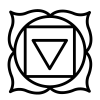
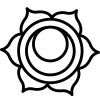
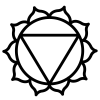
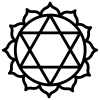
Key Characteristics
Composition of Opal
The lattice of spheres of opal that cause interference with light is several hundred times larger than the fundamental structure of crystalline silica. As a mineraloid, no unit cell describes the structure of opal. Nevertheless, opals can be roughly divided into those that show no signs of crystalline order (amorphous opal) and those that show signs of the beginning of crystalline order, commonly termed cryptocrystalline or microcrystalline opal. Dehydration experiments and infrared spectroscopy have shown that most of the H2O in the formula of SiO2·nH2O of opals is present in the familiar form of clusters of molecular water. Isolated water molecules, and silanols, structures such as SiOH, generally form a lesser proportion of the total and can reside near the surface or in defects inside the opal. The structure of low-pressure polymorphs of anhydrous silica consist of frameworks of fully corner bonded tetrahedra of SiO4. The higher temperature polymorphs of silica cristobalite and tridymite are frequently the first to crystallize from amorphous anhydrous silica, and the local structures of microcrystalline opals also appear to be closer to that of cristobalite and tridymite than to quartz. The structures of tridymite and cristobalite are closely related and can be described as hexagonal and cubic close-packed layers. It is therefore possible to have intermediate structures in which the layers are not regularly stacked.
Health & Safety Information
- ⚠️Quartz, silica, crystalline silica and flint are non-toxic materials, but very fine dust containing quartz, known as respirable crystalline silicon (RCS), can cause serious and fatal lung disease. Lapidaries should exercise caution when cutting silica.
More Images


Quick Facts
Physical Properties
- Color
- Colourless, white, yellow, red, orange, green, brown, black, blue
- Hardness (Mohs)
- 5.5 - 6.5
- Rock tumbling
- Not recommended
- Density
- 1.98 - 2.25 g/cm³
- Streak
- White
- Luster
- Greasy, Vitreous, Waxy
- Crystal System
- Amorphous
Chemical Properties
- Chemical Formula
- SiO2 · nH2O
- Elements
- H, O, Si
Also Known As
Identify Opal Instantly
- Snap a photo, get instant results
- 6,700+ rocks, minerals & crystals
- Discover collecting spots near you
Opal FAQs
How do I identify Opal?
Opal can be identified by its hardness of 5.5 - 6.5 on the Mohs scale, Colourless color, Greasy, Vitreous, Waxy luster, Amorphous crystal system. Look for these key characteristics when examining specimens.
What color is Opal?
Opal typically appears in Colourless, white, yellow, red, orange, green, brown, black, blue. Color can vary depending on impurities and formation conditions.
How hard is Opal?
Opal has a hardness of 5.5 - 6.5 on the Mohs scale. This gives it moderate hardness.
What is the composition of opal of Opal?
The lattice of spheres of opal that cause interference with light is several hundred times larger than the fundamental structure of crystalline silica. As a mineraloid, no unit cell describes the structure of opal. Nevertheless, opals can be roughly divided into those that show no signs of crystalline order (amorphous opal) and those that show signs of the beginning of crystalline order, commonly termed cryptocrystalline or microcrystalline opal. Dehydration experiments and infrared spectroscopy have shown that most of the H2O in the formula of SiO2·nH2O of opals is present in the familiar form of clusters of molecular water. Isolated water molecules, and silanols, structures such as SiOH, generally form a lesser proportion of the total and can reside near the surface or in defects inside the opal. The structure of low-pressure polymorphs of anhydrous silica consist of frameworks of fully corner bonded tetrahedra of SiO4. The higher temperature polymorphs of silica cristobalite and tridymite are frequently the first to crystallize from amorphous anhydrous silica, and the local structures of microcrystalline opals also appear to be closer to that of cristobalite and tridymite than to quartz. The structures of tridymite and cristobalite are closely related and can be described as hexagonal and cubic close-packed layers. It is therefore possible to have intermediate structures in which the layers are not regularly stacked.

%252FAbenakiite-(ce)-01.jpg&size=small)

