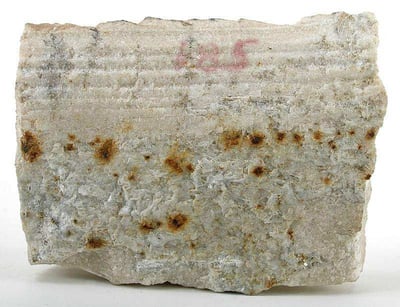
Phenakite
A variety of Phenakite Group
What is Phenakite?
Although phenakite is easily shaped and brilliantly iridescent, it has not caught on as a popular choice for jewelry. Instead, it is prized mostly in uncut samples for collectors. It is remarkably similar in appearance to quartz and can be misidentified by inexperienced mineral hunters.
Etymology & Origins
Its name comes from Ancient Greek: φέναξ, romanized: phénax, meaning "deceiver" due to its close visual similarity to quartz, named by Nils Gustaf Nordenskiöld in 1833.
Uses & Applications
Phenakite is an uncommon ore of beryllium, which is an essential metal often mixed into alloys for a variety of applications. This mineral is also occasionally used as a gemstone in jewelry or as a collector's mineral. However, its rarity prevents it from gaining popularity.
Healing Properties
Phenakite is a powerful stone that works on the Crown and Throat chakras to enhance visions and enable better understanding. It is said to affect not only individuals but crowds as well. Focusing on this stone may clear the mind for problem solving, and can help to alleviate feelings of fear related to lifestyle changes. Its positive energy is excellent for meditation and it is believed by many to open the door to spiritual understanding.
Optical Properties
- Refractive Index
- 1.650-1.695
- Birefringence
- 0.016
- Pleochroism
- Distinct: colorless, orangy-yellow
- Optical Character
- Biaxial positive
- Dispersion
- 0.015
Market Value Factors
Pricing varies for every rock and mineral, so use these universal factors to gauge Phenakite before comparing listings or appraisals.
Size & Weight
Larger, intact specimens usually command higher prices.
Rarity & Demand
Scarce material or popular varieties sell at a premium.
Condition & Finish
Chips, repairs, and heavy wear lower value; clean prep helps.
Treatment & Provenance
Untreated specimens with documented locality are prized.
Associated Chakras


Key Characteristics
Formation of Phenakite
Phenakite is found in high-temperature pegmatite veins and in mica-schists associated with quartz, chrysoberyl, apatite and topaz. It has long been known from the emerald and chrysoberyl mine on the Takovaya stream, near Yekaterinburg in the Urals of Russia, where large crystals occur in mica-schist. It is also found with topaz and amazon-stone in the granite of the Ilmen Mountains in the southern Urals and of the Pikes Peak region in Colorado (US). Small, gem grade individual crystals of phenakite showing a prismatic habit are noted in beryl dissolution cavities at the Noumas II Pegmatite, part of the Orange River pegmatite belt in the Northern Cape of South Africa. Large crystals of prismatic habit have been found in a feldspar quarry at Kragerø in Norway. Framont near Schirmeck in Alsace is another well-known locality. Still larger crystals, measuring 12 inches (300 mm) in diameter and weighing 28 lb (13 kg). have been found at Greenwood in Maine, but these are pseudomorphs of quartz after phenakite. For gem purposes the stone is cut in the brilliant form, of which there are two fine examples, weighing 34 and 43 carats (6.8 and 8.6 g), in the British Museum. The indices of refraction are higher than those of quartz, beryl or topaz; a faceted phenakite is consequently rather brilliant and may sometimes be mistaken for diamond.
Quick Facts
Physical Properties
- Color
- Colourless, white, yellow, pale rose
- Hardness (Mohs)
- 7.5 - 8
- Rock tumbling
- Tumbles well
- Density
- 2.96 g/cm³
- Streak
- Colorless
- Luster
- Vitreous
- Crystal System
- Trigonal
Chemical Properties
- Chemical Formula
- Be2SiO4
- Elements
- Be, O, Si
Identify Phenakite Instantly
- Snap a photo, get instant results
- 6,700+ rocks, minerals & crystals
- Discover collecting spots near you
Phenakite FAQs
How do I identify Phenakite?
Phenakite can be identified by its hardness of 7.5 - 8 on the Mohs scale, Colourless color, Vitreous luster, Trigonal crystal system. Look for these key characteristics when examining specimens.
What color is Phenakite?
Phenakite typically appears in Colourless, white, yellow, pale rose. Color can vary depending on impurities and formation conditions.
How hard is Phenakite?
Phenakite has a hardness of 7.5 - 8 on the Mohs scale. This makes it a relatively hard mineral suitable for jewelry.
What is the formation of phenakite of Phenakite?
Phenakite is found in high-temperature pegmatite veins and in mica-schists associated with quartz, chrysoberyl, apatite and topaz. It has long been known from the emerald and chrysoberyl mine on the Takovaya stream, near Yekaterinburg in the Urals of Russia, where large crystals occur in mica-schist. It is also found with topaz and amazon-stone in the granite of the Ilmen Mountains in the southern Urals and of the Pikes Peak region in Colorado (US). Small, gem grade individual crystals of phenakite showing a prismatic habit are noted in beryl dissolution cavities at the Noumas II Pegmatite, part of the Orange River pegmatite belt in the Northern Cape of South Africa. Large crystals of prismatic habit have been found in a feldspar quarry at Kragerø in Norway. Framont near Schirmeck in Alsace is another well-known locality. Still larger crystals, measuring 12 inches (300 mm) in diameter and weighing 28 lb (13 kg). have been found at Greenwood in Maine, but these are pseudomorphs of quartz after phenakite. For gem purposes the stone is cut in the brilliant form, of which there are two fine examples, weighing 34 and 43 carats (6.8 and 8.6 g), in the British Museum. The indices of refraction are higher than those of quartz, beryl or topaz; a faceted phenakite is consequently rather brilliant and may sometimes be mistaken for diamond.