Willemite
A variety of Phenakite Group

What is Willemite?
Willemite is a stunning example of nature going over and above the call of beauty! It is one of the most well-known fluorescent minerals used in the production of some of the first versions of tubes for televisions. Without willemite, we may not be watching television today!
Etymology & Origins
It was discovered in 1829 in the Belgian Vieille-Montagne mine. Armand Lévy was shown samples by a student at the university where he was teaching. Lévy named it after William I of the Netherlands (it is occasionally spelled villemite). The troostite variety is named after Dutch-American mineralogist Gerard Troost.
Uses & Applications
Willemite is an important ore of zinc, which is an essential metal used to produce batteries, paint, cosmetics, soaps, textiles, plastics, and much more. This mineral comes in many colors and has a wonderful fluorescence that makes it popular with collectors. However, willemite is too fragile for jewelry use.
Optical Properties
- Refractive Index
- 1.687-1.723
- Birefringence
- 0.028-0.030
- Pleochroism
- None
- Optical Character
- Biaxial positive
Market Value Factors
Pricing varies for every rock and mineral, so use these universal factors to gauge Willemite before comparing listings or appraisals.
Size & Weight
Larger, intact specimens usually command higher prices.
Rarity & Demand
Scarce material or popular varieties sell at a premium.
Condition & Finish
Chips, repairs, and heavy wear lower value; clean prep helps.
Treatment & Provenance
Untreated specimens with documented locality are prized.
Key Characteristics
Formation of Willemite
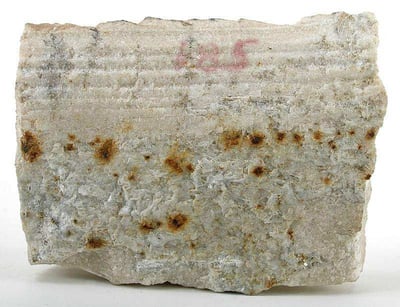
Willemite is usually formed as an alteration of previously existing sphalerite ore bodies, and is usually associated with limestone. It is also found in marble and may be the result of a metamorphism of earlier hemimorphite or smithsonite. Crystals have the form of hexagonal prisms terminated by rhombohedral planes: there are distinct cleavages parallel to the prism-faces and to the base. Granular and cleavage masses are of more common occurrence. It occurs in many places, but is best known from Arizona and the zinc, iron, manganese deposits at Franklin and Sterling Hill Mines in New Jersey. It often occurs with red zincite (zinc oxide) and franklinite (Fe,Mn,Zn)(Fe,Mn)2O4 (an iron rich zinc mineral occurring in sharp black isometric octahedral crystals and masses). Franklinite and zincite are not fluorescent.
More Images

Quick Facts
Physical Properties
- Color
- Colorless, white, pastel green, apple-green, light blue, azure-blue, yellow, burgundy-red, brown, mahogany-brown, gray, black, pink
- Hardness (Mohs)
- 5.5
- Rock tumbling
- With care
- Density
- 4.224 g/cm³
- Streak
- White
- Luster
- Vitreous, Resinous
- Crystal System
- Trigonal
Chemical Properties
- Chemical Formula
- Zn2SiO4
- Elements
- O, Si, Zn
Also Known As
Identify Willemite Instantly
- Snap a photo, get instant results
- 6,700+ rocks, minerals & crystals
- Discover collecting spots near you
Willemite FAQs
How do I identify Willemite?
Willemite can be identified by its hardness of 5.5 on the Mohs scale, Colorless color, Vitreous, Resinous luster, Trigonal crystal system. Look for these key characteristics when examining specimens.
What color is Willemite?
Willemite typically appears in Colorless, white, pastel green, apple-green, light blue, azure-blue, yellow, burgundy-red, brown, mahogany-brown, gray, black, pink. Color can vary depending on impurities and formation conditions.
How hard is Willemite?
Willemite has a hardness of 5.5 on the Mohs scale. This gives it moderate hardness.
What is the formation of willemite of Willemite?
Willemite is usually formed as an alteration of previously existing sphalerite ore bodies, and is usually associated with limestone. It is also found in marble and may be the result of a metamorphism of earlier hemimorphite or smithsonite. Crystals have the form of hexagonal prisms terminated by rhombohedral planes: there are distinct cleavages parallel to the prism-faces and to the base. Granular and cleavage masses are of more common occurrence. It occurs in many places, but is best known from Arizona and the zinc, iron, manganese deposits at Franklin and Sterling Hill Mines in New Jersey. It often occurs with red zincite (zinc oxide) and franklinite (Fe,Mn,Zn)(Fe,Mn)2O4 (an iron rich zinc mineral occurring in sharp black isometric octahedral crystals and masses). Franklinite and zincite are not fluorescent.