Ringwoodite
A variety of Minerals

What is Ringwoodite?
Ringwoodite is a high-pressure phase of Mg2SiO4 (magnesium silicate) formed at high temperatures and pressures of the Earth's mantle between 525 and 660 km (326 and 410 mi) depth. It may also contain iron and hydrogen. It is polymorphous with the olivine phase forsterite (a magnesium iron silicate). Ringwoodite is notable for being able to contain hydroxide ions (oxygen and hydrogen atoms bound together) within its structure. In this case two hydroxide ions usually take the place of a magnesium ion and two oxide ions. Combined with evidence of its occurrence deep in the Earth's mantle, this suggests that there is from one to three times the world ocean's equivalent of water in the mantle transition zone from 410 to 660 km deep. This mineral was first identified in the Tenham meteorite in 1969, and is inferred to be present in large quantities in the Earth’s mantle. Ringwoodite was named after the Australian earth scientist Ted Ringwood (1930–1993), who studied polymorphic phase transitions in the common mantle minerals olivine and pyroxene at pressures equivalent to depths as great as about 600 km. Olivine, wadsleyite, and ringwoodite are polymorphs found in the upper mantle of the earth. At depths greater than about 660 km, other minerals, including some with the perovskite structure, are stable. The properties of these minerals determine many of the properties of the mantle.
Market Value Factors
Pricing varies for every rock and mineral, so use these universal factors to gauge Ringwoodite before comparing listings or appraisals.
Size & Weight
Larger, intact specimens usually command higher prices.
Rarity & Demand
Scarce material or popular varieties sell at a premium.
Condition & Finish
Chips, repairs, and heavy wear lower value; clean prep helps.
Treatment & Provenance
Untreated specimens with documented locality are prized.
Key Characteristics
Characteristics of Ringwoodite
Ringwoodite is polymorphous with forsterite, Mg2SiO4, and has a spinel structure. Spinel group minerals crystallize in the isometric system with an octahedral habit. Olivine is most abundant in the upper mantle, above about 410 km (250 mi); the olivine polymorphs wadsleyite and ringwoodite are thought to dominate the transition zone of the mantle, a zone present from about 410 to 660 km depth. Ringwoodite is thought to be the most abundant mineral phase in the lower part of Earth’s transition zone. The physical and chemical property of this mineral partly determine properties of the mantle at those depths. The pressure range for stability of ringwoodite lies in the approximate range from 18 to 23 GPa. Natural ringwoodite has been found in many shocked chondritic meteorites, in which the ringwoodite occurs as fine-grained polycrystalline aggregates. Natural ringwoodite generally contains much more Mg than Fe but can form a gapless solid solution series from the pure Mg endmember to the pure Fe endmember. The latter has been discovered in a natural sample only recently and was named ahrensite, in honor of US mineral physicist Thomas J. Ahrens (1936–2010).
Composition of Ringwoodite
Ringwoodite has the spinel structure, in the isometric crystal system with space group Fd3m (or F43m). On an atomic scale, magnesium and silicon are in octahedral and tetrahedral coordination with oxygen, respectively. The Si-O and Mg-O bonds are both ionic and covalent. The cubic unit cell parameter is 8.063 Å for pure Mg2SiO4 and 8.234 Å for pure Fe2SiO4.
Quick Facts
Physical Properties
- Color
- Bluish- to smoke- gray, purple, colourless
- Density
- 3.9 g/cm³
Chemical Properties
- Chemical Formula
- (Mg,Fe2+)2SiO4
- Elements
- Fe, Mg, O, Si

Identify Ringwoodite Instantly
- Snap a photo, get instant results
- 6,700+ rocks, minerals & crystals
- Discover collecting spots near you
Ringwoodite FAQs
How do I identify Ringwoodite?
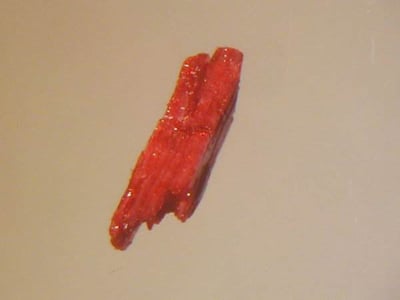
Ringwoodite can be identified by its Bluish- to smoke- gray color. Look for these key characteristics when examining specimens.
What color is Ringwoodite?
Ringwoodite typically appears in Bluish- to smoke- gray, purple, colourless. Color can vary depending on impurities and formation conditions.
What is the characteristics of ringwoodite of Ringwoodite?
Ringwoodite is polymorphous with forsterite, Mg2SiO4, and has a spinel structure. Spinel group minerals crystallize in the isometric system with an octahedral habit. Olivine is most abundant in the upper mantle, above about 410 km (250 mi); the olivine polymorphs wadsleyite and ringwoodite are thought to dominate the transition zone of the mantle, a zone present from about 410 to 660 km depth. Ringwoodite is thought to be the most abundant mineral phase in the lower part of Earth’s transition zone. The physical and chemical property of this mineral partly determine properties of the mantle at those depths. The pressure range for stability of ringwoodite lies in the approximate range from 18 to 23 GPa. Natural ringwoodite has been found in many shocked chondritic meteorites, in which the ringwoodite occurs as fine-grained polycrystalline aggregates. Natural ringwoodite generally contains much more Mg than Fe but can form a gapless solid solution series from the pure Mg endmember to the pure Fe endmember. The latter has been discovered in a natural sample only recently and was named ahrensite, in honor of US mineral physicist Thomas J. Ahrens (1936–2010).
What is the composition of ringwoodite of Ringwoodite?
Ringwoodite has the spinel structure, in the isometric crystal system with space group Fd3m (or F43m). On an atomic scale, magnesium and silicon are in octahedral and tetrahedral coordination with oxygen, respectively. The Si-O and Mg-O bonds are both ionic and covalent. The cubic unit cell parameter is 8.063 Å for pure Mg2SiO4 and 8.234 Å for pure Fe2SiO4.

%252FAbenakiite-(ce)-01.jpg&size=small)

