Rutile
A variety of Rutile Group
What is Rutile?
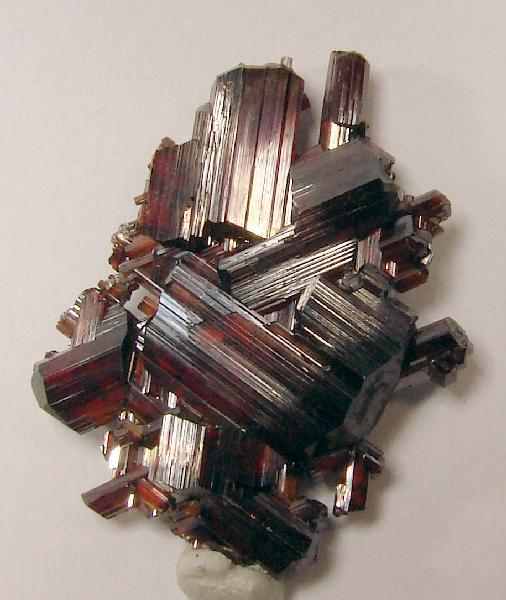
Rutile is a fairly common mineral mined for its titanium, which has many industrial uses (perhaps most famously in airplanes and spacecraft). When powdered, it is also used to make a strong white pigment. Although rarely carved as a gemstone in its own right, long, thin rutile crystal inclusions in other stones can create beautiful patterns, making these crystals more sought after (contrary to the general rule, in which gemstones with inclusions are less valuable).
Uses & Applications
Rutile is commonly used to create white pigment that can then be used in paint or ceramic glazes. It is also an ore for the metal titanium, which is used in a variety of ways, including as jewelry, metal prosthetics, scissors, and surgical tools. Quartz with rutile inclusions makes for a popular gemstone.
Healing Properties
Rutile is believed to be a powerful healing stone. It works on all of the chakras, aligning and activating each one. It is said to remove negative forces and replenish the body with positive energy. It is believed that it can enhance one's mental clarity and bring about greater achievements.
Optical Properties
- Refractive Index
- 2.609-2.903
- Birefringence
- 0.287
- Pleochroism
- Strong
- Optical Character
- Biaxial positive
Market Value Factors
Pricing varies for every rock and mineral, so use these universal factors to gauge Rutile before comparing listings or appraisals.
Size & Weight
Larger, intact specimens usually command higher prices.
Rarity & Demand
Scarce material or popular varieties sell at a premium.
Condition & Finish
Chips, repairs, and heavy wear lower value; clean prep helps.
Treatment & Provenance
Untreated specimens with documented locality are prized.
Where to Find Rutile
RockHoundR, the free-to-download rockhounding map from the Ruby Glint team, shows where collectors find rutile in the US, with land-access notes for BLM land and national forests. Collecting is banned in national parks.
See where to find rutileAlways check the local rules and get the landowner's permission before you collect.
Associated Chakras







Key Characteristics
Formation of Rutile
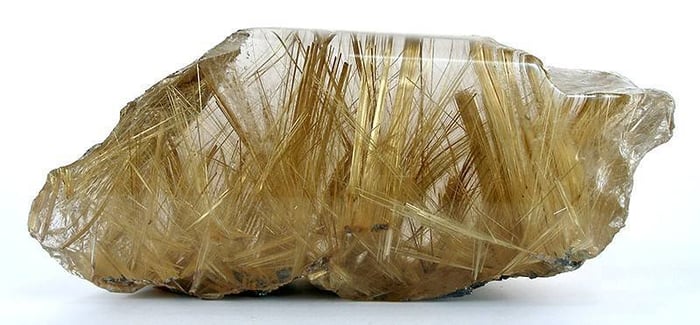
Rutile is a common accessory mineral in high-temperature and high-pressure metamorphic rocks and in igneous rocks. Thermodynamically, rutile is the most stable polymorph of TiO2 at all temperatures, exhibiting lower total free energy than metastable phases of anatase or brookite. Consequently, the transformation of the metastable TiO2 polymorphs to rutile is irreversible. As it has the lowest molecular volume of the three main polymorphs, it is generally the primary titanium bearing phase in most high-pressure metamorphic rocks, chiefly eclogites. Within the igneous environment, rutile is a common accessory mineral in plutonic igneous rocks, though it is also found occasionally in extrusive igneous rocks, particularly those such as kimberlites and lamproites that have deep mantle sources. Anatase and brookite are found in the igneous environment particularly as products of autogenic alteration during the cooling of plutonic rocks; anatase is also found in placer deposits sourced from primary rutile. The occurrence of large specimen crystals is most common in pegmatites, skarns, and granite greisens. Rutile is found as an accessory mineral in some altered igneous rocks, and in certain gneisses and schists. In groups of acicular crystals it is frequently seen penetrating quartz as in the fléches d'amour from Graubünden, Switzerland. In 2005 the Republic of Sierra Leone in West Africa had a production capacity of 23% of the world's annual rutile supply, which rose to approximately 30% in 2008.
Composition of Rutile
Rutile has a tetragonal unit cell, with unit cell parameters a = b = 4.584 Å, and c = 2.953 Å. The titanium cations have a coordination number of 6, meaning they are surrounded by an octahedron of 6 oxygen atoms. The oxygen anions have a coordination number of 3, resulting in a trigonal planar coordination. Rutile also shows a screw axis when its octahedra are viewed sequentially. Rutile crystals are most commonly observed to exhibit a prismatic or acicular growth habit with preferential orientation along their c axis, the [001] direction. This growth habit is favored as the {110} facets of rutile exhibit the lowest surface free energy and are therefore thermodynamically most stable. The c-axis oriented growth of rutile appears clearly in nanorods, nanowires and abnormal grain growth phenomena of this phase.
More Images
Quick Facts
Physical Properties
- Color
- Blood red, brownish yellow, brown-red, yellow, greyish-black, black, brown, bluish, violet
- Hardness (Mohs)
- 6 - 6.5
- Rock tumbling
- With care
- Density
- 4.25 g/cm³
- Streak
- Greyish black, pale brown, light yellow
- Luster
- Metallic, Adamantine
- Crystal System
- Tetragonal
Chemical Properties
- Chemical Formula
- TiO2
- Elements
- O, Ti
Also Known As
Identify Rutile Instantly
- Snap a photo, get instant results
- 6,700+ rocks, minerals & crystals
- Discover collecting spots near you
Rutile FAQs
How do I identify Rutile?
Rutile can be identified by its hardness of 6 - 6.5 on the Mohs scale, Blood red color, Metallic, Adamantine luster, Tetragonal crystal system. Look for these key characteristics when examining specimens.
What color is Rutile?
Rutile typically appears in Blood red, brownish yellow, brown-red, yellow, greyish-black, black, brown, bluish, violet. Color can vary depending on impurities and formation conditions.
How hard is Rutile?
Rutile has a hardness of 6 - 6.5 on the Mohs scale. This gives it moderate hardness.
What is the formation of rutile of Rutile?
Rutile is a common accessory mineral in high-temperature and high-pressure metamorphic rocks and in igneous rocks. Thermodynamically, rutile is the most stable polymorph of TiO2 at all temperatures, exhibiting lower total free energy than metastable phases of anatase or brookite. Consequently, the transformation of the metastable TiO2 polymorphs to rutile is irreversible. As it has the lowest molecular volume of the three main polymorphs, it is generally the primary titanium bearing phase in most high-pressure metamorphic rocks, chiefly eclogites. Within the igneous environment, rutile is a common accessory mineral in plutonic igneous rocks, though it is also found occasionally in extrusive igneous rocks, particularly those such as kimberlites and lamproites that have deep mantle sources. Anatase and brookite are found in the igneous environment particularly as products of autogenic alteration during the cooling of plutonic rocks; anatase is also found in placer deposits sourced from primary rutile. The occurrence of large specimen crystals is most common in pegmatites, skarns, and granite greisens. Rutile is found as an accessory mineral in some altered igneous rocks, and in certain gneisses and schists. In groups of acicular crystals it is frequently seen penetrating quartz as in the fléches d'amour from Graubünden, Switzerland. In 2005 the Republic of Sierra Leone in West Africa had a production capacity of 23% of the world's annual rutile supply, which rose to approximately 30% in 2008.
What is the composition of rutile of Rutile?
Rutile has a tetragonal unit cell, with unit cell parameters a = b = 4.584 Å, and c = 2.953 Å. The titanium cations have a coordination number of 6, meaning they are surrounded by an octahedron of 6 oxygen atoms. The oxygen anions have a coordination number of 3, resulting in a trigonal planar coordination. Rutile also shows a screw axis when its octahedra are viewed sequentially. Rutile crystals are most commonly observed to exhibit a prismatic or acicular growth habit with preferential orientation along their c axis, the [001] direction. This growth habit is favored as the {110} facets of rutile exhibit the lowest surface free energy and are therefore thermodynamically most stable. The c-axis oriented growth of rutile appears clearly in nanorods, nanowires and abnormal grain growth phenomena of this phase.

