Scolecite
A variety of Natrolite Subgroup

What is Scolecite?
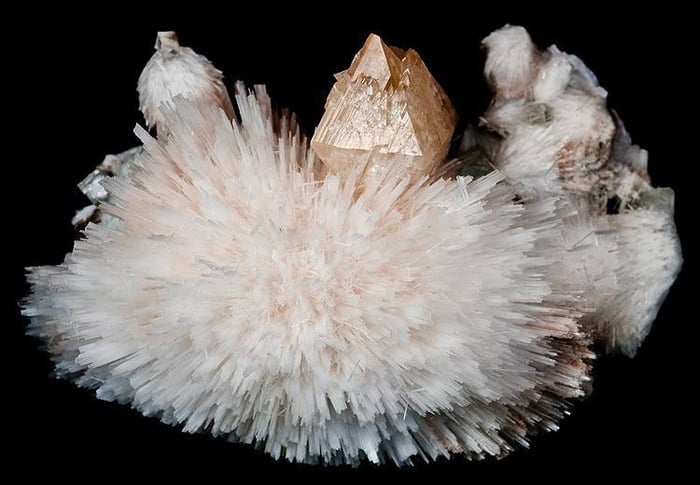
Scolecite is a silicate mineral that is highly prized among mineral collectors. It comes in numerous crystal forms, but usually forms a group of slender crystals. The spray formation is particularly interesting - it resembles an ice sculpture with thin, sharp, needle-like points. It is very similar to Natroline, and these two can be distinguished only by chemical analysis or optical tests.
Etymology & Origins
It was described in 1813, and named from the Greek word, σκώληξ (sko-lecks) = "worm" because of its reaction to the blowpipe flame.
Healing Properties
Scolecite is a transformative stone that can aid with communication with one's spirit guide. It has high vibrations that influence sleep and is often used under a pillow during rest times. It activates the Heart and Thymus chakras to open the user to a higher form of love and joy. It is a peaceful stone that offers a sense of calming energy to allow love and change to flow through.
Optical Properties
- Refractive Index
- 1.512-1.523
- Birefringence
- 0.011
- Optical Character
- Biaxial negative
Market Value Factors
Pricing varies for every rock and mineral, so use these universal factors to gauge Scolecite before comparing listings or appraisals.
Size & Weight
Larger, intact specimens usually command higher prices.
Rarity & Demand
Scarce material or popular varieties sell at a premium.
Condition & Finish
Chips, repairs, and heavy wear lower value; clean prep helps.
Treatment & Provenance
Untreated specimens with documented locality are prized.
Associated Chakras


Key Characteristics
Characteristics of Scolecite
Scolecite is usually colorless or white, but can also be pink, salmon, red or green. It is transparent to translucent, with a white streak and a luster which is vitreous, or silky for fibrous specimens. It has a Mohs hardness of 5 to 5 ⁄2 and a specific gravity in the range 2.16 to 2.40. (2.24 to 2.31 2.25 to 2.29 2.16 to 2.4 2.25 to 2.31). Cleavage is perfect in two directions parallel to the length of the crystals; the mineral is brittle with an irregular fracture. Twinning is common on {100}, twin axis [001], as penetration or contact twins producing V-shaped or fishtail terminations. Scolecite is pyroelectric and piezoelectric, sometimes fluorescent yellow to brown in longwave and shortwave ultraviolet light. It is soluble in common acids. Not radioactive.
Composition of Scolecite
The structure of the aluminosilicate framework is the same for scolecite, natrolite and mesolite. Scolecite has long ordered chains, rotated 24° round the axis of the chain. One Ca cation and three H2O molecules are in four ion sites in the channels parallel to the c crystal axis. There is no sign of aluminium ions occupying silicon ion sites.
More Images
Quick Facts
Physical Properties
- Color
- colorless, white , pink, salmon, red, green
- Hardness (Mohs)
- 5 - 5.5
- Rock tumbling
- With care
- Density
- 2.275 g/cm³
- Streak
- White
- Luster
- Vitreous
- Crystal System
- Monoclinic
Chemical Properties
- Chemical Formula
- CaAl2Si3O10 · 3H2O
- Elements
- Al, Ca, H, O, Si
Also Known As
Identify Scolecite Instantly
- Snap a photo, get instant results
- 6,700+ rocks, minerals & crystals
- Discover collecting spots near you
Scolecite FAQs
How do I identify Scolecite?
Scolecite can be identified by its hardness of 5 - 5.5 on the Mohs scale, colorless color, Vitreous luster, Monoclinic crystal system. Look for these key characteristics when examining specimens.
What color is Scolecite?
Scolecite typically appears in colorless, white , pink, salmon, red, green. Color can vary depending on impurities and formation conditions.
How hard is Scolecite?
Scolecite has a hardness of 5 - 5.5 on the Mohs scale. This gives it moderate hardness.
What is the characteristics of scolecite of Scolecite?
Scolecite is usually colorless or white, but can also be pink, salmon, red or green. It is transparent to translucent, with a white streak and a luster which is vitreous, or silky for fibrous specimens. It has a Mohs hardness of 5 to 5 ⁄2 and a specific gravity in the range 2.16 to 2.40. (2.24 to 2.31 2.25 to 2.29 2.16 to 2.4 2.25 to 2.31). Cleavage is perfect in two directions parallel to the length of the crystals; the mineral is brittle with an irregular fracture. Twinning is common on {100}, twin axis [001], as penetration or contact twins producing V-shaped or fishtail terminations. Scolecite is pyroelectric and piezoelectric, sometimes fluorescent yellow to brown in longwave and shortwave ultraviolet light. It is soluble in common acids. Not radioactive.
What is the composition of scolecite of Scolecite?
The structure of the aluminosilicate framework is the same for scolecite, natrolite and mesolite. Scolecite has long ordered chains, rotated 24° round the axis of the chain. One Ca cation and three H2O molecules are in four ion sites in the channels parallel to the c crystal axis. There is no sign of aluminium ions occupying silicon ion sites.
