Natrolite
A variety of Natrolite Subgroup

What is Natrolite?
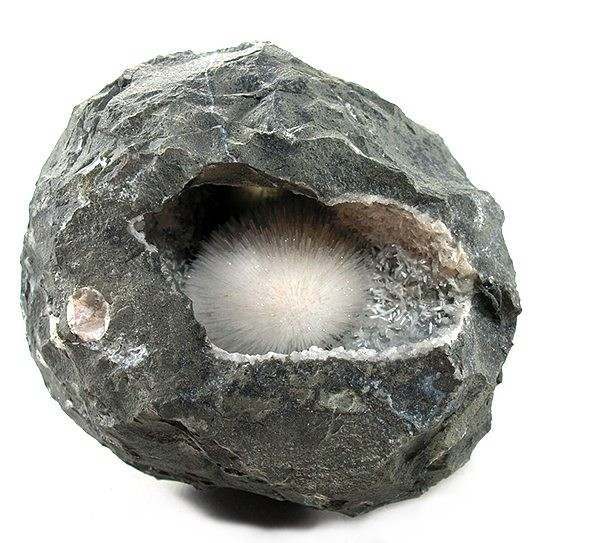
Natrolite is a whitish mineral that can occasionally produce striking and distinctive crystal formations. Long, slender clusters of crystals radiating out from a central point give it a sea-urchin or puff-ball-like appearance. Such exceptional specimens are prized by collectors. Occasionally, natrolite is also used commercially in water purifiers and chemical filtration systems.
Etymology & Origins
It was named natrolite by Martin Heinrich Klaproth in 1803. The name is derived from natron (νατρών), the Greek word for soda, in reference to the sodium content, and lithos (λίθος), meaning stone. Needle stone or needle-zeolite are other informal names, alluding to the common acicular habit of the crystals, which are often very slender and are aggregated in divergent tufts.
Uses & Applications
Natrolite can be used to purify water or filter chemicals from other materials. It is also used as a gemstone, and the striking forms its crystals can take are quite beautiful; large crystals of natrolite are highly prized by collectors.
Healing Properties
Natrolite is believed to be a powerful stone in the practice of Reiki, harmonizing the body's energy and kick-starting physical and emotional healing. Excessive bloating may benefit from natrolite, and it might encourage active toxin removal. The stone's particles are supposedly so tiny that they can infiltrate the body's cells, which is how they remove toxic components.
Optical Properties
- Refractive Index
- 1.478-1.493
- Birefringence
- 0.012-0.013
- Pleochroism
- None
- Optical Character
- Biaxial positive
Market Value Factors
Pricing varies for every rock and mineral, so use these universal factors to gauge Natrolite before comparing listings or appraisals.
Size & Weight
Larger, intact specimens usually command higher prices.
Rarity & Demand
Scarce material or popular varieties sell at a premium.
Condition & Finish
Chips, repairs, and heavy wear lower value; clean prep helps.
Treatment & Provenance
Untreated specimens with documented locality are prized.
Key Characteristics
Rock Types of Natrolite
Several varieties of natrolite have been distinguished by special Nips. Fargite is a red natrolite from Glenfarg in Perthshire. Bergmannite, or Spreustein, is an impure variety which has resulted by the alteration of other minerals, chiefly sodalite, in the augite syenite of southern Norway.
Characteristics of Natrolite
Larger crystals most commonly have the form of a square prism terminated by a low pyramid, the prism angle being nearly a right angle. The crystals are tetragonal in appearance, though actually orthorhombic. There are perfect cleavages parallel to the faces of the prism. The mineral also often occurs in compact fibrous aggregates, the fibers having a divergent or radial arrangement. Natrolite is readily distinguished from other fibrous zeolites by its optical characteristics. Between crossed nicols the fibers extinguish parallel to their length, and they do not show an optic figure in convergent polarized light. Natrolite is usually white or colorless, but sometimes reddish or yellowish. The luster is vitreous, or, in finely fibrous specimens, silky. The specific gravity is 2.2, and the hardness is 5.5. The mineral is readily fusible, melting in a candle-flame to which it imparts a yellow color owing to the presence of sodium. It is decomposed by hydrochloric acid with separation of gelatinous silica.
More Images


Quick Facts
Physical Properties
- Color
- White, Colorless, Red, Yellow, Brown, Green, bluish
- Hardness (Mohs)
- 5 - 5.5
- Rock tumbling
- With care
- Density
- 2.25 g/cm³
- Streak
- White
- Luster
- Pearly, Vitreous
- Crystal System
- Orthorhombic
Chemical Properties
- Chemical Formula
- Na2Al2Si3O10 · 2H2O
- Elements
- Al, H, Na, O, Si
Also Known As
Identify Natrolite Instantly
- Snap a photo, get instant results
- 6,700+ rocks, minerals & crystals
- Discover collecting spots near you
Natrolite FAQs
How do I identify Natrolite?
Natrolite can be identified by its hardness of 5 - 5.5 on the Mohs scale, White color, Pearly, Vitreous luster, Orthorhombic crystal system. Look for these key characteristics when examining specimens.
What color is Natrolite?
Natrolite typically appears in White, Colorless, Red, Yellow, Brown, Green, bluish. Color can vary depending on impurities and formation conditions.
How hard is Natrolite?
Natrolite has a hardness of 5 - 5.5 on the Mohs scale. This gives it moderate hardness.
What is the rock types of natrolite of Natrolite?
Several varieties of natrolite have been distinguished by special Nips. Fargite is a red natrolite from Glenfarg in Perthshire. Bergmannite, or Spreustein, is an impure variety which has resulted by the alteration of other minerals, chiefly sodalite, in the augite syenite of southern Norway.
What is the characteristics of natrolite of Natrolite?
Larger crystals most commonly have the form of a square prism terminated by a low pyramid, the prism angle being nearly a right angle. The crystals are tetragonal in appearance, though actually orthorhombic. There are perfect cleavages parallel to the faces of the prism. The mineral also often occurs in compact fibrous aggregates, the fibers having a divergent or radial arrangement. Natrolite is readily distinguished from other fibrous zeolites by its optical characteristics. Between crossed nicols the fibers extinguish parallel to their length, and they do not show an optic figure in convergent polarized light. Natrolite is usually white or colorless, but sometimes reddish or yellowish. The luster is vitreous, or, in finely fibrous specimens, silky. The specific gravity is 2.2, and the hardness is 5.5. The mineral is readily fusible, melting in a candle-flame to which it imparts a yellow color owing to the presence of sodium. It is decomposed by hydrochloric acid with separation of gelatinous silica.
