Siderite
A variety of Calcite Group

What is Siderite?
Siderite is an economically-important mineral that is often mined as an ore of iron. The mineral is also sometimes called "Chalybite", especially when it comes from Cornwall, England. Siderite crystals, which are typically tan, grey, yellow, or honey-colored, are soft and brittle - although the occasional exceptional specimen may be carved into a gemstone, sought after only by highly specialized collectors.
Etymology & Origins
It takes its name from the Greek word σίδηρος sideros, "iron". It is a valuable iron mineral, since it is 48% iron and contains no sulfur or phosphorus.
Uses & Applications
Siderite can be used as an ore for iron, though it is only found in a few places in the world. Often, it is processed into a form called "pig iron" that is extremely strong and heat resistant, making it useful to create furnaces. When ground into a powder, it can also be used to create brown pigments.
Healing Properties
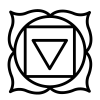
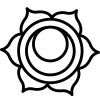
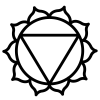
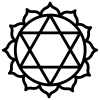
Siderite is believed to provide positive energy and can help enhance one's career and provide stability in employment. It works on all of the chakras and is said to enrich every aspect of the mind, body and spirit. Carry it in your pocket to keep all the chakras aligned.
Optical Properties
- Refractive Index
- 1.633-1.875
- Birefringence
- 0.24
- Pleochroism
- None
- Optical Character
- Uniaxial negative
Market Value Factors
Pricing varies for every rock and mineral, so use these universal factors to gauge Siderite before comparing listings or appraisals.
Size & Weight
Larger, intact specimens usually command higher prices.
Rarity & Demand
Scarce material or popular varieties sell at a premium.
Condition & Finish
Chips, repairs, and heavy wear lower value; clean prep helps.
Treatment & Provenance
Untreated specimens with documented locality are prized.
Where to Find Siderite
RockHoundR, the free-to-download rockhounding map from the Ruby Glint team, shows where collectors find siderite in the US, with land-access notes for BLM land and national forests. Collecting is banned in national parks.
See where to find sideriteAlways check the local rules and get the landowner's permission before you collect.
Associated Chakras

Key Characteristics
Formation of Siderite
Siderite is commonly found in hydrothermal veins, and is associated with barite, fluorite, galena, and others. It is also a common diagenetic mineral in shales and sandstones, where it sometimes forms concretions, which can encase three-dimensionally preserved fossils. In sedimentary rocks, siderite commonly forms at shallow burial depths and its elemental composition is often related to the depositional environment of the enclosing sediments. In addition, a number of recent studies have used the oxygen isotopic composition of sphaerosiderite (a type associated with soils) as a proxy for the isotopic composition of meteoric water shortly after deposition.
More Images


Quick Facts
Physical Properties
- Color
- Yellowish-brown to greyish-brown, pale yellow to tannish, grey, brown, green, red, black, sometimes, nearly colourless, tarnished iridescent at times, colourless to yellow, yellow-brown in transmitted light
- Hardness (Mohs)
- 3.5 - 4.5
- Rock tumbling
- Not recommended
- Density
- 3.932 g/cm³
- Streak
- White
- Luster
- Pearly, Vitreous, Silky
- Crystal System
- Trigonal
Chemical Properties
- Chemical Formula
- FeCO3
- Elements
- C, Fe, O
Also Known As
Identify Siderite Instantly
- Snap a photo, get instant results
- 6,700+ rocks, minerals & crystals
- Discover collecting spots near you
Siderite FAQs
How do I identify Siderite?
Siderite can be identified by its hardness of 3.5 - 4.5 on the Mohs scale, Yellowish-brown to greyish-brown color, Pearly, Vitreous, Silky luster, Trigonal crystal system. Look for these key characteristics when examining specimens.
What color is Siderite?
Siderite typically appears in Yellowish-brown to greyish-brown, pale yellow to tannish, grey, brown, green, red, black, sometimes, nearly colourless, tarnished iridescent at times, colourless to yellow, yellow-brown in transmitted light. Color can vary depending on impurities and formation conditions.
How hard is Siderite?
Siderite has a hardness of 3.5 - 4.5 on the Mohs scale. This gives it moderate hardness.
What is the formation of siderite of Siderite?
Siderite is commonly found in hydrothermal veins, and is associated with barite, fluorite, galena, and others. It is also a common diagenetic mineral in shales and sandstones, where it sometimes forms concretions, which can encase three-dimensionally preserved fossils. In sedimentary rocks, siderite commonly forms at shallow burial depths and its elemental composition is often related to the depositional environment of the enclosing sediments. In addition, a number of recent studies have used the oxygen isotopic composition of sphaerosiderite (a type associated with soils) as a proxy for the isotopic composition of meteoric water shortly after deposition.


