Smithsonite
A variety of Calcite Group

What is Smithsonite?
Smithsonite is a tricky mineral to correctly identify because it can present itself in various colors. Centuries ago, it was once the primary source for zinc mining; however, other minerals have now taken its place. This crystal is too soft to be very useful in the gem trade. It was given the name smithsonite after James Smithson, of Smithsonian Museum fame.
Etymology & Origins
Historically, smithsonite was identified with hemimorphite before it was realized that they were two different minerals. The two minerals are very similar in appearance and the term calamine has been used for both, leading to some confusion. The distinct mineral smithsonite was named in 1832 by François Sulpice Beudant in honor of English chemist and mineralogist James Smithson (c.1765–1829), whose bequest established the Smithsonian Institution and who first identified the mineral in 1802.
Uses & Applications
Smithsonite is an important source of zinc in some areas. Zinc is added to vitamin supplements and is used in applications such as pennies, tires, paint, sunscreen, batteries, galvanizing metals, and making alloys. Smithsonite also used as an ornamental stone and gemstone.
Healing Properties
Smithsonite is often used to reduce stress and calm emotions. Many say it is a powerful stone that helps declutter the mind, improve clarity and allow for better resolutions when used during challenging times. It is believed to help with depression, low energy levels, and shyness. Use of this stone can empower a person to find their inner strengths and become confident in their decision making.
Optical Properties
- Refractive Index
- 1.620-1.850
- Birefringence
- 0.228
- Pleochroism
- None
- Optical Character
- Uniaxial negative
- Dispersion
- 0.014-0.031
Market Value Factors
Pricing varies for every rock and mineral, so use these universal factors to gauge Smithsonite before comparing listings or appraisals.
Size & Weight
Larger, intact specimens usually command higher prices.
Rarity & Demand
Scarce material or popular varieties sell at a premium.
Condition & Finish
Chips, repairs, and heavy wear lower value; clean prep helps.
Treatment & Provenance
Untreated specimens with documented locality are prized.
Where to Find Smithsonite
RockHoundR, the free-to-download rockhounding map from the Ruby Glint team, shows where collectors find smithsonite in the US, with land-access notes for BLM land and national forests. Collecting is banned in national parks.
See where to find smithsoniteAlways check the local rules and get the landowner's permission before you collect.
Associated Chakras







Key Characteristics
Characteristics of Smithsonite
Smithsonite is a variably colored trigonal mineral which only rarely is found in well formed crystals. The typical habit is as earthy botryoidal masses. It has a Mohs hardness of 4.5 and a specific gravity of 4.4 to 4.5.
Formation of Smithsonite
Smithsonite occurs as a secondary mineral in the weathering or oxidation zone of zinc-bearing ore deposits. It sometimes occurs as replacement bodies in carbonate rocks and as such may constitute zinc ore. It commonly occurs in association with hemimorphite, willemite, hydrozincite, cerussite, malachite, azurite, aurichalcite and anglesite. It forms two limited solid solution series, with substitution of manganese leading to rhodochrosite, and with iron, leading to siderite.
Health & Safety Information
- ⚠️Smithsonite dust is toxic because it contains heavy metals Zinc.
- ⚠️Zinc
- ⚠️Smithsonite is safe to handle in its finished, polished state, but excessive exposure to its dust may lead to heavy metal poisoning. When cutting or polishing smithsonite, wear a dust mask to minimize dust inhalation. Store it in a sealed container in a well-ventilated area, away from children and pets. For those involved in crystal healing, never put it in your mouth.
More Images


Quick Facts
Physical Properties
- Color
- White, grey, yellow, green to apple-green, blue, pink, purple, bluish grey, brown, colourless, faintly tinted
- Hardness (Mohs)
- 4 - 4.5
- Rock tumbling
- Not recommended
- Density
- 4.43 g/cm³
- Streak
- White
- Luster
- Pearly, Vitreous
- Crystal System
- Trigonal
Chemical Properties
- Chemical Formula
- ZnCO3
- Elements
- C, O, Zn
Also Known As
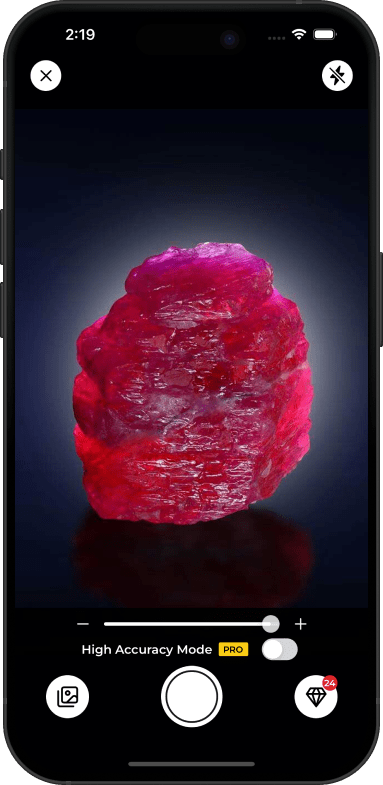
Identify Smithsonite Instantly
- Snap a photo, get instant results
- 6,700+ rocks, minerals & crystals
- Discover collecting spots near you
Smithsonite FAQs
How do I identify Smithsonite?
Smithsonite can be identified by its hardness of 4 - 4.5 on the Mohs scale, White color, Pearly, Vitreous luster, Trigonal crystal system. Look for these key characteristics when examining specimens.
What color is Smithsonite?
Smithsonite typically appears in White, grey, yellow, green to apple-green, blue, pink, purple, bluish grey, brown, colourless, faintly tinted. Color can vary depending on impurities and formation conditions.
How hard is Smithsonite?
Smithsonite has a hardness of 4 - 4.5 on the Mohs scale. This gives it moderate hardness.
What is the characteristics of smithsonite of Smithsonite?
Smithsonite is a variably colored trigonal mineral which only rarely is found in well formed crystals. The typical habit is as earthy botryoidal masses. It has a Mohs hardness of 4.5 and a specific gravity of 4.4 to 4.5.
What is the formation of smithsonite of Smithsonite?
Smithsonite occurs as a secondary mineral in the weathering or oxidation zone of zinc-bearing ore deposits. It sometimes occurs as replacement bodies in carbonate rocks and as such may constitute zinc ore. It commonly occurs in association with hemimorphite, willemite, hydrozincite, cerussite, malachite, azurite, aurichalcite and anglesite. It forms two limited solid solution series, with substitution of manganese leading to rhodochrosite, and with iron, leading to siderite.


