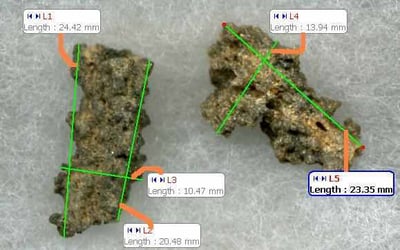
Tektite
A variety of Metamorphic

What is Tektite?
Tektite is a small, pebble-like, glassy object probably formed during meteorite impacts. Its name, Tektite, is derived from the Greek word tektos, which means molten. They were known to humans since ancient times - the first known mention dates back to China around 900 BC, but they still pose many questions to the scientific community. Tektite can vary in size from millimeters to centimeters.
Uses & Applications
Tektite was used by the ancient Greeks and other cultures around the world as talismans, often worn or carried. The stone is still used for these purposes, often as a necklace. Meditation centers often display the rock, sometimes as small pebbles in a bowl. Larger stones are sometimes formed into decorative and spiritual artwork.
Healing Properties
Tektite activates all of the chakras for complete healing. When used specifically on the Third Eye chakra, this stone can bring greater spiritual understanding. Its calming energy encourages peace of mind and relaxation. Tektite aims to improve self-discipline, provide a sense of purpose, and strengthen motivation.
Optical Properties
- Refractive Index
- 1.490-1.520
Discover Values
Market Value Factors
Pricing varies for every rock and mineral, so use these universal factors to gauge Tektite before comparing listings or appraisals.
Size & Weight
Larger, intact specimens usually command higher prices.
Rarity & Demand
Scarce material or popular varieties sell at a premium.
Condition & Finish
Chips, repairs, and heavy wear lower value; clean prep helps.
Treatment & Provenance
Untreated specimens with documented locality are prized.
The Meaning
Due to its scarcity, tektite was prized as a very valuable stone that was thought to bring good luck, so it was often carved into amulets and talismans. According to a certain legend, tektite stones were the fallen emeralds from the sky. In some cultures, the stone was associated with fertility.
Associated Chakras







Key Characteristics
Characteristics of Tektite
a fairly homogeneous composition an extremely low content of water and other volatiles an abundance of lechatelierite a general lack of microscopic crystals known as microlites and chemical relation to the local bedrock or local sediments their distribution within geographically extensive strewn fields
Formation of Tektite
Since 1963, the majority of known tektites have been known to occur only within four geographically extensive strewn fields: the Australasian, Central European, Ivory Coast, and North American.[8][9] As summarized by Koeberl,[10] the tektites within each strewn field are related to each other with respect to the criteria of petrological, physical, and chemical properties, as well as their age. In addition, three of the four strewn fields have been clearly linked with impact craters using those same criteria.
Composition of Tektite
Varies; color can be caused by Fe2+ (for yellowish greens) and Fe3+ (for browns)
Health & Safety Information
- ⚠️Quartz, silica, crystalline silica and flint are non-toxic materials, but very fine dust containing quartz, known as respirable crystalline silicon (RCS), can cause serious and fatal lung disease. Lapidaries should exercise caution when cutting silica.
More Images

Quick Facts
Physical Properties
- Color
- Black, gray, brown, etc.
- Hardness (Mohs)
- 5 - 6.5
- Rock tumbling
- With care
- Density
- 2.33 - 3 g/cm³
- Luster
- Vitreous, Dull
Also Known As
Identify Tektite Instantly
- Snap a photo, get instant results
- 6,700+ rocks, minerals & crystals
- Discover collecting spots near you
Tektite FAQs
How do I identify Tektite?
Tektite can be identified by its hardness of 5 - 6.5 on the Mohs scale, Black color, Vitreous, Dull luster. Look for these key characteristics when examining specimens.
What color is Tektite?
Tektite typically appears in Black, gray, brown, etc.. Color can vary depending on impurities and formation conditions.
How hard is Tektite?
Tektite has a hardness of 5 - 6.5 on the Mohs scale. This gives it moderate hardness.
What is the characteristics of tektite of Tektite?
a fairly homogeneous composition an extremely low content of water and other volatiles an abundance of lechatelierite a general lack of microscopic crystals known as microlites and chemical relation to the local bedrock or local sediments their distribution within geographically extensive strewn fields
What is the formation of tektite of Tektite?
Since 1963, the majority of known tektites have been known to occur only within four geographically extensive strewn fields: the Australasian, Central European, Ivory Coast, and North American.[8][9] As summarized by Koeberl,[10] the tektites within each strewn field are related to each other with respect to the criteria of petrological, physical, and chemical properties, as well as their age. In addition, three of the four strewn fields have been clearly linked with impact craters using those same criteria.
What is the composition of tektite of Tektite?
Varies; color can be caused by Fe2+ (for yellowish greens) and Fe3+ (for browns)