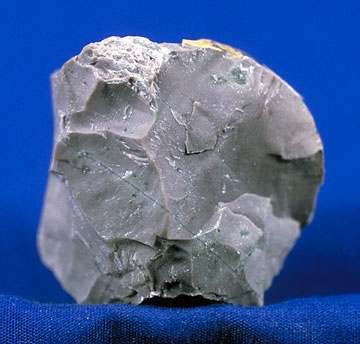
Chalk
A variety of Sedimentary

What is Chalk?
Chalk is a soft, white, porous, sedimentary carbonate rock, a form of limestone composed of the mineral calcite and originally formed deep under the sea by the compression of sub-microscopic plankton which had fallen to the sea floor. Chalk is common throughout Western Europe, where deposits underlie parts of France, and steep cliffs are often seen where they meet the sea in places such as the Dover cliffs on the Kent coast of the English Channel. Chalk is mined for use in industry, such as for quicklime, bricks and builder's putty, and in agriculture, for raising pH in soils with high acidity. It is also used for "blackboard chalk" for writing and drawing on various types of surfaces, although these can also be manufactured from other carbonate-based minerals, or gypsum.
Uses & Applications
Most people first encounter chalk in school where it refers to blackboard chalk, which was originally made of mineral chalk, since it readily crumbles and leaves particles that stick loosely to rough surfaces, allowing it to make writing that can be readily erased. Blackboard chalk manufacturers now may use mineral chalk, other mineral sources of calcium carbonate, or the mineral gypsum (calcium sulfate). While gypsum-based blackboard chalk is the lowest cost to produce, and thus widely used in the developing world, use of carbonate-based chalk produces larger particles and thus less dust, and it is marketed as "dustless chalk". Coloured chalks, pastel chalks, and sidewalk chalk (shaped into larger sticks and often coloured), used to draw on sidewalks, streets, and driveways, are primarily made of gypsum rather than calcium carbonate chalk. Chalk is a source of quicklime by thermal decomposition, or slaked lime following quenching of quicklime with water. In southeast England, deneholes are a notable example of ancient chalk pits. Such bell pits may also mark the sites of ancient flint mines, where the prime object was to remove flint nodules for stone tool manufacture. The surface remains at Cissbury are one such example, but perhaps the most famous is the extensive complex at Grimes Graves in Norfolk. Woodworking joints may be fitted by chalking one of the mating surfaces. A trial fit will leave a chalk mark on the high spots of the corresponding surface. Chalk transferring to cover the complete surface indicates a good fit. Builder's putty also mainly contains chalk as a filler in linseed oil. Chalk may be used for its properties as a base. In agriculture, chalk is used for raising pH in soils with high acidity. The most common forms are CaCO3 (calcium carbonate) and CaO (calcium oxide). Small doses of chalk can also be used as an antacid. Additionally, the small particles of chalk make it a substance ideal for cleaning and polishing. For example, toothpaste commonly contains small amounts of chalk, which serves as a mild abrasive. Polishing chalk is chalk prepared with a carefully controlled grain size, for very fine polishing of metals. Chalk can also be used as fingerprint powder.
Market Value Factors
Pricing varies for every rock and mineral, so use these universal factors to gauge Chalk before comparing listings or appraisals.
Size & Weight
Larger, intact specimens usually command higher prices.
Rarity & Demand
Scarce material or popular varieties sell at a premium.
Condition & Finish
Chips, repairs, and heavy wear lower value; clean prep helps.
Treatment & Provenance
Untreated specimens with documented locality are prized.
Key Characteristics
Formation of Chalk
Chalk was formed in the Cretaceous, between 99 and 65 million years ago. Ninety million years ago what is now the chalk downland of Northern Europe was ooze accumulating at the bottom of a great sea. Chalk was one of the earliest rocks, made up of microscopic particles to be studied under the microscope, when it was found to be composed almost entirely of coccoliths. Their shells were made of calcite extracted from the rich seawater. As they died, a substantial layer gradually built up over millions of years and, through the weight of overlying sediments, eventually became consolidated into rock. Later earth movements related to the formation of the European Alps raised these former sea-floor deposits above sea level. It forms under reasonably deep marine conditions from the gradual accumulation of minute calcite shells of single-celled marine animals known as foraminifera, microscopic fragments of larger ostracods and bivalves, and from the calcareous remains (coccoliths) shed from a type of single-celled algae called coccolithophores. The foraminifera fall to the sea floor and are then consolidated and compressed during diagenesis into chalk rock.
Composition of Chalk
Chalk is a type of sedimentary rock of a carbonate type.
More Images


Quick Facts
Physical Properties
- Color
- White, Grey
- Streak
- White
Chemical Properties

Identify Chalk Instantly
- Snap a photo, get instant results
- 6,700+ rocks, minerals & crystals
- Discover collecting spots near you
Chalk FAQs
How do I identify Chalk?
Chalk can be identified by its White color. Look for these key characteristics when examining specimens.
What color is Chalk?
Chalk typically appears in White, Grey. Color can vary depending on impurities and formation conditions.
What is the formation of chalk of Chalk?
Chalk was formed in the Cretaceous, between 99 and 65 million years ago. Ninety million years ago what is now the chalk downland of Northern Europe was ooze accumulating at the bottom of a great sea. Chalk was one of the earliest rocks, made up of microscopic particles to be studied under the microscope, when it was found to be composed almost entirely of coccoliths. Their shells were made of calcite extracted from the rich seawater. As they died, a substantial layer gradually built up over millions of years and, through the weight of overlying sediments, eventually became consolidated into rock. Later earth movements related to the formation of the European Alps raised these former sea-floor deposits above sea level. It forms under reasonably deep marine conditions from the gradual accumulation of minute calcite shells of single-celled marine animals known as foraminifera, microscopic fragments of larger ostracods and bivalves, and from the calcareous remains (coccoliths) shed from a type of single-celled algae called coccolithophores. The foraminifera fall to the sea floor and are then consolidated and compressed during diagenesis into chalk rock.
What is the composition of chalk of Chalk?
Chalk is a type of sedimentary rock of a carbonate type.