Descloizite
A variety of Adelite-descloizite Group

What is Descloizite?
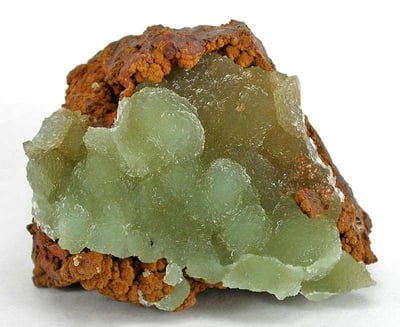
Descloizite, named for a 19th century French minerologist, is a rare mineral that often sports a distinctive, glassy appearance. Crystals of descloizite may range in hue from black to brown to deep red (impressively-colored specimens like these are highly sought after). This mineral is occasionally mined for its lead or zinc.
Etymology & Origins
It was discovered in the Sierra de Córdoba deposit in Córdoba, Argentina in 1854 and named in honor of the French mineralogist Alfred Des Cloizeaux (1817–1897).
Uses & Applications
Descloizite is largely composed of lead and zinc, but it is such a rare mineral that it is not a very valuable ore for either element. It is primarily valued as a collectors item, though its close association with other lead-bearing minerals make it a good indicator of lead nearby.
Market Value Factors
Pricing varies for every rock and mineral, so use these universal factors to gauge Descloizite before comparing listings or appraisals.
Size & Weight
Larger, intact specimens usually command higher prices.
Rarity & Demand
Scarce material or popular varieties sell at a premium.
Condition & Finish
Chips, repairs, and heavy wear lower value; clean prep helps.
Treatment & Provenance
Untreated specimens with documented locality are prized.
Key Characteristics
Rock Types of Descloizite
A variety known as cuprodescloizite is dull green in color; it contains a considerable amount of copper replacing zinc and some arsenic replacing vanadium. There is also an arsenate analogue called arsendescloizite.
Formation of Descloizite
It was discovered in the Sierra de Córdoba deposit in Córdoba, Argentina in 1854 and named in honor of the French mineralogist Alfred Des Cloizeaux (1817–1897). It occurs as small prismatic or pyramidal crystals, usually forming drusy crusts and stalactitic aggregates; also as fibrous encrusting masses with a mammillary surface. Descloizite occurs in oxidised portions of veins of lead ores in association with pyromorphite, vanadinite, wulfenite, mottramite, mimetite and cerussite. The Otavi ("O-tarvi") Mountainland of northern Namibia was once considered home to the greatest vanadium deposits in the world, including those at Berg Aukas ("OW-cuss"), Abenab ("UB-en-ub"), Baltika ("BUL-tika") and Uitsab ("ATE-sub"). Descloizite and mottramite were the main ore minerals in each of these deposits, which are now exhausted. Other localities are the Sierra de Cordoba in Argentina; Lake Valley in Sierra County, New Mexico; Arizona; Phoenixville in Pennsylvania and Obir, Carinthia Austria.
Health & Safety Information
- ⚠️Descloizite dust is toxic because it contains heavy metals Lead, Zinc, Vanadium.
- ⚠️Lead, Zinc, Vanadium
- ⚠️It's advisable to handle descloizite carefully to avoid generating dust and wash hands thoroughly afterward. When cutting or polishing descloizite, wear a dust mask to prevent inhaling heavy metal particles. Store descloizite in a sealed container in a well-ventilated area, away from children and pets. For those involved in crystal healing, never put it in your mouth.
More Images

Quick Facts
Physical Properties
- Color
- Brownish red, red-orange, reddish brown to blackish brown, nearly black
- Hardness (Mohs)
- 3 - 3.5
- Rock tumbling
- Not recommended
- Density
- 6.202 g/cm³
- Streak
- Orange to brownish red
- Luster
- Greasy, Resinous, Waxy, Sub-vitreous
- Crystal System
- Orthorhombic
Chemical Properties
- Chemical Formula
- PbZn(VO4)(OH)
- Elements
- H, O, Pb, V, Zn
Also Known As
Identify Descloizite Instantly
- Snap a photo, get instant results
- 6,700+ rocks, minerals & crystals
- Discover collecting spots near you
Descloizite FAQs
How do I identify Descloizite?
Descloizite can be identified by its hardness of 3 - 3.5 on the Mohs scale, Brownish red color, Greasy, Resinous, Waxy, Sub-vitreous luster, Orthorhombic crystal system. Look for these key characteristics when examining specimens.
What color is Descloizite?
Descloizite typically appears in Brownish red, red-orange, reddish brown to blackish brown, nearly black. Color can vary depending on impurities and formation conditions.
How hard is Descloizite?
Descloizite has a hardness of 3 - 3.5 on the Mohs scale. This makes it a soft mineral that can be scratched easily.
What is the rock types of descloizite of Descloizite?
A variety known as cuprodescloizite is dull green in color; it contains a considerable amount of copper replacing zinc and some arsenic replacing vanadium. There is also an arsenate analogue called arsendescloizite.
What is the formation of descloizite of Descloizite?
It was discovered in the Sierra de Córdoba deposit in Córdoba, Argentina in 1854 and named in honor of the French mineralogist Alfred Des Cloizeaux (1817–1897). It occurs as small prismatic or pyramidal crystals, usually forming drusy crusts and stalactitic aggregates; also as fibrous encrusting masses with a mammillary surface. Descloizite occurs in oxidised portions of veins of lead ores in association with pyromorphite, vanadinite, wulfenite, mottramite, mimetite and cerussite. The Otavi ("O-tarvi") Mountainland of northern Namibia was once considered home to the greatest vanadium deposits in the world, including those at Berg Aukas ("OW-cuss"), Abenab ("UB-en-ub"), Baltika ("BUL-tika") and Uitsab ("ATE-sub"). Descloizite and mottramite were the main ore minerals in each of these deposits, which are now exhausted. Other localities are the Sierra de Cordoba in Argentina; Lake Valley in Sierra County, New Mexico; Arizona; Phoenixville in Pennsylvania and Obir, Carinthia Austria.