Mottramite
A variety of Adelite-descloizite Group

What is Mottramite?
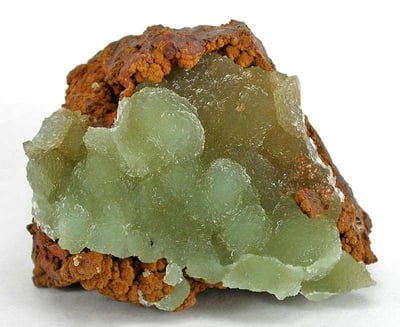
Mottramite is a unique mineral regarded for its yellow-green and brown bumpy appearance. It is relatively brittle and nearly opaque in color. This mineral is a secondary mineral usually found with vanadium in oxidized zones, which means that those areas have been exposed to water containing oxygen and other gases and have been subjected to other chemical reactions.
Uses & Applications
Mottramite forms in the oxidized portions of copper-lead deposits, making it an occasional ore for lead and copper. Both metals are essential for a wide variety of industries and applications, which makes mottramite valuable. This mineral is also occasionally cut into gemstones and sought after for mineral collections.
Market Value Factors
Pricing varies for every rock and mineral, so use these universal factors to gauge Mottramite before comparing listings or appraisals.
Size & Weight
Larger, intact specimens usually command higher prices.
Rarity & Demand
Scarce material or popular varieties sell at a premium.
Condition & Finish
Chips, repairs, and heavy wear lower value; clean prep helps.
Treatment & Provenance
Untreated specimens with documented locality are prized.
Key Characteristics
Characteristics of Mottramite
No cleavage has been observed. The mineral is brittle and breaks with a subconchoidal to uneven fracture. It is quite soft, with Mohs hardness 3 to 3 ⁄2, just a little harder than calcite. The hardness is slightly greater on crystal surfaces. It is a heavy mineral, with specific gravity 5.9, because of the lead content. It is readily soluble in acids.
Appearance of Mottramite
Drusy crusts of tiny intergrown crystals are common, also encrustations and mammillary or botryoidal surfaces. The crystals are equant dipyramids or prisms parallel to the c crystal axis, but always microscopic. The colour is various shades of green, yellow-green, blackish brown or nearly black. Crystals often grow step by step, with the different steps or zones having different colours. The streak is yellowish green, or yellow, and the crystals are transparent to opaque, with a greasy lustre.
Formation of Mottramite
The type locality is Mottram St Andrew, Cheshire, England, UK and type material is conserved at the Natural History Museum, London 52314-52315. Mottramite is a secondary, supergene mineral found principally in the oxidized zones of vanadium bearing base metal deposits, especially sandstones. Associated minerals are descloizite, duftite, mimetite, wulfenite, cerussite, azurite and dioptase.
Health & Safety Information
- ⚠️Mottramite dust is toxic because it contains heavy metals Lead, Copper, Vanadium.
- ⚠️Lead, Copper, Vanadium
- ⚠️It's advisable to handle mottramite carefully to avoid generating dust and wash hands thoroughly afterward. When cutting or polishing mottramite, wear a dust mask to prevent inhaling heavy metal particles. Store mottramite in a sealed container in a well-ventilated area, away from children and pets. For those involved in crystal healing, never put it in your mouth.
More Images


Quick Facts
Physical Properties
- Color
- Grass-green, olive-green, yellow-green, siskin-green, blackish brown, nearly black
- Hardness (Mohs)
- 3 - 3.5
- Rock tumbling
- Not recommended
- Density
- 6.187 g/cm³
- Streak
- Yellowish green
- Luster
- Greasy
- Crystal System
- Orthorhombic
Chemical Properties
- Chemical Formula
- PbCu(VO4)(OH)
- Elements
- Cu, H, O, Pb, V
Also Known As
Identify Mottramite Instantly
- Snap a photo, get instant results
- 6,700+ rocks, minerals & crystals
- Discover collecting spots near you
Mottramite FAQs
How do I identify Mottramite?
Mottramite can be identified by its hardness of 3 - 3.5 on the Mohs scale, Grass-green color, Greasy luster, Orthorhombic crystal system. Look for these key characteristics when examining specimens.
What color is Mottramite?
Mottramite typically appears in Grass-green, olive-green, yellow-green, siskin-green, blackish brown, nearly black. Color can vary depending on impurities and formation conditions.
How hard is Mottramite?
Mottramite has a hardness of 3 - 3.5 on the Mohs scale. This makes it a soft mineral that can be scratched easily.
What is the characteristics of mottramite of Mottramite?
No cleavage has been observed. The mineral is brittle and breaks with a subconchoidal to uneven fracture. It is quite soft, with Mohs hardness 3 to 3 ⁄2, just a little harder than calcite. The hardness is slightly greater on crystal surfaces. It is a heavy mineral, with specific gravity 5.9, because of the lead content. It is readily soluble in acids.
What is the appearance of mottramite of Mottramite?
Drusy crusts of tiny intergrown crystals are common, also encrustations and mammillary or botryoidal surfaces. The crystals are equant dipyramids or prisms parallel to the c crystal axis, but always microscopic. The colour is various shades of green, yellow-green, blackish brown or nearly black. Crystals often grow step by step, with the different steps or zones having different colours. The streak is yellowish green, or yellow, and the crystals are transparent to opaque, with a greasy lustre.
What is the formation of mottramite of Mottramite?
The type locality is Mottram St Andrew, Cheshire, England, UK and type material is conserved at the Natural History Museum, London 52314-52315. Mottramite is a secondary, supergene mineral found principally in the oxidized zones of vanadium bearing base metal deposits, especially sandstones. Associated minerals are descloizite, duftite, mimetite, wulfenite, cerussite, azurite and dioptase.