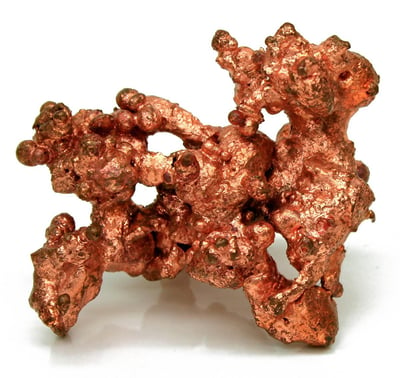
Gold
A variety of Copper Group
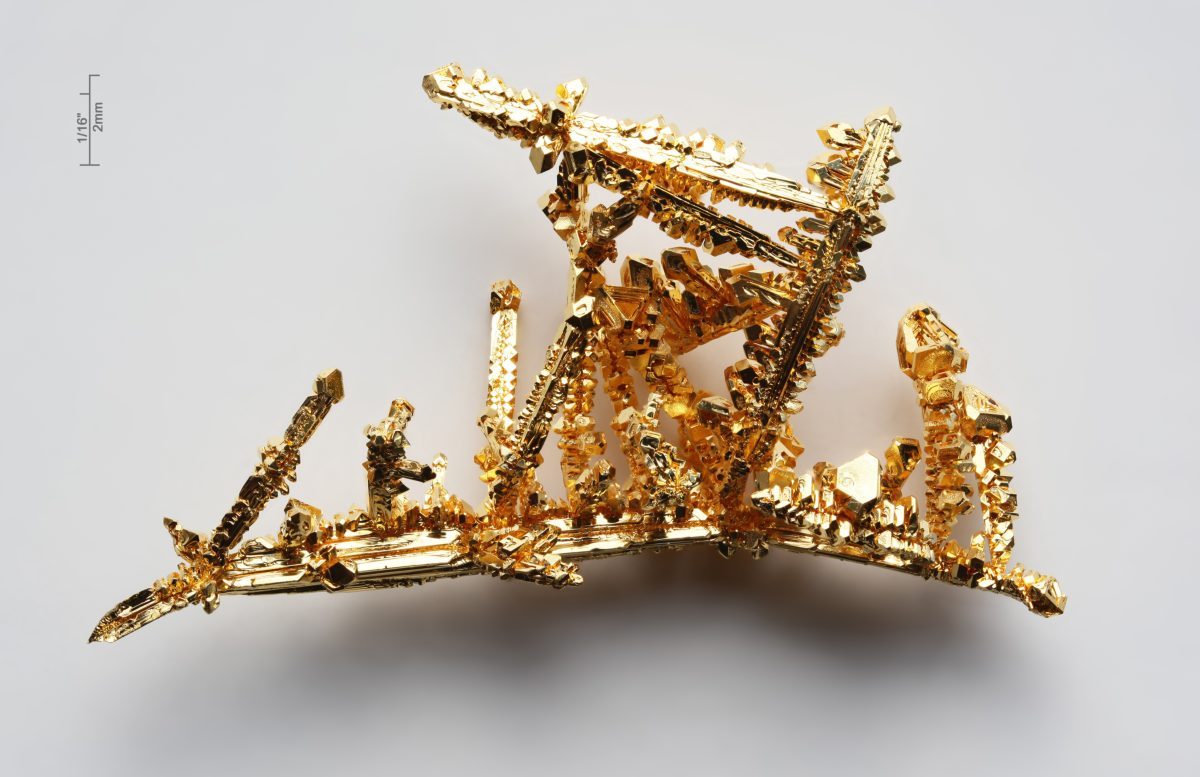
What is Gold?
Gold is an element that needs no introduction. It is found almost everywhere in small amounts, and in very few places in large quantities. Its usage in society dates back to ancient Egypt and perhaps even earlier. All the gold found on earth is said by scientists to have arrived here on meteorites.
Etymology & Origins
"Gold" is cognate with similar words in many Germanic languages, deriving via Proto-Germanic *gulþą from Proto-Indo-European *ǵʰelh₃- ("to shine, to gleam; to be yellow or green"). The symbol Au is from the Latin: aurum, the Latin word for "gold". The Proto-Indo-European ancestor of aurum was *h₂é-h₂us-o-, meaning "glow". This word is derived from the same root (Proto-Indo-European *h₂u̯es- "to dawn") as *h₂éu̯sōs, the ancestor of the Latin word Aurora, "dawn". This etymological relationship is presumably behind the frequent claim in scientific publications that aurum meant "shining dawn".
Uses & Applications
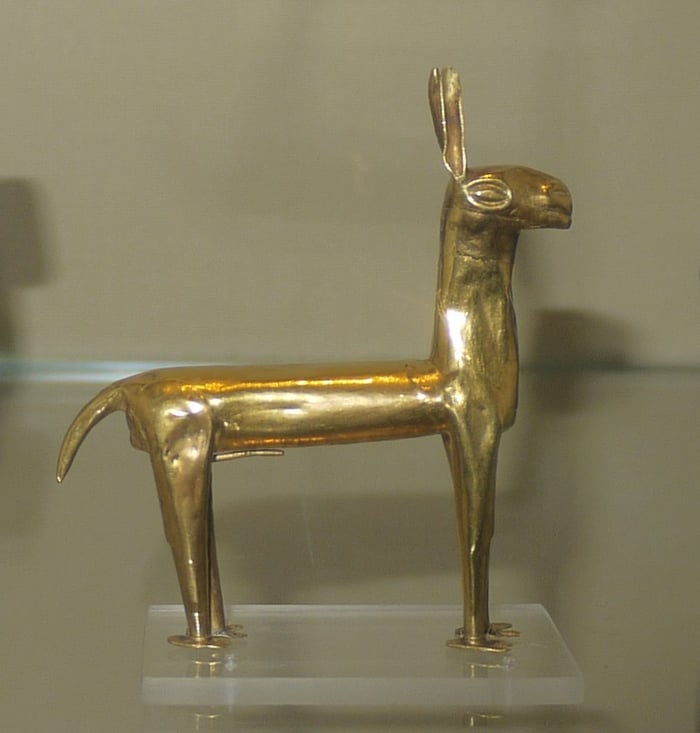
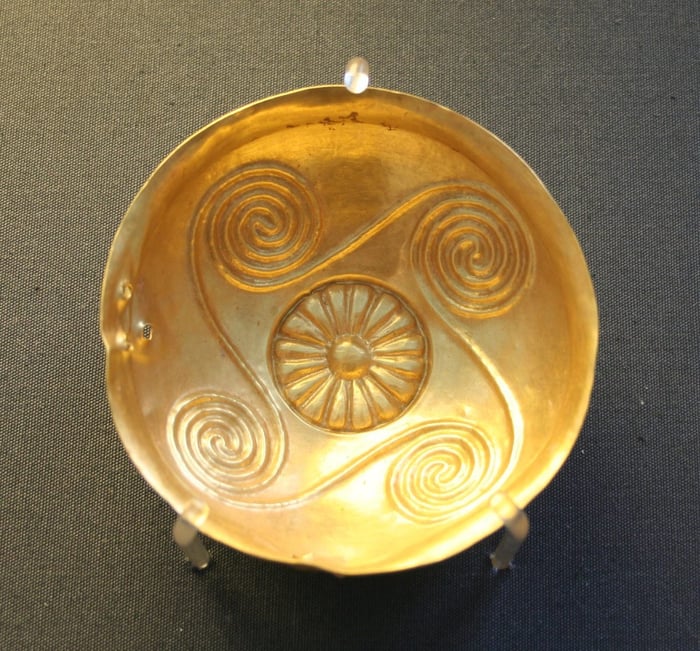
Gold is one of the most useful minerals on the planet, utilized in many industries. The most common applications are in jewelry and currency, for which it has been used for 6000 years! Dentists use gold for fillings, crowns, and bridges while the aerospace industry uses it to lubricate technologies and as a conductor for electricity. Gold is also used in glassmaking, architecture, and electronics.
Healing Properties
Gold is believed to possess a warm energy that helps to release stress and protect the emotional body from negative forces. It is said to have transformative power that can change negative energy into positive energy. When used with other stones in jewelry, it is believed to increase their power. It is often attributed to building confidence and alleviating feelings of anger that are sometimes a result of self-doubt.
Discover Values
This stone excels in rarity, popularity, beauty, cultural value, collection value.
Market Value Factors
Pricing varies for every rock and mineral, so use these universal factors to gauge Gold before comparing listings or appraisals.
Size & Weight
Larger, intact specimens usually command higher prices.
Rarity & Demand
Scarce material or popular varieties sell at a premium.
Condition & Finish
Chips, repairs, and heavy wear lower value; clean prep helps.
Treatment & Provenance
Untreated specimens with documented locality are prized.
Where to Find Gold
RockHoundR, the free-to-download rockhounding map from the Ruby Glint team, shows where collectors find gold in the US, with land-access notes for BLM land and national forests. Collecting is banned in national parks.
See where to find goldAlways check the local rules and get the landowner's permission before you collect.
Geochemistry
Although gold is the most noble of the noble metals, it still forms many diverse compounds. The oxidation state of gold in its compounds ranges from −1 to +5, but Au(I) and Au(III) dominate its chemistry. Au(I), referred to as the aurous ion, is the most common oxidation state with soft ligands such as thioethers, thiolates, and tertiary phosphines. Au(I) compounds are typically linear. A good example is Au(CN)2, which is the soluble form of gold encountered in mining. The binary gold halides, such as AuCl, form zigzag polymeric chains, again featuring linear coordination at Au. Most drugs based on gold are Au(I) derivatives. Au(III) (referred to as the auric) is a common oxidation state, and is illustrated by gold(III) chloride, Au2Cl6. The gold atom centers in Au(III) complexes, like other d compounds, are typically square planar, with chemical bonds that have both covalent and ionic character. Gold does not react with oxygen at any temperature and, up to 100 °C, is resistant to attack from ozone. Some free halogens react with gold. Gold is strongly attacked by fluorine at dull-red heat to form gold(III) fluoride. Powdered gold reacts with chlorine at 180 °C to form AuCl3. Gold reacts with bromine at 140 °C to form gold(III) bromide, but reacts only very slowly with iodine to form the monoiodide. Gold does not react with sulfur directly, but gold(III) sulfide can be made by passing hydrogen sulfide through a dilute solution of gold(III) chloride or chlorauric acid. Gold readily dissolves in mercury at room temperature to form an amalgam, and forms alloys with many other metals at higher temperatures. These alloys can be produced to modify the hardness and other metallurgical properties, to control melting point or to create exotic colors. Gold is unaffected by most acids. It does not react with hydrofluoric, hydrochloric, hydrobromic, hydriodic, sulfuric, or nitric acid. It does react with selenic acid, and is dissolved by aqua regia, a 1:3 mixture of nitric acid and hydrochloric acid. Nitric acid oxidizes the metal to +3 ions, but only in minute amounts, typically undetectable in the pure acid because of the chemical equilibrium of the reaction. However, the ions are removed from the equilibrium by hydrochloric acid, forming AuCl4 ions, or chloroauric acid, thereby enabling further oxidation. Gold is similarly unaffected by most bases. It does not react with aqueous, solid, or molten sodium or potassium hydroxide. It does however, react with sodium or potassium cyanide under alkaline conditions when oxygen is present to form soluble complexes. Common oxidation states of gold include +1 (gold(I) or aurous compounds) and +3 (gold(III) or auric compounds). Gold ions in solution are readily reduced and precipitated as metal by adding any other metal as the reducing agent. The added metal is oxidized and dissolves, allowing the gold to be displaced from solution and be recovered as a solid precipitate.
Associated Chakras



Key Characteristics
Characteristics of Gold
Gold is the most malleable of all metals. It can be drawn into a wire of single-atom width, and then stretched considerably before it breaks. Such nanowires distort via formation, reorientation and migration of dislocations and crystal twins without noticeable hardening. A single gram of gold can be beaten into a sheet of 1 square metre (11 sq ft), and an avoirdupois ounce into 300 square feet (28 m). Gold leaf can be beaten thin enough to become semi-transparent. The transmitted light appears greenish blue, because gold strongly reflects yellow and red. Such semi-transparent sheets also strongly reflect infrared light, making them useful as infrared (radiant heat) shields in visors of heat-resistant suits, and in sun-visors for spacesuits. Gold is a good conductor of heat and electricity. Gold has a density of 19.3 g/cm, almost identical to that of tungsten at 19.25 g/cm; as such, tungsten has been used in counterfeiting of gold bars, such as by plating a tungsten bar with gold, or taking an existing gold bar, drilling holes, and replacing the removed gold with tungsten rods. By comparison, the density of lead is 11.34 g/cm, and that of the densest element, osmium, is 22.588±0.015 g/cm.
Formation of Gold
On Earth, gold is found in ores in rock formed from the Precambrian time onward. It most often occurs as a native metal, typically in a metal solid solution with silver (i.e. as a gold silver alloy). Such alloys usually have a silver content of 8–10%. Electrum is elemental gold with more than 20% silver. Electrum's color runs from golden-silvery to silvery, dependent upon the silver content. The more silver, the lower the specific gravity. Native gold occurs as very small to microscopic particles embedded in rock, often together with quartz or sulfide minerals such as "fool's gold", which is a pyrite. These are called lode deposits. The metal in a native state is also found in the form of free flakes, grains or larger nuggets that have been eroded from rocks and end up in alluvial deposits called placer deposits. Such free gold is always richer at the surface of gold-bearing veins owing to the oxidation of accompanying minerals followed by weathering, and washing of the dust into streams and rivers, where it collects and can be welded by water action to form nuggets. Gold sometimes occurs combined with tellurium as the minerals calaverite, krennerite, nagyagite, petzite and sylvanite (see telluride minerals), and as the rare bismuthide maldonite (Au2Bi) and antimonide aurostibite (AuSb2). Gold also occurs in rare alloys with copper, lead, and mercury: the minerals auricupride (Cu3Au), novodneprite (AuPb3) and weishanite ((Au, Ag)3Hg2). Recent research suggests that microbes can sometimes play an important role in forming gold deposits, transporting and precipitating gold to form grains and nuggets that collect in alluvial deposits. Another recent study has claimed water in faults vaporizes during an earthquake, depositing gold. When an earthquake strikes, it moves along a fault. Water often lubricates faults, filling in fractures and jogs. About 10 kilometres (6.2 mi) below the surface, under incredible temperatures and pressures, the water carries high concentrations of carbon dioxide, silica, and gold. During an earthquake, the fault jog suddenly opens wider. The water inside the void instantly vaporizes, flashing to steam and forcing silica, which forms the mineral quartz, and gold out of the fluids and onto nearby surfaces.
Health & Safety Information
- ⚠️Pure metallic (elemental) gold is non-toxic and non-irritating when ingested and is sometimes used as a food decoration in the form of gold leaf. Metallic gold is also a component of the alcoholic drinks Goldschläger, Gold Strike, and Goldwasser. Metallic gold is approved as a food additive in the EU (E175 in the Codex Alimentarius). Although the gold ion is toxic, the acceptance of metallic gold as a food additive is due to its relative chemical inertness, and resistance to being corroded or transformed into soluble salts (gold compounds) by any known chemical process which would be encountered in the human body. Soluble compounds (gold salts) such as gold chloride are toxic to the liver and kidneys. Common cyanide salts of gold such as potassium gold cyanide, used in gold electroplating, are toxic by virtue of both their cyanide and gold content. There are rare cases of lethal gold poisoning from potassium gold cyanide. Gold toxicity can be ameliorated with chelation therapy with an agent such as dimercaprol. Gold metal was voted Allergen of the Year in 2001 by the American Contact Dermatitis Society; gold contact allergies affect mostly women. Despite this, gold is a relatively non-potent contact allergen, in comparison with metals like nickel. A sample of the fungus Aspergillus niger was found growing from gold mining solution; and was found to contain cyano metal complexes, such as gold, silver, copper, iron and zinc. The fungus also plays a role in the solubilization of heavy metal sulfides.
More Images
Quick Facts
Physical Properties
- Color
- Rich yellow
- Hardness (Mohs)
- 2.5 - 3
- Rock tumbling
- Not recommended
- Density
- 19.309 g/cm³
- Streak
- Shining yellow
- Luster
- Metallic
- Crystal System
- Isometric
Chemical Properties
- Chemical Formula
- Au
- Elements
- Au
Also Known As
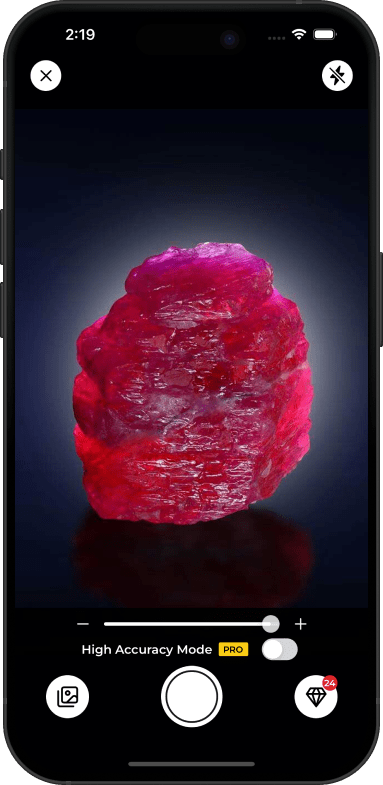
Identify Gold Instantly
- Snap a photo, get instant results
- 6,700+ rocks, minerals & crystals
- Discover collecting spots near you
Gold FAQs
How do I identify Gold?
Gold can be identified by its hardness of 2.5 - 3 on the Mohs scale, Rich yellow color, Metallic luster, Isometric crystal system. Look for these key characteristics when examining specimens.
What color is Gold?
Gold typically appears in Rich yellow. Color can vary depending on impurities and formation conditions.
How hard is Gold?
Gold has a hardness of 2.5 - 3 on the Mohs scale. This makes it a soft mineral that can be scratched easily.
What is the characteristics of gold of Gold?
Gold is the most malleable of all metals. It can be drawn into a wire of single-atom width, and then stretched considerably before it breaks. Such nanowires distort via formation, reorientation and migration of dislocations and crystal twins without noticeable hardening. A single gram of gold can be beaten into a sheet of 1 square metre (11 sq ft), and an avoirdupois ounce into 300 square feet (28 m). Gold leaf can be beaten thin enough to become semi-transparent. The transmitted light appears greenish blue, because gold strongly reflects yellow and red. Such semi-transparent sheets also strongly reflect infrared light, making them useful as infrared (radiant heat) shields in visors of heat-resistant suits, and in sun-visors for spacesuits. Gold is a good conductor of heat and electricity. Gold has a density of 19.3 g/cm, almost identical to that of tungsten at 19.25 g/cm; as such, tungsten has been used in counterfeiting of gold bars, such as by plating a tungsten bar with gold, or taking an existing gold bar, drilling holes, and replacing the removed gold with tungsten rods. By comparison, the density of lead is 11.34 g/cm, and that of the densest element, osmium, is 22.588±0.015 g/cm.
What is the formation of gold of Gold?
On Earth, gold is found in ores in rock formed from the Precambrian time onward. It most often occurs as a native metal, typically in a metal solid solution with silver (i.e. as a gold silver alloy). Such alloys usually have a silver content of 8–10%. Electrum is elemental gold with more than 20% silver. Electrum's color runs from golden-silvery to silvery, dependent upon the silver content. The more silver, the lower the specific gravity. Native gold occurs as very small to microscopic particles embedded in rock, often together with quartz or sulfide minerals such as "fool's gold", which is a pyrite. These are called lode deposits. The metal in a native state is also found in the form of free flakes, grains or larger nuggets that have been eroded from rocks and end up in alluvial deposits called placer deposits. Such free gold is always richer at the surface of gold-bearing veins owing to the oxidation of accompanying minerals followed by weathering, and washing of the dust into streams and rivers, where it collects and can be welded by water action to form nuggets. Gold sometimes occurs combined with tellurium as the minerals calaverite, krennerite, nagyagite, petzite and sylvanite (see telluride minerals), and as the rare bismuthide maldonite (Au2Bi) and antimonide aurostibite (AuSb2). Gold also occurs in rare alloys with copper, lead, and mercury: the minerals auricupride (Cu3Au), novodneprite (AuPb3) and weishanite ((Au, Ag)3Hg2). Recent research suggests that microbes can sometimes play an important role in forming gold deposits, transporting and precipitating gold to form grains and nuggets that collect in alluvial deposits. Another recent study has claimed water in faults vaporizes during an earthquake, depositing gold. When an earthquake strikes, it moves along a fault. Water often lubricates faults, filling in fractures and jogs. About 10 kilometres (6.2 mi) below the surface, under incredible temperatures and pressures, the water carries high concentrations of carbon dioxide, silica, and gold. During an earthquake, the fault jog suddenly opens wider. The water inside the void instantly vaporizes, flashing to steam and forcing silica, which forms the mineral quartz, and gold out of the fluids and onto nearby surfaces.