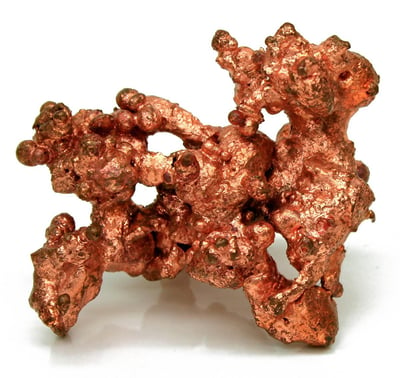
Silver
A variety of Copper Group

What is Silver?
Prized since antiquity, silver is the most abundant and least expensive of the precious metals. Soft and ductile, this element can easily be shaped into jewelry and coins - and people have been doing so for thousands of years. Because it tarnishes fairly easily, in modern jewelry it is often combined into alloys with other metals (such as is the case with Sterling silver, usually made of silver and Copper). Industrial uses include electronics, solar panels, glass, mirrors, and many medical components.
Etymology & Origins
The word "silver" appears in Old English in various spellings, such as seolfor and siolfor. It is cognate with Old High German silabar; Gothic silubr; or Old Norse silfr, all ultimately deriving from Proto-Germanic *silubra. The Balto-Slavic words for silver are rather similar to the Germanic ones (e.g. Russian серебро [serebró], Polish srebro, Lithuanian sidãbras), as is the Celtiberian form silabur. They may have a common Indo-European origin, although their morphology rather suggest a non-Indo-European Wanderwort. Some scholars have thus proposed a Paleo-Hispanic origin, pointing to the Basque form zilharr as an evidence. The chemical symbol Ag is from the Latin word for "silver", argentum (compare Ancient Greek ἄργυρος, árgyros), from the Proto-Indo-European root *h₂erǵ- (formerly reconstructed as *arǵ-), meaning "white" or "shining". This was the usual Proto-Indo-European word for the metal, whose reflexes are missing in Germanic and Balto-Slavic.
Uses & Applications
The diverse and appealing attributes of silver make it one of the most versatile minerals. It is found everywhere from jewelry to engines to DVDs. It is non-toxic so is used in many consumer products, even in some deodorants due to its antimicrobial properties. Silver is also the best electric and thermal conductor due to its high number of moveable atoms. However, it is pricier than other conductors and is mostly used in more specialized products such as circuit boards and satellites.
Healing Properties
Silver is believed to work with the power of the moon, reflecting negative energies away from the wearer and allowing positive energy to flow through. It is said to enhance psychic abilities and if often worn during sleep to help enhance dreams. It is thought that wearing silver will help a person realize their higher purpose and allow them to move forward in life.
Discover Values
This stone excels in popularity.
Market Value Factors
Pricing varies for every rock and mineral, so use these universal factors to gauge Silver before comparing listings or appraisals.
Size & Weight
Larger, intact specimens usually command higher prices.
Rarity & Demand
Scarce material or popular varieties sell at a premium.
Condition & Finish
Chips, repairs, and heavy wear lower value; clean prep helps.
Treatment & Provenance
Untreated specimens with documented locality are prized.
Where to Find Silver
RockHoundR, the free-to-download rockhounding map from the Ruby Glint team, shows where collectors find silver in the US, with land-access notes for BLM land and national forests. Collecting is banned in national parks.
See where to find silverAlways check the local rules and get the landowner's permission before you collect.
Geochemistry
Silver is a rather unreactive metal. This is because its filled 4d shell is not very effective in shielding the electrostatic forces of attraction from the nucleus to the outermost 5s electron, and hence silver is near the bottom of the electrochemical series (E(Ag/Ag) = +0.799 V). In group 11, silver has the lowest first ionization energy (showing the instability of the 5s orbital), but has higher second and third ionization energies than copper and gold (showing the stability of the 4d orbitals), so that the chemistry of silver is predominantly that of the +1 oxidation state, reflecting the increasingly limited range of oxidation states along the transition series as the d-orbitals fill and stabilize. Unlike copper, for which the larger hydration energy of Cu as compared to Cu is the reason why the former is the more stable in aqueous solution and solids despite lacking the stable filled d-subshell of the latter, with silver this effect is swamped by its larger second ionisation energy. Hence, Ag is the stable species in aqueous solution and solids, with Ag being much less stable as it oxidizes water. Most silver compounds have significant covalent character due to the small size and high first ionization energy (730.8 kJ/mol) of silver. Furthermore, silver's Pauling electronegativity of 1.93 is higher than that of lead (1.87), and its electron affinity of 125.6 kJ/mol is much higher than that of hydrogen (72.8 kJ/mol) and not much less than that of oxygen (141.0 kJ/mol). Due to its full d-subshell, silver in its main +1 oxidation state exhibits relatively few properties of the transition metals proper from groups 4 to 10, forming rather unstable organometallic compounds, forming linear complexes showing very low coordination numbers like 2, and forming an amphoteric oxide as well as Zintl phases like the post-transition metals. Unlike the preceding transition metals, the +1 oxidation state of silver is stable even in the absence of π-acceptor ligands. Silver does not react with air, even at red heat, and thus was considered by alchemists as a noble metal along with gold. Its reactivity is intermediate between that of copper (which forms copper(I) oxide when heated in air to red heat) and gold. Like copper, silver reacts with sulfur and its compounds; in their presence, silver tarnishes in air to form the black silver sulfide (copper forms the green sulfate instead, while gold does not react). Unlike copper, silver will not react with the halogens, with the exception of fluorine gas, with which it forms the difluoride. While silver is not attacked by non-oxidizing acids, the metal dissolves readily in hot concentrated sulfuric acid, as well as dilute or concentrated nitric acid. In the presence of air, and especially in the presence of hydrogen peroxide, silver dissolves readily in aqueous solutions of cyanide. The three main forms of deterioration in historical silver artifacts are tarnishing, formation of silver chloride due to long-term immersion in salt water, as well as reaction with nitrate ions or oxygen. Fresh silver chloride is pale yellow, becoming purplish on exposure to light; it projects slightly from the surface of the artifact or coin. The precipitation of copper in ancient silver can be used to date artifacts, as copper is nearly always a constituent of silver alloys. Silver metal is attacked by strong oxidizers such as potassium permanganate (KMnO4) and potassium dichromate (K2Cr2O7), and in the presence of potassium bromide (KBr). These compounds are used in photography to bleach silver images, converting them to silver bromide that can either be fixed with thiosulfate or redeveloped to intensify the original image. Silver forms cyanide complexes (silver cyanide) that are soluble in water in the presence of an excess of cyanide ions. Silver cyanide solutions are used in electroplating of silver. The common oxidation states of silver are (in order of commonness): +1 (the most stable state; for example, silver nitrate, AgNO3); +2 (highly oxidising; for example, silver(II) fluoride, AgF2); and even very rarely +3 (extreme oxidising; for example, potassium tetrafluoroargentate(III), KAgF4). The +1 state is by far the most common, followed by the easily reducible +2 state. The +3 state requires very strong oxidising agents to attain, such as fluorine or peroxodisulfate, and some silver(III) compounds react with atmospheric moisture and attack glass. Indeed, silver(III) fluoride is usually obtained by reacting silver or silver monofluoride with the strongest known oxidizing agent, krypton difluoride.
Associated Chakras

Key Characteristics
Characteristics of Silver
Silver is similar in its physical and chemical properties to its two vertical neighbours in group 11 of the periodic table, copper and gold. Its 47 electrons are arranged in the configuration [Kr]4d5s, similarly to copper ([Ar]3d4s) and gold ([Xe]4f5d6s); group 11 is one of the few groups in the d-block which has a completely consistent set of electron configurations. This distinctive electron configuration, with a single electron in the highest occupied s subshell over a filled d subshell, accounts for many of the singular properties of metallic silver. Silver is an extremely soft, ductile and malleable transition metal, though it is slightly less malleable than gold. Silver crystallizes in a face-centered cubic lattice with bulk coordination number 12, where only the single 5s electron is delocalized, similarly to copper and gold. Unlike metals with incomplete d-shells, metallic bonds in silver are lacking a covalent character and are relatively weak. This observation explains the low hardness and high ductility of single crystals of silver. Silver has a brilliant white metallic luster that can take a high polish, and which is so characteristic that the name of the metal itself has become a colour name. Unlike copper and gold, the energy required to excite an electron from the filled d band to the s-p conduction band in silver is large enough (around 385 kJ/mol) that it no longer corresponds to absorption in the visible region of the spectrum, but rather in the ultraviolet; hence silver is not a coloured metal. Protected silver has greater optical reflectivity than aluminium at all wavelengths longer than ~450 nm. At wavelengths shorter than 450 nm, silver's reflectivity is inferior to that of aluminium and drops to zero near 310 nm. Very high electrical and thermal conductivity is common to the elements in group 11, because their single s electron is free and does not interact with the filled d subshell, as such interactions (which occur in the preceding transition metals) lower electron mobility. The electrical conductivity of silver is the greatest of all metals, greater even than copper, although the conductivity of carbon (in the diamond allotrope) and superfluid helium-4 are even higher. Silver also has the lowest contact resistance of any metal. Silver is rarely used for its electrical condictivity due to its high cost, although an exception is in radio-frequency engineering, particularly at VHF and higher frequencies where silver plating improves electrical conductivity because those currents tend to flow on the surface of conductors rather than through the interior. During World War II in the US, 13540 tons of silver were used for the electromagnets in calutrons for enriching uranium, mainly because of the wartime shortage of copper. Silver readily forms alloys with copper and gold, as well as zinc. Zinc-silver alloys with low zinc concentration may be considered as face-centred cubic solid solutions of zinc in silver, as the structure of the silver is largely unchanged while the electron concentration rises as more zinc is added. Increasing the electron concentration further leads to body-centred cubic (electron concentration 1.5), complex cubic (1.615), and hexagonal close-packed phases (1.75).
Formation of Silver
The abundance of silver in the Earth's crust is 0.08 parts per million, almost exactly the same as that of mercury. It mostly occurs in sulfide ores, especially acanthite and argentite, Ag2S. Argentite deposits sometimes also contain native silver when they occur in reducing environments, and when in contact with salt water they are converted to chlorargyrite (including horn silver), AgCl, which is prevalent in Chile and New South Wales. Most other silver minerals are silver pnictides or chalcogenides; they are generally lustrous semiconductors. Most true silver deposits, as opposed to argentiferous deposits of other metals, came from Tertiary period vulcanism. The principal sources of silver are the ores of copper, copper-nickel, lead, and lead-zinc obtained from Peru, Bolivia, Mexico, China, Australia, Chile, Poland and Serbia. Peru, Bolivia and Mexico have been mining silver since 1546, and are still major world producers. Top silver-producing mines are Cannington (Australia), Fresnillo (Mexico), San Cristóbal (Bolivia), Antamina (Peru), Rudna (Poland), and Penasquito (Mexico). Top near-term mine development projects through 2015 are Pascua Lama (Chile), Navidad (Argentina), Jaunicipio (Mexico), Malku Khota (Bolivia), and Hackett River (Canada). In Central Asia, Tajikistan is known to have some of the largest silver deposits in the world. Silver is usually found in nature combined with other metals, or in minerals that contain silver compounds, generally in the form of sulfides such as galena (lead sulfide) or cerussite (lead carbonate). So the primary production of silver requires the smelting and then cupellation of argentiferous lead ores, a historically important process. Lead melts at 327 °C, lead oxide at 888 °C and silver melts at 960 °C. To separate the silver, the alloy is melted again at the high temperature of 960 °C to 1000 °C in an oxidizing environment. The lead oxidises to lead monoxide, then known as litharge, which captures the oxygen from the other metals present. The liquid lead oxide is removed or absorbed by capillary action into the hearth linings. Ag(s) + 2Pb(s) + O2(g) → 2PbO(absorbed) + Ag(l) Today, silver metal is primarily produced instead as a secondary byproduct of electrolytic refining of copper, lead, and zinc, and by application of the Parkes process on lead bullion from ore that also contains silver. In such processes, silver follows the non-ferrous metal in question through its concentration and smelting, and is later purified out. For example, in copper production, purified copper is electrolytically deposited on the cathode, while the less reactive precious metals such as silver and gold collect under the anode as the so-called "anode slime". This is then separated and purified of base metals by treatment with hot aerated dilute sulfuric acid and heating with lime or silica flux, before the silver is purified to over 99.9% purity via electrolysis in nitrate solution. Commercial-grade fine silver is at least 99.9% pure, and purities greater than 99.999% are available. In 2014, Mexico was the top producer of silver (5,000 tonnes or 18.7% of the world's total of 26,800 t), followed by China (4,060 t) and Peru (3,780 t).
Quick Facts
Physical Properties
- Color
- Silver-white, tarnishes dark gray to black
- Hardness (Mohs)
- 2.5 - 3
- Rock tumbling
- Not recommended
- Density
- 10.497 g/cm³
- Streak
- Silver white
- Luster
- Metallic
- Crystal System
- Isometric
Chemical Properties
- Chemical Formula
- Ag
- Elements
- Ag
Also Known As
Identify Silver Instantly
- Snap a photo, get instant results
- 6,700+ rocks, minerals & crystals
- Discover collecting spots near you
Silver FAQs
How do I identify Silver?
Silver can be identified by its hardness of 2.5 - 3 on the Mohs scale, Silver-white color, Metallic luster, Isometric crystal system. Look for these key characteristics when examining specimens.
What color is Silver?
Silver typically appears in Silver-white, tarnishes dark gray to black. Color can vary depending on impurities and formation conditions.
How hard is Silver?
Silver has a hardness of 2.5 - 3 on the Mohs scale. This makes it a soft mineral that can be scratched easily.
What is the characteristics of silver of Silver?
Silver is similar in its physical and chemical properties to its two vertical neighbours in group 11 of the periodic table, copper and gold. Its 47 electrons are arranged in the configuration [Kr]4d5s, similarly to copper ([Ar]3d4s) and gold ([Xe]4f5d6s); group 11 is one of the few groups in the d-block which has a completely consistent set of electron configurations. This distinctive electron configuration, with a single electron in the highest occupied s subshell over a filled d subshell, accounts for many of the singular properties of metallic silver. Silver is an extremely soft, ductile and malleable transition metal, though it is slightly less malleable than gold. Silver crystallizes in a face-centered cubic lattice with bulk coordination number 12, where only the single 5s electron is delocalized, similarly to copper and gold. Unlike metals with incomplete d-shells, metallic bonds in silver are lacking a covalent character and are relatively weak. This observation explains the low hardness and high ductility of single crystals of silver. Silver has a brilliant white metallic luster that can take a high polish, and which is so characteristic that the name of the metal itself has become a colour name. Unlike copper and gold, the energy required to excite an electron from the filled d band to the s-p conduction band in silver is large enough (around 385 kJ/mol) that it no longer corresponds to absorption in the visible region of the spectrum, but rather in the ultraviolet; hence silver is not a coloured metal. Protected silver has greater optical reflectivity than aluminium at all wavelengths longer than ~450 nm. At wavelengths shorter than 450 nm, silver's reflectivity is inferior to that of aluminium and drops to zero near 310 nm. Very high electrical and thermal conductivity is common to the elements in group 11, because their single s electron is free and does not interact with the filled d subshell, as such interactions (which occur in the preceding transition metals) lower electron mobility. The electrical conductivity of silver is the greatest of all metals, greater even than copper, although the conductivity of carbon (in the diamond allotrope) and superfluid helium-4 are even higher. Silver also has the lowest contact resistance of any metal. Silver is rarely used for its electrical condictivity due to its high cost, although an exception is in radio-frequency engineering, particularly at VHF and higher frequencies where silver plating improves electrical conductivity because those currents tend to flow on the surface of conductors rather than through the interior. During World War II in the US, 13540 tons of silver were used for the electromagnets in calutrons for enriching uranium, mainly because of the wartime shortage of copper. Silver readily forms alloys with copper and gold, as well as zinc. Zinc-silver alloys with low zinc concentration may be considered as face-centred cubic solid solutions of zinc in silver, as the structure of the silver is largely unchanged while the electron concentration rises as more zinc is added. Increasing the electron concentration further leads to body-centred cubic (electron concentration 1.5), complex cubic (1.615), and hexagonal close-packed phases (1.75).
What is the formation of silver of Silver?
The abundance of silver in the Earth's crust is 0.08 parts per million, almost exactly the same as that of mercury. It mostly occurs in sulfide ores, especially acanthite and argentite, Ag2S. Argentite deposits sometimes also contain native silver when they occur in reducing environments, and when in contact with salt water they are converted to chlorargyrite (including horn silver), AgCl, which is prevalent in Chile and New South Wales. Most other silver minerals are silver pnictides or chalcogenides; they are generally lustrous semiconductors. Most true silver deposits, as opposed to argentiferous deposits of other metals, came from Tertiary period vulcanism. The principal sources of silver are the ores of copper, copper-nickel, lead, and lead-zinc obtained from Peru, Bolivia, Mexico, China, Australia, Chile, Poland and Serbia. Peru, Bolivia and Mexico have been mining silver since 1546, and are still major world producers. Top silver-producing mines are Cannington (Australia), Fresnillo (Mexico), San Cristóbal (Bolivia), Antamina (Peru), Rudna (Poland), and Penasquito (Mexico). Top near-term mine development projects through 2015 are Pascua Lama (Chile), Navidad (Argentina), Jaunicipio (Mexico), Malku Khota (Bolivia), and Hackett River (Canada). In Central Asia, Tajikistan is known to have some of the largest silver deposits in the world. Silver is usually found in nature combined with other metals, or in minerals that contain silver compounds, generally in the form of sulfides such as galena (lead sulfide) or cerussite (lead carbonate). So the primary production of silver requires the smelting and then cupellation of argentiferous lead ores, a historically important process. Lead melts at 327 °C, lead oxide at 888 °C and silver melts at 960 °C. To separate the silver, the alloy is melted again at the high temperature of 960 °C to 1000 °C in an oxidizing environment. The lead oxidises to lead monoxide, then known as litharge, which captures the oxygen from the other metals present. The liquid lead oxide is removed or absorbed by capillary action into the hearth linings. Ag(s) + 2Pb(s) + O2(g) → 2PbO(absorbed) + Ag(l) Today, silver metal is primarily produced instead as a secondary byproduct of electrolytic refining of copper, lead, and zinc, and by application of the Parkes process on lead bullion from ore that also contains silver. In such processes, silver follows the non-ferrous metal in question through its concentration and smelting, and is later purified out. For example, in copper production, purified copper is electrolytically deposited on the cathode, while the less reactive precious metals such as silver and gold collect under the anode as the so-called "anode slime". This is then separated and purified of base metals by treatment with hot aerated dilute sulfuric acid and heating with lime or silica flux, before the silver is purified to over 99.9% purity via electrolysis in nitrate solution. Commercial-grade fine silver is at least 99.9% pure, and purities greater than 99.999% are available. In 2014, Mexico was the top producer of silver (5,000 tonnes or 18.7% of the world's total of 26,800 t), followed by China (4,060 t) and Peru (3,780 t).