Pectolite
A variety of Wollastonite Group
What is Pectolite?
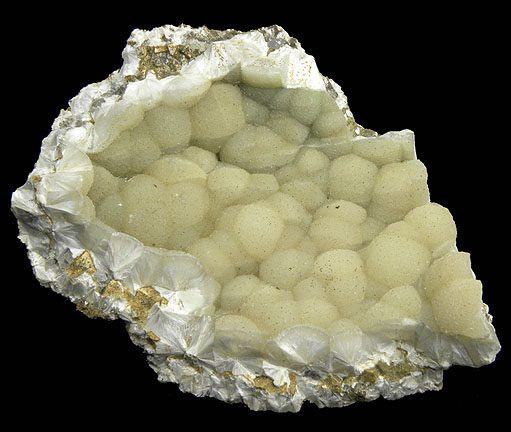
Pectolite is a unique material known for its unusual crystals that form extremely slender fibers radiating from the central point outwards. This crystal habit makes the material very delicate and fragile — it can be easily broken and dented when touched. Pectolite is highly after by collectors, particularly the blue variety called larimar.
Uses & Applications
Pectolite doesn't have any industrial uses but it is prized and collected by mineralogists and gemstone enthusiasts for its elongated and fragile crystals. Few of these crystals are gem-worthy, but it is a hard material and the better examples can occasionally be polished and incorporated into items like rings, necklaces, and bracelets.
Healing Properties
Pectolite supposedly connects most strongly to the crown and third eye chakras and effectively harmonizes their energies. The belief is that this stone brings tranquility and wisdom to the possessor. Pectolite is also said to aid the removal of feelings of guilt that may be plaguing your life.
Optical Properties
- Refractive Index
- 1.595-1.645
- Birefringence
- 0.028-0.038
- Pleochroism
- None
- Optical Character
- Biaxial positive
Market Value Factors
Pricing varies for every rock and mineral, so use these universal factors to gauge Pectolite before comparing listings or appraisals.
Size & Weight
Larger, intact specimens usually command higher prices.
Rarity & Demand
Scarce material or popular varieties sell at a premium.
Condition & Finish
Chips, repairs, and heavy wear lower value; clean prep helps.
Treatment & Provenance
Untreated specimens with documented locality are prized.
Associated Chakras


Key Characteristics
Formation of Pectolite
It was first described in 1828 at Mt. Baldo, Trento Province, Italy and named from the Greek pektos – "compacted" and lithos – "stone". It occurs as a primary mineral in nepheline syenites, within hydrothermal cavities in basalts and diabase and in serpentinites in association with zeolites, datolite, prehnite, calcite and serpentine. It is found in a wide variety of worldwide locations.
More Images

Quick Facts
Physical Properties
- Color
- Colourless, white, pale pink, greenish, pale blue
- Hardness (Mohs)
- 4.5 - 5
- Rock tumbling
- Not recommended
- Density
- 2.87 g/cm³
- Streak
- White
- Luster
- Silky, Sub-vitreous
- Crystal System
- Triclinic
Chemical Properties
- Chemical Formula
- NaCa2Si3O8(OH)
- Elements
- Ca, H, Na, O, Si
Also Known As
Identify Pectolite Instantly
- Snap a photo, get instant results
- 6,700+ rocks, minerals & crystals
- Discover collecting spots near you
Pectolite FAQs
How do I identify Pectolite?
Pectolite can be identified by its hardness of 4.5 - 5 on the Mohs scale, Colourless color, Silky, Sub-vitreous luster, Triclinic crystal system. Look for these key characteristics when examining specimens.
What color is Pectolite?
Pectolite typically appears in Colourless, white, pale pink, greenish, pale blue. Color can vary depending on impurities and formation conditions.
How hard is Pectolite?
Pectolite has a hardness of 4.5 - 5 on the Mohs scale. This gives it moderate hardness.
What is the formation of pectolite of Pectolite?
It was first described in 1828 at Mt. Baldo, Trento Province, Italy and named from the Greek pektos – "compacted" and lithos – "stone". It occurs as a primary mineral in nepheline syenites, within hydrothermal cavities in basalts and diabase and in serpentinites in association with zeolites, datolite, prehnite, calcite and serpentine. It is found in a wide variety of worldwide locations.
