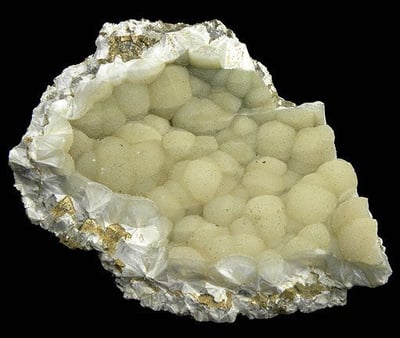
Wollastonite
A variety of Wollastonite Group
What is Wollastonite?
Since it is made of calcium, silicon, and oxygen, wollastonite has hundreds of practical uses in just about every industrial field. When added to plastics, it provides strength; when used in paint it acts as a leveling agent; in ceramics creates a lovely glaze. Wollastonite truly is a wonder mineral!
Uses & Applications
Wollastonite is a calcium siliconate material with an enormous range of industrial applications. Its bright white coloring makes it popular for ceramics and tiles. It is also used in brakes and clutches, in paint, plastics, metal making and concrete. Particularly importantly, it is a replacement for asbestos in many products.
Market Value Factors
Pricing varies for every rock and mineral, so use these universal factors to gauge Wollastonite before comparing listings or appraisals.
Size & Weight
Larger, intact specimens usually command higher prices.
Rarity & Demand
Scarce material or popular varieties sell at a premium.
Condition & Finish
Chips, repairs, and heavy wear lower value; clean prep helps.
Treatment & Provenance
Untreated specimens with documented locality are prized.
Key Characteristics
Characteristics of Wollastonite
Wollastonite occurs as bladed crystal masses, single crystals can show an acicular particle shape and usually it exhibits a white color, but sometimes cream, grey or very pale green. The streak of wollastonite is white, its Mohs hardness is 4.5–5 and specific gravity is 2.87–3.09. There are more than one cleavage planes for it, there is a perfect cleavage on {100}, good cleavages on {001}, and {102}, and an imperfect cleavage on {101}. It is common for wollastonite to have a twin axis [010], a composition plane (100), and rarely to have a twin axis [001]. The luster is usually vitreous to pearly. The melting point of wollastonite is about 1540 ˚C.
Formation of Wollastonite
Wollastonite usually occurs as a common constituent of a thermally metamorphosed impure limestone, it also could occur when the silicon is due to metamorphism in contact altered calcareous sediments, or to contamination in the invading igneous rock. In most of these occurrences it is the result of the following reaction between calcite and silica with the loss of carbon dioxide: CaCO3 + SiO2 → CaSiO3 + CO2 Wollastonite may also be produced in a diffusion reaction in skarn, it develops when limestone within a sandstone is metamorphosed by a dike, which results in the formation of wollastonite in the sandstone as a result of outward migration of Ca.
Composition of Wollastonite
In a pure CaSiO3, each component forms nearly half of the mineral by weight: 48.3% of CaO and 51.7% of SiO2. In some cases, small amounts of iron (Fe), and manganese (Mn), and lesser amounts of magnesium (Mg) substitute for calcium (Ca) in the mineral formula (e.g., rhodonite). Wollastonite can form a series of solid solutions in the system CaSiO3-FeSiO3, or hydrothermal synthesis of phases in the system MnSiO3-CaSiO3.
Quick Facts
Physical Properties
- Color
- White, gray-white, light green, pinkish, brown, red, yellow
- Hardness (Mohs)
- 4.5 - 5
- Rock tumbling
- Not recommended
- Density
- 2.9 g/cm³
- Streak
- White
- Luster
- Pearly, Vitreous
- Crystal System
- Triclinic
Chemical Properties
- Chemical Formula
- CaSiO3
- Elements
- Ca, O, Si
Also Known As
Identify Wollastonite Instantly
- Snap a photo, get instant results
- 6,700+ rocks, minerals & crystals
- Discover collecting spots near you
Wollastonite FAQs
How do I identify Wollastonite?
Wollastonite can be identified by its hardness of 4.5 - 5 on the Mohs scale, White color, Pearly, Vitreous luster, Triclinic crystal system. Look for these key characteristics when examining specimens.
What color is Wollastonite?
Wollastonite typically appears in White, gray-white, light green, pinkish, brown, red, yellow. Color can vary depending on impurities and formation conditions.
How hard is Wollastonite?
Wollastonite has a hardness of 4.5 - 5 on the Mohs scale. This gives it moderate hardness.
What is the characteristics of wollastonite of Wollastonite?
Wollastonite occurs as bladed crystal masses, single crystals can show an acicular particle shape and usually it exhibits a white color, but sometimes cream, grey or very pale green. The streak of wollastonite is white, its Mohs hardness is 4.5–5 and specific gravity is 2.87–3.09. There are more than one cleavage planes for it, there is a perfect cleavage on {100}, good cleavages on {001}, and {102}, and an imperfect cleavage on {101}. It is common for wollastonite to have a twin axis [010], a composition plane (100), and rarely to have a twin axis [001]. The luster is usually vitreous to pearly. The melting point of wollastonite is about 1540 ˚C.
What is the formation of wollastonite of Wollastonite?
Wollastonite usually occurs as a common constituent of a thermally metamorphosed impure limestone, it also could occur when the silicon is due to metamorphism in contact altered calcareous sediments, or to contamination in the invading igneous rock. In most of these occurrences it is the result of the following reaction between calcite and silica with the loss of carbon dioxide: CaCO3 + SiO2 → CaSiO3 + CO2 Wollastonite may also be produced in a diffusion reaction in skarn, it develops when limestone within a sandstone is metamorphosed by a dike, which results in the formation of wollastonite in the sandstone as a result of outward migration of Ca.
What is the composition of wollastonite of Wollastonite?
In a pure CaSiO3, each component forms nearly half of the mineral by weight: 48.3% of CaO and 51.7% of SiO2. In some cases, small amounts of iron (Fe), and manganese (Mn), and lesser amounts of magnesium (Mg) substitute for calcium (Ca) in the mineral formula (e.g., rhodonite). Wollastonite can form a series of solid solutions in the system CaSiO3-FeSiO3, or hydrothermal synthesis of phases in the system MnSiO3-CaSiO3.