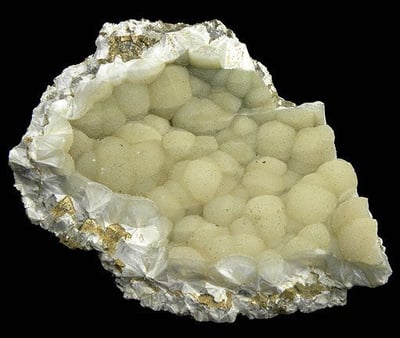
Serandite
A variety of Wollastonite Group

What is Serandite?
Stumbling upon serandite will require two things: extreme luck and being in Quebec, Canada. There have been sporadic reports of finding serandite elsewhere worldwide, but never large enough to be collectible. They are so incredibly rare that they are considered the rarest of all of the manganese-rich gemstones. Crystals of this mineral rarely occur larger than 3 carats.
Etymology & Origins
Serandite was discovered on Rouma Island, part of the Los Islands in Guinea. The mineral was described by À. Lacroix in the journal Comptes rendus hebdomadaires des séances de l'Académie des Sciences. He named it sérandite in honor of J.M. Sérand, a mineral collector who helped in the collection of the mineral.
Uses & Applications
It is sometimes used as a gemstone.
Optical Properties
- Refractive Index
- 1.672-1.708
- Birefringence
- 0.036
- Optical Character
- Biaxial positive
Market Value Factors
Pricing varies for every rock and mineral, so use these universal factors to gauge Serandite before comparing listings or appraisals.
Size & Weight
Larger, intact specimens usually command higher prices.
Rarity & Demand
Scarce material or popular varieties sell at a premium.
Condition & Finish
Chips, repairs, and heavy wear lower value; clean prep helps.
Treatment & Provenance
Untreated specimens with documented locality are prized.
The Meaning
Serandite does not hold a large mythological history, however, this stone was believed in antiquity to have ties with Hestia, the Greek Goddess of Home and Hearth, who was invoked in prayers for tranquility, peace, and safety.
Key Characteristics
Characteristics of Serandite
Serandite is transparent to translucent and is normally salmon-pink, light pink, rose-red, orange, brown, black, or colorless; in thin section, it is colorless. Octahedrally bonded Mn(II) is the primary contributor to the mineral's pink colors. Crystals of the mineral can be prismatic to acicular and elongated along [010], bladed, blocky, or tabular and flattened on {100}, occur as a radiating aggregate, or have massive habit. Sérandite is a member of the wollastonite group and is the manganese analogue of pectolite.
Formation of Serandite
Serandite has been found in Australia, Brazil, Canada, Guinea, Italy, Japan, Namibia, Norway, Russia, South Africa, and the United States. The type material is held at the National Museum of Natural History in Washington, D.C. At Mont Saint-Hilaire, Quebec, serandite occurs in sodalite xenoliths and pegmatites cutting syenites within an intrusive alkalic gabbro-syenite complex. In Point of Rocks, New Mexico, it occurs in vugs in phonolite. At the Tumannoe deposit in Russia, serandite occurs in a manganese rich deposit associated with volcanic rocks and terrigenous (non-marine) sediments which has been altered by contact metamorphism. Serandite has been found in association with aegirine, analcime, arfvedsonite, astrophyllite, eudialyte, fluorite, leucophanite, mangan-neptunite, microcline, nepheline, sodalite, and villiaumite.
Quick Facts
Physical Properties
- Color
- Pale pink, salmon-red, salmon-orange, deep orange, rose-red, brown, colourless
- Hardness (Mohs)
- 5 - 5.5
- Rock tumbling
- With care
- Density
- 3.42 g/cm³
- Streak
- White
- Luster
- Greasy, Vitreous, Sub-vitreous
- Crystal System
- Triclinic
Chemical Properties
- Chemical Formula
- NaMn2+2Si3O8(OH)
- Elements
- H, Mn, Na, O, Si
Identify Serandite Instantly
- Snap a photo, get instant results
- 6,700+ rocks, minerals & crystals
- Discover collecting spots near you
Serandite FAQs
How do I identify Serandite?
Serandite can be identified by its hardness of 5 - 5.5 on the Mohs scale, Pale pink color, Greasy, Vitreous, Sub-vitreous luster, Triclinic crystal system. Look for these key characteristics when examining specimens.
What color is Serandite?
Serandite typically appears in Pale pink, salmon-red, salmon-orange, deep orange, rose-red, brown, colourless. Color can vary depending on impurities and formation conditions.
How hard is Serandite?
Serandite has a hardness of 5 - 5.5 on the Mohs scale. This gives it moderate hardness.
What is the characteristics of serandite of Serandite?
Serandite is transparent to translucent and is normally salmon-pink, light pink, rose-red, orange, brown, black, or colorless; in thin section, it is colorless. Octahedrally bonded Mn(II) is the primary contributor to the mineral's pink colors. Crystals of the mineral can be prismatic to acicular and elongated along [010], bladed, blocky, or tabular and flattened on {100}, occur as a radiating aggregate, or have massive habit. Sérandite is a member of the wollastonite group and is the manganese analogue of pectolite.
What is the formation of serandite of Serandite?
Serandite has been found in Australia, Brazil, Canada, Guinea, Italy, Japan, Namibia, Norway, Russia, South Africa, and the United States. The type material is held at the National Museum of Natural History in Washington, D.C. At Mont Saint-Hilaire, Quebec, serandite occurs in sodalite xenoliths and pegmatites cutting syenites within an intrusive alkalic gabbro-syenite complex. In Point of Rocks, New Mexico, it occurs in vugs in phonolite. At the Tumannoe deposit in Russia, serandite occurs in a manganese rich deposit associated with volcanic rocks and terrigenous (non-marine) sediments which has been altered by contact metamorphism. Serandite has been found in association with aegirine, analcime, arfvedsonite, astrophyllite, eudialyte, fluorite, leucophanite, mangan-neptunite, microcline, nepheline, sodalite, and villiaumite.