Pyromorphite
A variety of Apatite Group
What is Pyromorphite?
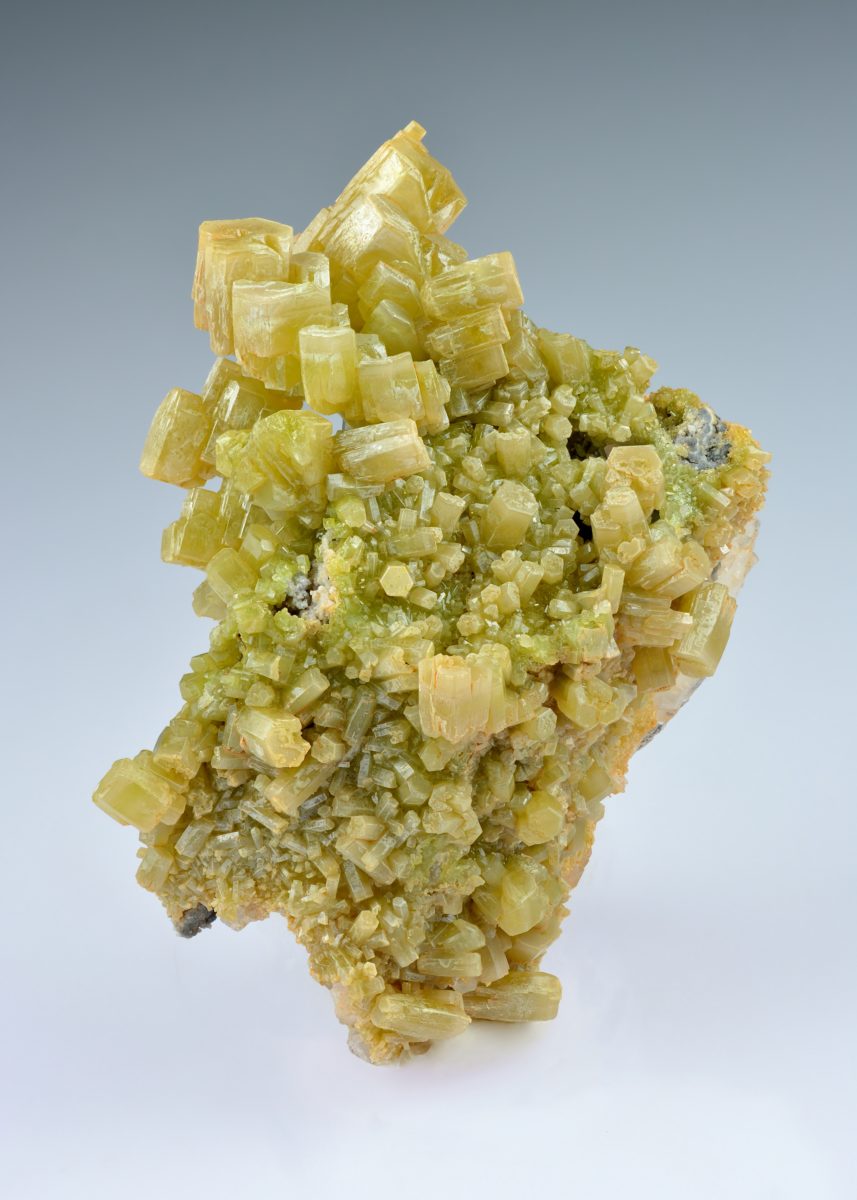
Pyromorphite, its named derived from the Greek word for "fire", is an uncommon and distinctive mineral. Many pyromorphite specimens bear striking yellow, green, or chartreuse colorations and impressive crystal structures. While there are few commercial uses for this mineral, attractive specimens are sought after by collectors.
Etymology & Origins
The phosphate was first distinguished chemically by M. H. Klaproth in 1784, and it was named pyromorphite by J. F. L. Hausmann in 1813. The name is derived from the Greek for pyr (fire) and morfe (form) due to its crystallization behavior after being melted.
Uses & Applications
Pyromorphite is a source of lead, though it does not occur abundantly and is not the most popular ore of lead. Due to its bright green color, it is a popular collectors item and gemstone that can be very expensive and desirable.
Healing Properties
Pyromorphite is believed to attract wealth and abundance, while unlocking your creativity and allowing for innovative ideas and critical thinking. The energy from this crystal is believed to facilitate happiness and support all aspects of a person's emotional and physical health.
Optical Properties
- Refractive Index
- 2.042-2.059
- Birefringence
- 0.01
- Pleochroism
- Weak
- Optical Character
- Uniaxial negative
Market Value Factors
Pricing varies for every rock and mineral, so use these universal factors to gauge Pyromorphite before comparing listings or appraisals.
Size & Weight
Larger, intact specimens usually command higher prices.
Rarity & Demand
Scarce material or popular varieties sell at a premium.
Condition & Finish
Chips, repairs, and heavy wear lower value; clean prep helps.
Treatment & Provenance
Untreated specimens with documented locality are prized.
Associated Chakras
Key Characteristics
Characteristics of Pyromorphite
The color of the mineral is usually some bright shade of green, yellow or brown, and the luster is resinous. The hardness is 3.5 to 4, and the specific gravity 6.5 - 7.1. Owing to isomorphous replacement of the phosphorus by arsenic there may be a gradual passage from pyromorphite to mimetite. Varieties containing calcium isomorphously replacing lead are lower in density (specific gravity 5.9 - 6.5) and usually lighter in color; they bear the names polysphaerite (because of the globular form), miesite from Mies in Bohemia, nussierite from Nuizière, Chénelette, near Beaujeu, Rhône, France, and cherokine from Cherokee County in Georgia.
Health & Safety Information
- ⚠️Pyromorphite dust is toxic because it contains heavy metals Lead.
- ⚠️Lead
- ⚠️It's advisable to handle pyromorphite carefully to avoid generating dust and wash hands thoroughly afterward. When cutting or polishing pyromorphite, wear a dust mask to prevent inhaling heavy metal particles. Store pyromorphite in a sealed container in a well-ventilated area, away from children and pets. For those involved in crystal healing, never put it in your mouth.
More Images


Quick Facts
Physical Properties
- Color
- Green to dark green, yellow, greenish-yellow, yellowish-green, orangish-yellow, shades of brown, white, colourless
- Hardness (Mohs)
- 3.5 - 4
- Rock tumbling
- Not recommended
- Density
- 7.109 g/cm³
- Streak
- White
- Luster
- Greasy, Resinous, Waxy, Sub-vitreous
- Crystal System
- Hexagonal
Chemical Properties
- Chemical Formula
- Pb5(PO4)3Cl
- Elements
- Cl, O, P, Pb
Also Known As
Identify Pyromorphite Instantly
- Snap a photo, get instant results
- 6,700+ rocks, minerals & crystals
- Discover collecting spots near you
Pyromorphite FAQs
How do I identify Pyromorphite?
Pyromorphite can be identified by its hardness of 3.5 - 4 on the Mohs scale, Green to dark green color, Greasy, Resinous, Waxy, Sub-vitreous luster, Hexagonal crystal system. Look for these key characteristics when examining specimens.
What color is Pyromorphite?
Pyromorphite typically appears in Green to dark green, yellow, greenish-yellow, yellowish-green, orangish-yellow, shades of brown, white, colourless. Color can vary depending on impurities and formation conditions.
How hard is Pyromorphite?
Pyromorphite has a hardness of 3.5 - 4 on the Mohs scale. This gives it moderate hardness.
What is the characteristics of pyromorphite of Pyromorphite?
The color of the mineral is usually some bright shade of green, yellow or brown, and the luster is resinous. The hardness is 3.5 to 4, and the specific gravity 6.5 - 7.1. Owing to isomorphous replacement of the phosphorus by arsenic there may be a gradual passage from pyromorphite to mimetite. Varieties containing calcium isomorphously replacing lead are lower in density (specific gravity 5.9 - 6.5) and usually lighter in color; they bear the names polysphaerite (because of the globular form), miesite from Mies in Bohemia, nussierite from Nuizière, Chénelette, near Beaujeu, Rhône, France, and cherokine from Cherokee County in Georgia.


