Vanadinite
A variety of Apatite Group

What is Vanadinite?
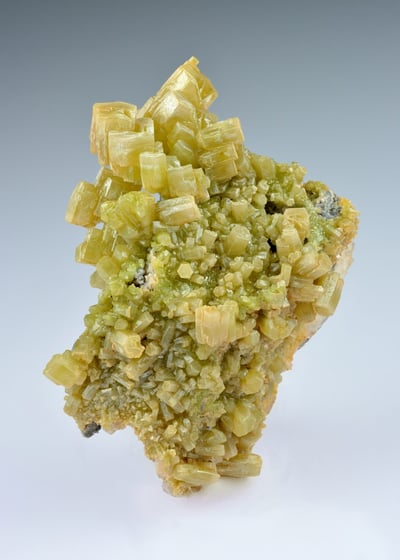
Vanadinite is a rare mineral in the apatite family that often bears strikingly-colored vermillion or blood-red crystals. The mineral, as its name suggests, contains the element Vanadium, and it is indeed an important ore of that element. Vanadium is an additive to steel alloys, and is also used in glassmaking, ceramics, and some types of batteries.
Etymology & Origins
It was originally discovered in Mexico by the Spanish mineralogist Andrés Manuel del Río in 1801. He called the mineral "brown lead" and asserted that it contained a new element, which he first named pancromium and later, erythronium. However, he was later led to believe that this was not a new element but merely an impure form of chromium. In 1830, Nils Gabriel Sefström discovered a new element, which he named vanadium. It was later revealed that this was identical to the metal discovered earlier by Andrés Manuel del Río. Del Río's "brown lead" was also rediscovered, in 1838 in Zimapan, Hidalgo, Mexico, and was named vanadinite because of its high vanadium content. Other names that have since been given to vanadinite are johnstonite and lead vanadate.
Uses & Applications
Vanadinite is an ore for the metal vanadium, a common additive to steel that can then be used in armor, as well as a component of automobile parts such as axles and pistons. It is also used to create many other metal tools and crankshafts, and may be used as a pigment for ceramics and glass. Vanadinite is often closely associated with lead deposits.
Healing Properties
Vanadinite is believed to enhance mental function, concentration and physical stamina. Often used during exercise workouts, study periods, or long hours at the office, it is said to promote action and productivity. It can be used during meditation or placed in the home or workplace. This stone harmonizes well with other crystals for enhanced healing energy.
Discover Values
Market Value Factors
Pricing varies for every rock and mineral, so use these universal factors to gauge Vanadinite before comparing listings or appraisals.
Size & Weight
Larger, intact specimens usually command higher prices.
Rarity & Demand
Scarce material or popular varieties sell at a premium.
Condition & Finish
Chips, repairs, and heavy wear lower value; clean prep helps.
Treatment & Provenance
Untreated specimens with documented locality are prized.
Associated Chakras
Key Characteristics
Characteristics of Vanadinite
Vanadinite is in the apatite group of phosphates, and forms a chemical series with the minerals pyromorphite (Pb5(PO4)3Cl) and mimetite (Pb5(AsO4)3Cl), with both of which it may form solid solutions. Whereas most chemical series involve the substitution of metallic ions, this series substitutes its anion groups; phosphate (PO4), arsenate (AsO4) and vanadate (VO4). Common impurities of vanadinite include phosphorus, arsenic and calcium, where these may act as an isomorphic substitute for vanadium. Vanadinite when containing a high amount of the arsenic impurity is known as endlichite. Vanadinite is usually bright-red or orange-red in colour, although sometimes brown, red-brown, grey, yellow, or colourless. Its distinctive colour makes it popular among mineral collectors. Its streak can be either pale yellow or brownish-yellow. Vanadinite may be transparent, translucent or opaque, and its lustre can range from resinous to adamantine. Vanadinite is anisotropic, meaning that some of its properties differ when measured along different axes. When measured perpendicular and parallel to its axis of anisotropy, its refractive indices are 2.350 and 2.416 respectively. This gives it a birefringence of 0.066. Vanadinite is very brittle, producing small, conchoidal fragments when fractured. Its hardness is 3–4 on the Mohs scale, about the same as a copper coin. Vanadinite is particularly heavy for a translucent mineral. It has a molar mass of 1416.27 g/mole and its specific gravity can range between 6.6 and 7.2 because of impurities.
Formation of Vanadinite
Vanadinite occurs as a secondary mineral in the oxidized zone of lead-bearing deposits, the vanadium is leached from wall-rock silicates. Associated minerals include mimetite, pyromorphite, descloizite, mottramite, wulfenite, cerussite, anglesite, calcite, barite, and various iron oxide minerals. Deposits of vanadinite are found worldwide including Austria, Spain, Scotland, the Ural Mountains, South Africa, Namibia, Morocco, Argentina, Mexico, and 4 states of the United States: Arizona, Colorado, New Mexico, and South Dakota. Vanadinite deposits are found in over 400 mines across the world. Notable vanadinite mines include those at Mibladen and Touisset in Morocco; Tsumeb, Namibia; Cordoba, Argentina; and Sierra County, New Mexico, and Gila County, Arizona, in the United States.
Composition of Vanadinite
Vanadinite is a lead chlorovanadate with the chemical formula Pb5(VO4)3Cl. It is composed (by weight) of 73.15% lead, 10.79% vanadium, 13.56% oxygen, and 2.50% chlorine. Each structural unit of vanadinite contains a chlorine ion surrounded by six divalent lead ions at the corners of a regular octahedron, with one of the lead ions provided by an adjoining vanadinite molecule. The distance between each lead and chlorine ion is 317 picometres. The shortest distance between each lead ion is 4.48 Å. The octahedron shares two of its opposite faces with that of neighbouring vanadinite units, forming a continuous chain of octahedrons. Each vanadium atom is surrounded by four oxygen atoms at the corners of an irregular tetrahedron. The distance between each oxygen and vanadium atom is either 1.72 or 1.76 Å. Three oxygen tetrahedrons adjoin each of the lead octahedrons along the chain. Crystals of vanadinite conform to a hexagonal system of symmetry. This internal structure is often reflected in the hexagonal external shape of the crystals. The crystals are usually in the form of short hexagonal prisms, but can also be found as hexagonal pyramids, rounded masses or crusts. A unit cell of vanadinite, the smallest divisible unit that possesses the same symmetry and properties, is in the form of a hexagonal prism. The unit cell of vanadinite is composed of two of its molecules and has the dimensions a = 10.331 Å and c = 7.343 Å), where a is the length of each side of the hexagon and c is the height of the prism. The volume of each unit cell of vanadinite, given by the formula V = ac sin(60°), is 678.72 Å.
Health & Safety Information
- ⚠️Vanadinite dust is toxic because it contains heavy metals Lead, Vanadium.
- ⚠️Lead, Vanadium
- ⚠️It's advisable to handle vanadinite carefully to avoid generating dust and wash hands thoroughly afterward. When cutting or polishing vanadinite, wear a dust mask to prevent inhaling heavy metal particles. Store vanadinite in a sealed container in a well-ventilated area, away from children and pets. For those involved in crystal healing, never put it in your mouth.
More Images


Quick Facts
Physical Properties
- Color
- Orange-red, red-brown, brown, bright red, yellow, whitish, pale straw-yellow
- Hardness (Mohs)
- 2.5 - 3
- Rock tumbling
- Not recommended
- Density
- 6.95 g/cm³
- Streak
- White to pale yellow, light brownish yellow
- Luster
- Resinous, Adamantine
- Crystal System
- Hexagonal
Chemical Properties
- Chemical Formula
- Pb5(VO4)3Cl
- Elements
- Cl, O, Pb, V
Also Known As
Identify Vanadinite Instantly
- Snap a photo, get instant results
- 6,700+ rocks, minerals & crystals
- Discover collecting spots near you
Vanadinite FAQs
How do I identify Vanadinite?
Vanadinite can be identified by its hardness of 2.5 - 3 on the Mohs scale, Orange-red color, Resinous, Adamantine luster, Hexagonal crystal system. Look for these key characteristics when examining specimens.
What color is Vanadinite?
Vanadinite typically appears in Orange-red, red-brown, brown, bright red, yellow, whitish, pale straw-yellow. Color can vary depending on impurities and formation conditions.
How hard is Vanadinite?
Vanadinite has a hardness of 2.5 - 3 on the Mohs scale. This makes it a soft mineral that can be scratched easily.
What is the characteristics of vanadinite of Vanadinite?
Vanadinite is in the apatite group of phosphates, and forms a chemical series with the minerals pyromorphite (Pb5(PO4)3Cl) and mimetite (Pb5(AsO4)3Cl), with both of which it may form solid solutions. Whereas most chemical series involve the substitution of metallic ions, this series substitutes its anion groups; phosphate (PO4), arsenate (AsO4) and vanadate (VO4). Common impurities of vanadinite include phosphorus, arsenic and calcium, where these may act as an isomorphic substitute for vanadium. Vanadinite when containing a high amount of the arsenic impurity is known as endlichite. Vanadinite is usually bright-red or orange-red in colour, although sometimes brown, red-brown, grey, yellow, or colourless. Its distinctive colour makes it popular among mineral collectors. Its streak can be either pale yellow or brownish-yellow. Vanadinite may be transparent, translucent or opaque, and its lustre can range from resinous to adamantine. Vanadinite is anisotropic, meaning that some of its properties differ when measured along different axes. When measured perpendicular and parallel to its axis of anisotropy, its refractive indices are 2.350 and 2.416 respectively. This gives it a birefringence of 0.066. Vanadinite is very brittle, producing small, conchoidal fragments when fractured. Its hardness is 3–4 on the Mohs scale, about the same as a copper coin. Vanadinite is particularly heavy for a translucent mineral. It has a molar mass of 1416.27 g/mole and its specific gravity can range between 6.6 and 7.2 because of impurities.
What is the formation of vanadinite of Vanadinite?
Vanadinite occurs as a secondary mineral in the oxidized zone of lead-bearing deposits, the vanadium is leached from wall-rock silicates. Associated minerals include mimetite, pyromorphite, descloizite, mottramite, wulfenite, cerussite, anglesite, calcite, barite, and various iron oxide minerals. Deposits of vanadinite are found worldwide including Austria, Spain, Scotland, the Ural Mountains, South Africa, Namibia, Morocco, Argentina, Mexico, and 4 states of the United States: Arizona, Colorado, New Mexico, and South Dakota. Vanadinite deposits are found in over 400 mines across the world. Notable vanadinite mines include those at Mibladen and Touisset in Morocco; Tsumeb, Namibia; Cordoba, Argentina; and Sierra County, New Mexico, and Gila County, Arizona, in the United States.
What is the composition of vanadinite of Vanadinite?
Vanadinite is a lead chlorovanadate with the chemical formula Pb5(VO4)3Cl. It is composed (by weight) of 73.15% lead, 10.79% vanadium, 13.56% oxygen, and 2.50% chlorine. Each structural unit of vanadinite contains a chlorine ion surrounded by six divalent lead ions at the corners of a regular octahedron, with one of the lead ions provided by an adjoining vanadinite molecule. The distance between each lead and chlorine ion is 317 picometres. The shortest distance between each lead ion is 4.48 Å. The octahedron shares two of its opposite faces with that of neighbouring vanadinite units, forming a continuous chain of octahedrons. Each vanadium atom is surrounded by four oxygen atoms at the corners of an irregular tetrahedron. The distance between each oxygen and vanadium atom is either 1.72 or 1.76 Å. Three oxygen tetrahedrons adjoin each of the lead octahedrons along the chain. Crystals of vanadinite conform to a hexagonal system of symmetry. This internal structure is often reflected in the hexagonal external shape of the crystals. The crystals are usually in the form of short hexagonal prisms, but can also be found as hexagonal pyramids, rounded masses or crusts. A unit cell of vanadinite, the smallest divisible unit that possesses the same symmetry and properties, is in the form of a hexagonal prism. The unit cell of vanadinite is composed of two of its molecules and has the dimensions a = 10.331 Å and c = 7.343 Å), where a is the length of each side of the hexagon and c is the height of the prism. The volume of each unit cell of vanadinite, given by the formula V = ac sin(60°), is 678.72 Å.