Vivianite
A variety of Vivianite Group

What is Vivianite?
Vivianite is a soft, fragile mineral that grows in a wide variety of forms, occasionally creating very impressive crystals. Though it is colorless in its pure form, the mineral oxidizes quickly, often changing into a striking green or blue hue. Vivianite has no commercial or industrial uses, although attractive specimens are sought after by collectors.
Etymology & Origins
It was named by Abraham Gottlob Werner in 1817, the year of his death, after either John Henry Vivian (1785–1855), a Welsh-Cornish politician, mine owner and mineralogist living in Truro, Cornwall, England, or after Jeffrey G. Vivian, an English mineralogist. Vivianite was discovered at Wheal Kind, in St Agnes, Cornwall.
Uses & Applications
Vivianite is very popular among collectors as raw specimens and as gemstones. However, there are no known industrial or household uses for this mineral. Vivianite was historically once used as a pigment in oil paints, though it is rarely used in that context in modern times.
Healing Properties
Vivianite is believed to be a restorative stone that will help to remove negative energy from your emotional, physical and spiritual body and replace it with positive healing energy. It is said that just holding the crystal in the hand can revitalize the individual. It is often used to alleviate stress and help boost a more positive outlook, allowing an individual to move forward in life.
Optical Properties
- Refractive Index
- 1.560-1.640
- Birefringence
- 0.054-0.075
- Pleochroism
- Strong: deep blue, pale yellowish green, yellowish green
- Optical Character
- Biaxial positive
Market Value Factors
Pricing varies for every rock and mineral, so use these universal factors to gauge Vivianite before comparing listings or appraisals.
Size & Weight
Larger, intact specimens usually command higher prices.
Rarity & Demand
Scarce material or popular varieties sell at a premium.
Condition & Finish
Chips, repairs, and heavy wear lower value; clean prep helps.
Treatment & Provenance
Untreated specimens with documented locality are prized.
Associated Chakras
Key Characteristics
Characteristics of Vivianite
Vivianite is a soft mineral, with Mohs hardness only 1 ⁄2 to 2, and specific gravity 2.7. It splits easily, with perfect cleavage perpendicular to the b crystal axis, due to the sheet-like structure of the mineral. It is sectile, with a fibrous fracture, and thin laminae parallel to the cleavage plane are flexible. It is easily soluble in acids. It has a melting point of 1,114 °C (2,037 °F), it darkens in color in H2O2 and is not radioactive.
Appearance of Vivianite
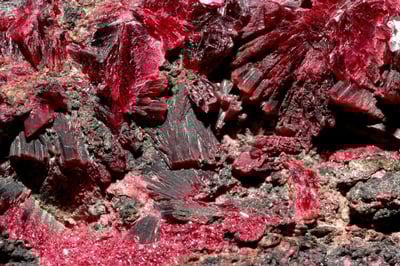
The mineral may occur as crystals, or as masses or concretions. The crystals are usually prismatic parallel to the c crystal axis, and flattened perpendicular to the b axis. Equant crystals are rarer. They may also occur as stellate (star-shaped) groups, or encrustations with a bladed or fibrous structure. Unaltered specimens are colorless to very pale green, but they oxidize on exposure to light (and possibly also in situ) to blue, then darker green, brown, purple and purplish black. The streak is white, altering to dark blue or brown. Crystals are transparent to translucent with a vitreous luster, pearly on the cleavage surface, or dull and earthy.
Composition of Vivianite
In pure end member vivianite all the iron is divalent, Fe, but there are two distinct sites in the structure that these ions can occupy. In the first site the Fe is surrounded by four water molecules and two oxygens, making an octahedral group. In the second site the Fe is surrounded by two water molecules and four oxygens, again making an octahedral group. The oxygens are part of the phosphate groups (PO4), that are tetrahedral. The vivianite structure has chains of these octahedra and tetrahedra that form sheets perpendicular to the a crystal axis. The sheets are held together by weak bonds, and that accounts for the perfect cleavage between them. The crystals are monoclinic, class 2/m, space group C 2/m, with two formula units per unit cell (Z = 2). The approximate values of the unit cell parameters are a = 10.1 Å, b = 13.4 Å, c = 4.7 Å and β = 104.3°, with slightly different values given by different sources: a = 10.086 Å, b = 13.441 Å, c = 4.703 Å, β = 104.27° a = 10.06 Å, b = 13.41 Å, c = 4.696 Å, β = 104.3° a = 10.034–10.086 Å, b= 13.434–13.441 Å, c= 4.687–4.714 Å, β = 102.65–104.27° a = 10.024(6) Å, b = 13.436(3) Å, c = 4.693(4) Å, β = 102.30(5)°
More Images

Quick Facts
Physical Properties
- Color
- Colourless and transparent when fresh, quickly turning pale to deep blue, greenish-blue or bluish-green
- Hardness (Mohs)
- 1.5 - 2
- Rock tumbling
- Not recommended
- Density
- 2.696 g/cm³
- Streak
- Colourless to bluish white, quickly changing to dark blue or brown
- Luster
- Pearly, Vitreous, Dull
- Crystal System
- Monoclinic
Chemical Properties
- Chemical Formula
- Fe2+3(PO4)2 · 8H2O
- Elements
- Fe, H, O, P
Also Known As
Identify Vivianite Instantly
- Snap a photo, get instant results
- 6,700+ rocks, minerals & crystals
- Discover collecting spots near you
Vivianite FAQs
How do I identify Vivianite?
Vivianite can be identified by its hardness of 1.5 - 2 on the Mohs scale, Colourless and transparent when fresh color, Pearly, Vitreous, Dull luster, Monoclinic crystal system. Look for these key characteristics when examining specimens.
What color is Vivianite?
Vivianite typically appears in Colourless and transparent when fresh, quickly turning pale to deep blue, greenish-blue or bluish-green. Color can vary depending on impurities and formation conditions.
How hard is Vivianite?
Vivianite has a hardness of 1.5 - 2 on the Mohs scale. This makes it a soft mineral that can be scratched easily.
What is the characteristics of vivianite of Vivianite?
Vivianite is a soft mineral, with Mohs hardness only 1 ⁄2 to 2, and specific gravity 2.7. It splits easily, with perfect cleavage perpendicular to the b crystal axis, due to the sheet-like structure of the mineral. It is sectile, with a fibrous fracture, and thin laminae parallel to the cleavage plane are flexible. It is easily soluble in acids. It has a melting point of 1,114 °C (2,037 °F), it darkens in color in H2O2 and is not radioactive.
What is the appearance of vivianite of Vivianite?
The mineral may occur as crystals, or as masses or concretions. The crystals are usually prismatic parallel to the c crystal axis, and flattened perpendicular to the b axis. Equant crystals are rarer. They may also occur as stellate (star-shaped) groups, or encrustations with a bladed or fibrous structure. Unaltered specimens are colorless to very pale green, but they oxidize on exposure to light (and possibly also in situ) to blue, then darker green, brown, purple and purplish black. The streak is white, altering to dark blue or brown. Crystals are transparent to translucent with a vitreous luster, pearly on the cleavage surface, or dull and earthy.
What is the composition of vivianite of Vivianite?
In pure end member vivianite all the iron is divalent, Fe, but there are two distinct sites in the structure that these ions can occupy. In the first site the Fe is surrounded by four water molecules and two oxygens, making an octahedral group. In the second site the Fe is surrounded by two water molecules and four oxygens, again making an octahedral group. The oxygens are part of the phosphate groups (PO4), that are tetrahedral. The vivianite structure has chains of these octahedra and tetrahedra that form sheets perpendicular to the a crystal axis. The sheets are held together by weak bonds, and that accounts for the perfect cleavage between them. The crystals are monoclinic, class 2/m, space group C 2/m, with two formula units per unit cell (Z = 2). The approximate values of the unit cell parameters are a = 10.1 Å, b = 13.4 Å, c = 4.7 Å and β = 104.3°, with slightly different values given by different sources: a = 10.086 Å, b = 13.441 Å, c = 4.703 Å, β = 104.27° a = 10.06 Å, b = 13.41 Å, c = 4.696 Å, β = 104.3° a = 10.034–10.086 Å, b= 13.434–13.441 Å, c= 4.687–4.714 Å, β = 102.65–104.27° a = 10.024(6) Å, b = 13.436(3) Å, c = 4.693(4) Å, β = 102.30(5)°