Aegirine
A variety of Clinopyroxene Subgroup

What is Aegirine?
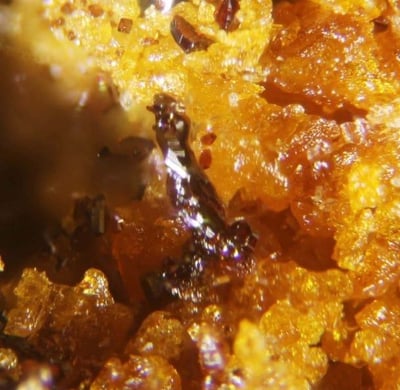
Aegirine is commonly found in volcanic rock formed near seawater, and was named after a Scandinavian sea god, Aegir. The slender, prism-shaped crystals are highly sought after by collectors. It is most commonly found in the United States, predominately in quarries of Arkansas.
Etymology & Origins
Aegirine was named after Ægir, the Norse god of the sea. A synonym for the mineral is acmite (from Greek ἀκμή "point, edge") in reference to the typical pointed crystals.
Uses & Applications
It is sometimes used as a gemstone.
Healing Properties
Aegirine is believed to provide protection from psychic attacks and is often used by those fighting addictive behaviors. It may be helpful for anyone with electrical sensitivity, such as to cell phones and computers. When worn as jewelry it is said to stimulate joy and happiness. It may also relieve stress and restore hope by dispelling negative feelings.
Optical Properties
- Refractive Index
- 1.760-1.805
- Birefringence
- 0.045
- Optical Character
- Biaxial negative
Market Value Factors
Pricing varies for every rock and mineral, so use these universal factors to gauge Aegirine before comparing listings or appraisals.
Size & Weight
Larger, intact specimens usually command higher prices.
Rarity & Demand
Scarce material or popular varieties sell at a premium.
Condition & Finish
Chips, repairs, and heavy wear lower value; clean prep helps.
Treatment & Provenance
Untreated specimens with documented locality are prized.
Associated Chakras







Key Characteristics
Rock Types of Aegirine
The acmite variety was first described in 1821, at Kongsberg, Norway, and the aegirine variety in 1835 for an occurrence in Rundemyr, Øvre Eiker, Buskerud, Norway.
More Images

Quick Facts
Physical Properties
- Color
- Dark green to greenish black, reddish brown, black
- Hardness (Mohs)
- 6
- Rock tumbling
- With care
- Density
- 3.5 - 3.54 g/cm³
- Streak
- Yellowish-grey
- Luster
- Vitreous
- Crystal System
- Monoclinic
Chemical Properties
- Chemical Formula
- NaFe3+Si2O6
- Elements
- Fe, Na, O, Si
Also Known As
Identify Aegirine Instantly
- Snap a photo, get instant results
- 6,700+ rocks, minerals & crystals
- Discover collecting spots near you
Aegirine FAQs
How do I identify Aegirine?
Aegirine can be identified by its hardness of 6 on the Mohs scale, Dark green to greenish black color, Vitreous luster, Monoclinic crystal system. Look for these key characteristics when examining specimens.
What color is Aegirine?
Aegirine typically appears in Dark green to greenish black, reddish brown, black. Color can vary depending on impurities and formation conditions.
How hard is Aegirine?
Aegirine has a hardness of 6 on the Mohs scale. This gives it moderate hardness.
What is the rock types of aegirine of Aegirine?
The acmite variety was first described in 1821, at Kongsberg, Norway, and the aegirine variety in 1835 for an occurrence in Rundemyr, Øvre Eiker, Buskerud, Norway.