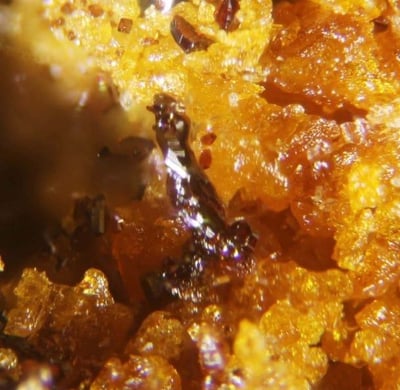
Jadeite
A variety of Clinopyroxene Subgroup

What is Jadeite?
Jadeite is the rarer of two separate minerals that are commonly referred to as Jade. Evidence of its use for decorative items dates as far back as twelve thousand years ago. In China, deeply green jadeite is often called "Imperial Jade;" highly prized for centuries, the mineral has been used to create intricate carvings, vases, and pieces of jewelry.
Etymology & Origins
The name jadeite is derived (via French: jade and Latin: ilia) from the Spanish phrase "piedra de ijada" which means "stone of the side". The Latin version of the name, lapis nephriticus, is the origin of the term nephrite, which is a different mineral that also shares the common name jade.
Uses & Applications
Jadeite is the preferred version of Jade for producing carvings and ornaments. It is more rare than the other mineral commonly called Jade, and has at times in history been worth more than diamonds. It is used as an honored gift for birthdays, weddings and other special celebrations.
Optical Properties
- Refractive Index
- 1.652-1.688
- Birefringence
- 0.012-0.020
- Pleochroism
- None
- Optical Character
- Biaxial positive
Discover Values
This stone excels in beauty, collection value.
Market Value Factors
Pricing varies for every rock and mineral, so use these universal factors to gauge Jadeite before comparing listings or appraisals.
Size & Weight
Larger, intact specimens usually command higher prices.
Rarity & Demand
Scarce material or popular varieties sell at a premium.
Condition & Finish
Chips, repairs, and heavy wear lower value; clean prep helps.
Treatment & Provenance
Untreated specimens with documented locality are prized.
The Meaning
In ancient China, jadeite was prized as an "imperial gem" and was considered a symbol of status, spirituality, health and purity. Many other cultures and civilizations such as Maori, Aztec and Maya valued the stone. Maya people used it in their ceremonial rituals, while Maori would make precious objects out of it and pass them down to the next generation. In Central America, jadeite was also thought to have magical healing capabilities that could be wielded against various ailments.
Geochemistry
Jadeite forms solid solutions with other pyroxene endmembers such as augite and diopside (CaMg-rich endmembers), aegirine (NaFe endmember), and kosmochlor (NaCr endmember). Pyroxenes rich in both the jadeite and augite endmembers are known as omphacite. Jadeite is formed in metamorphic rocks under high pressure and relatively low temperature conditions. Albite (NaAlSi3O8) is a common mineral of the Earth's crust, and it has a specific gravity of about 2.6, much less than that of jadeite. With increasing pressure, albite breaks down to form the high-pressure assemblage of jadeite plus quartz. Minerals associated with jadeite include: glaucophane, lawsonite, muscovite, aragonite, serpentine and quartz. Rocks that consist almost entirely of jadeite are called jadeitite. In all well-documented occurrences, jadeitite appears to have formed from subduction zone fluids in association with serpentinite. Jadeitite is resistant to weathering, and boulders of jadeitite released from the serpentine-rich environments in which they formed are found in a variety of environments.
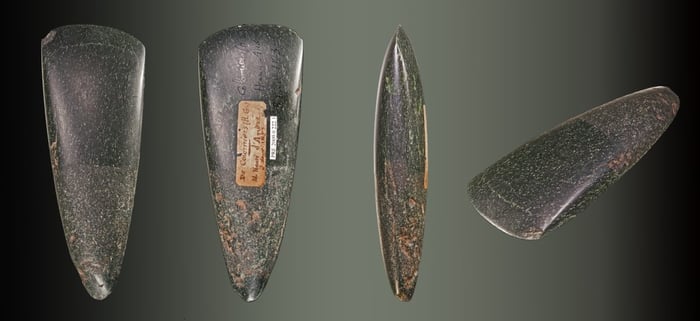
More Images
Quick Facts
Physical Properties
- Color
- Apple-green, greenish white, purplish blue, blue-green, violet, white, black
- Hardness (Mohs)
- 6
- Rock tumbling
- With care
- Density
- 3.3 - 3.38 g/cm³
- Streak
- White
- Luster
- Pearly, Sub-vitreous
- Crystal System
- Monoclinic
Chemical Properties
- Chemical Formula
- Na(Al,Fe3+)Si2O6
- Elements
- Al, Fe, Na, O, Si
Also Known As
Identify Jadeite Instantly
- Snap a photo, get instant results
- 6,700+ rocks, minerals & crystals
- Discover collecting spots near you
Jadeite FAQs
How do I identify Jadeite?
Jadeite can be identified by its hardness of 6 on the Mohs scale, Apple-green color, Pearly, Sub-vitreous luster, Monoclinic crystal system. Look for these key characteristics when examining specimens.
What color is Jadeite?
Jadeite typically appears in Apple-green, greenish white, purplish blue, blue-green, violet, white, black. Color can vary depending on impurities and formation conditions.
How hard is Jadeite?
Jadeite has a hardness of 6 on the Mohs scale. This gives it moderate hardness.