Limestone
A variety of Sedimentary

What is Limestone?
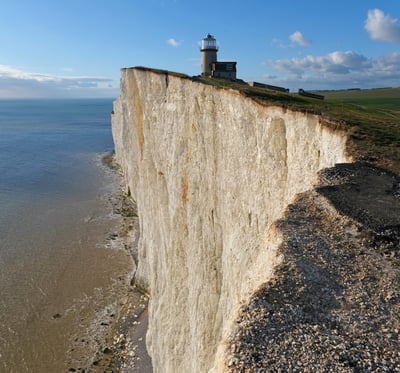
Limestone is a famous and widespread sedimentary rock that is composed mainly of calcium carbonate crystals. Many iconic geologic formations, including the White Cliffs of Dover, Bryce Canyon of Utah, and Mammoth Cave of Kentucky, were formed primarily through the erosion patterns of this relatively soft stone. Limestone is utilized in roads and buildings, is key component in concrete, and a part of household products ranging from dyes to toothpaste.
Uses & Applications
Limestone has a diverse range of uses, particularly as a construction material in building walls and flooring, as well as outdoor paving stones and railroad ballasts. When crushed, limestone can be mixed with other materials to make concrete. It is also commonly used as chalk to write or draw.
Discover Values
Market Value Factors
Pricing varies for every rock and mineral, so use these universal factors to gauge Limestone before comparing listings or appraisals.
Size & Weight
Larger, intact specimens usually command higher prices.
Rarity & Demand
Scarce material or popular varieties sell at a premium.
Condition & Finish
Chips, repairs, and heavy wear lower value; clean prep helps.
Treatment & Provenance
Untreated specimens with documented locality are prized.
Key Characteristics
Rock Types of Limestone
Robert J. Dunham published his system for limestone in 1962. It focuses on the depositional fabric of carbonate rocks. Dunham divides the rocks into four main groups based on relative proportions of coarser clastic particles, based on criteria such as whether the grains were originally in mutual contact, and therefore self-supporting, or whether the rock is characterized by the presence of frame builders and algal mats.
Characteristics of Limestone
About 10% of all sedimentary rocks are limestones. Limestone is partially soluble, especially in acid, and therefore forms many erosional landforms. These include limestone pavements, pot holes, cenotes, caves and gorges. Such erosion landscapes are known as karsts. Limestone is less resistant than most igneous rocks, but more resistant than most other sedimentary rocks. It is therefore usually associated with hills and downland, and occurs in regions with other sedimentary rocks, typically clays. Karst topography and caves develop in limestone rocks due to their solubility in dilute acidic groundwater. The solubility of limestone in water and weak acid solutions leads to karst landscapes. Regions overlying limestone bedrock tend to have fewer visible above-ground sources (ponds and streams), as surface water easily drains downward through joints in the limestone. While draining, water and organic acid from the soil slowly (over thousands or millions of years) enlarges these cracks, dissolving the calcium carbonate and carrying it away in solution. Most cave systems are through limestone bedrock. Cooling groundwater or mixing of different groundwaters will also create conditions suitable for cave formation. Coastal limestones are often eroded by organisms which bore into the rock by various means. This process is known as bioerosion. It is most common in the tropics, and it is known throughout the fossil record (see Taylor and Wilson, 2003). Bands of limestone emerge from the Earth's surface in often spectacular rocky outcrops and islands. Examples include the Rock of Gibraltar, the Burren in County Clare, Ireland; the Verdon Gorge in France; Malham Cove in North Yorkshire and the Isle of Wight, England; the Great Orme in Wales; on Fårö near the Swedish island of Gotland, the Niagara Escarpment in Canada/United States, Notch Peak in Utah, the Ha Long Bay National Park in Vietnam and the hills around the Lijiang River and Guilin city in China. The Florida Keys, islands off the south coast of Florida, are composed mainly of oolitic limestone (the Lower Keys) and the carbonate skeletons of coral reefs (the Upper Keys), which thrived in the area during interglacial periods when sea level was higher than at present. Unique habitats are found on alvars, extremely level expanses of limestone with thin soil mantles. The largest such expanse in Europe is the Stora Alvaret on the island of Öland, Sweden. Another area with large quantities of limestone is the island of Gotland, Sweden. Huge quarries in northwestern Europe, such as those of Mount Saint Peter (Belgium/Netherlands), extend for more than a hundred kilometers. The world's largest limestone quarry is at Michigan Limestone and Chemical Company in Rogers City, Michigan.
Formation of Limestone
The solubility of calcium carbonate (CaCO3) is controlled largely by the partial pressure of carbon dioxide (CO2) in the water. This is summarized in the reaction: CaCO3 + H2O + CO2 → Ca2+(aq) + 2 HCO3− Increases in temperature or decreases in pressure tend to reduce the partial pressure of CO2 and precipitate CaCO3. Reduction in salinity also reduces the solubility of CaCO3, by several orders of magnitude for fresh water versus seawater. Near-surface water of the earth's oceans are oversaturated with CaCO3 by a factor of more than six. The failure of CaCO3 to precipitate out of these waters is likely due to interference by dissolved magnesium ions with nucleation of calcite crystals, the necessary first step in precipitation. Although ooids may form through purely inorganic processes, the bulk of CaCO3 precipitation in the oceans is the result of biological activity. Much of this takes place on carbonate platforms.
Composition of Limestone
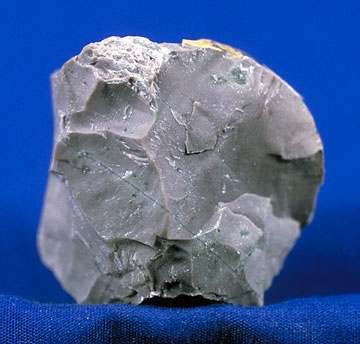
Like most other sedimentary rocks, most limestone is composed of grains. Most grains in limestone are skeletal fragments of marine organisms such as coral or foraminifera. These organisms secrete shells made of aragonite or calcite, and leave these shells behind when they die. Other carbonate grains composing limestones are ooids, peloids, intraclasts, and extraclasts. Limestone often contains variable amounts of silica in the form of chert (chalcedony, flint, jasper, etc.) or siliceous skeletal fragment (sponge spicules, diatoms, radiolarians), and travertine (a precipitate of calcite and aragonite).
More Images


Quick Facts
Physical Properties
- Color
- White, gray, tan, yellow, pink, or red, etc.
- Hardness (Mohs)
- 3 - 4
- Rock tumbling
- Not recommended
- Density
- 1.5 - 2.7 g/cm³
Also Known As

Identify Limestone Instantly
- Snap a photo, get instant results
- 6,700+ rocks, minerals & crystals
- Discover collecting spots near you
Limestone FAQs
How do I identify Limestone?
Limestone can be identified by its hardness of 3 - 4 on the Mohs scale, White color. Look for these key characteristics when examining specimens.
What color is Limestone?
Limestone typically appears in White, gray, tan, yellow, pink, or red, etc.. Color can vary depending on impurities and formation conditions.
How hard is Limestone?
Limestone has a hardness of 3 - 4 on the Mohs scale. This makes it a soft mineral that can be scratched easily.
What is the rock types of limestone of Limestone?
Robert J. Dunham published his system for limestone in 1962. It focuses on the depositional fabric of carbonate rocks. Dunham divides the rocks into four main groups based on relative proportions of coarser clastic particles, based on criteria such as whether the grains were originally in mutual contact, and therefore self-supporting, or whether the rock is characterized by the presence of frame builders and algal mats.
What is the characteristics of limestone of Limestone?
About 10% of all sedimentary rocks are limestones. Limestone is partially soluble, especially in acid, and therefore forms many erosional landforms. These include limestone pavements, pot holes, cenotes, caves and gorges. Such erosion landscapes are known as karsts. Limestone is less resistant than most igneous rocks, but more resistant than most other sedimentary rocks. It is therefore usually associated with hills and downland, and occurs in regions with other sedimentary rocks, typically clays. Karst topography and caves develop in limestone rocks due to their solubility in dilute acidic groundwater. The solubility of limestone in water and weak acid solutions leads to karst landscapes. Regions overlying limestone bedrock tend to have fewer visible above-ground sources (ponds and streams), as surface water easily drains downward through joints in the limestone. While draining, water and organic acid from the soil slowly (over thousands or millions of years) enlarges these cracks, dissolving the calcium carbonate and carrying it away in solution. Most cave systems are through limestone bedrock. Cooling groundwater or mixing of different groundwaters will also create conditions suitable for cave formation. Coastal limestones are often eroded by organisms which bore into the rock by various means. This process is known as bioerosion. It is most common in the tropics, and it is known throughout the fossil record (see Taylor and Wilson, 2003). Bands of limestone emerge from the Earth's surface in often spectacular rocky outcrops and islands. Examples include the Rock of Gibraltar, the Burren in County Clare, Ireland; the Verdon Gorge in France; Malham Cove in North Yorkshire and the Isle of Wight, England; the Great Orme in Wales; on Fårö near the Swedish island of Gotland, the Niagara Escarpment in Canada/United States, Notch Peak in Utah, the Ha Long Bay National Park in Vietnam and the hills around the Lijiang River and Guilin city in China. The Florida Keys, islands off the south coast of Florida, are composed mainly of oolitic limestone (the Lower Keys) and the carbonate skeletons of coral reefs (the Upper Keys), which thrived in the area during interglacial periods when sea level was higher than at present. Unique habitats are found on alvars, extremely level expanses of limestone with thin soil mantles. The largest such expanse in Europe is the Stora Alvaret on the island of Öland, Sweden. Another area with large quantities of limestone is the island of Gotland, Sweden. Huge quarries in northwestern Europe, such as those of Mount Saint Peter (Belgium/Netherlands), extend for more than a hundred kilometers. The world's largest limestone quarry is at Michigan Limestone and Chemical Company in Rogers City, Michigan.
What is the formation of limestone of Limestone?
The solubility of calcium carbonate (CaCO3) is controlled largely by the partial pressure of carbon dioxide (CO2) in the water. This is summarized in the reaction: CaCO3 + H2O + CO2 → Ca2+(aq) + 2 HCO3− Increases in temperature or decreases in pressure tend to reduce the partial pressure of CO2 and precipitate CaCO3. Reduction in salinity also reduces the solubility of CaCO3, by several orders of magnitude for fresh water versus seawater. Near-surface water of the earth's oceans are oversaturated with CaCO3 by a factor of more than six. The failure of CaCO3 to precipitate out of these waters is likely due to interference by dissolved magnesium ions with nucleation of calcite crystals, the necessary first step in precipitation. Although ooids may form through purely inorganic processes, the bulk of CaCO3 precipitation in the oceans is the result of biological activity. Much of this takes place on carbonate platforms.